-
by sayum
25 August 2026 12:32 PM







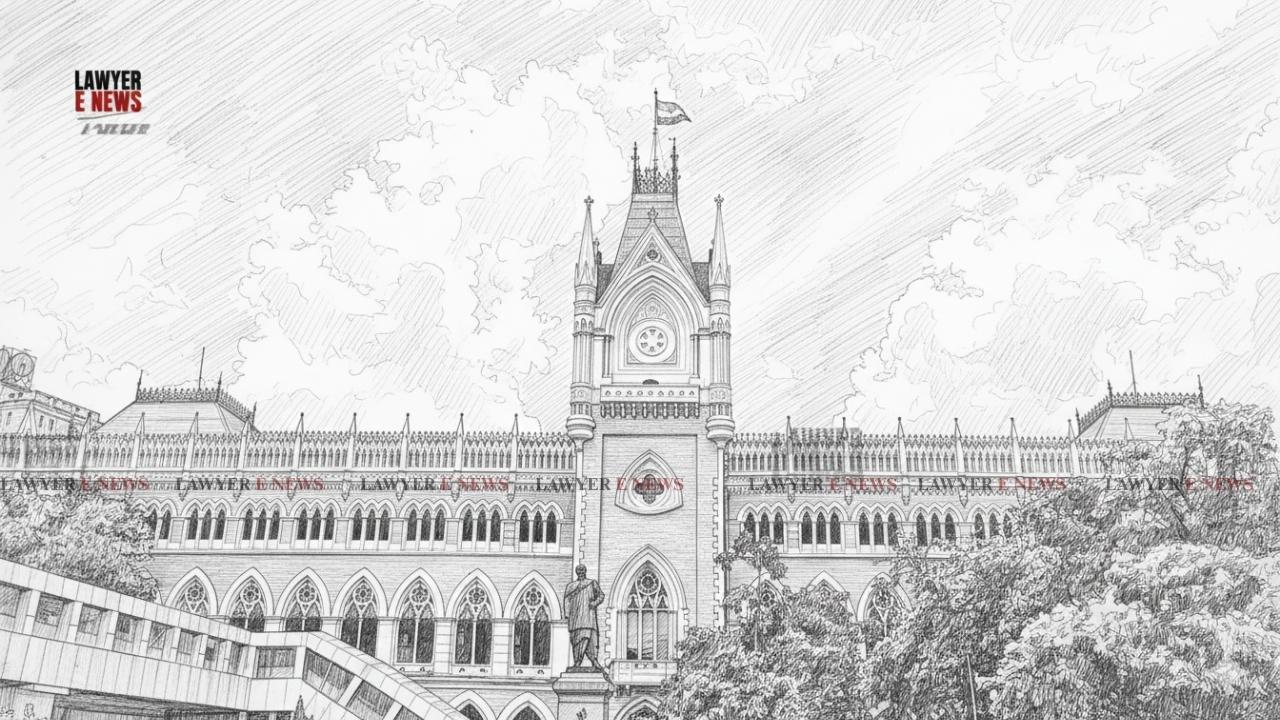
“Where Retention Is Under Section 6(1)(b) & (c) of the WBEA Act, Lessee Fiction Under Section 4B(2) WBLR Act Cannot Apply”, In a landmark judgment Calcutta High Court clarified the legal status of landholders under the West Bengal land laws and firmly held that automatic retention of land under Section 6(1)(b) and (c) of the West Bengal Estates Acquisition Act, 1953 (WBEA Act) entitles the holder to be treated as a “raiyat” under the West Bengal Land Reforms Act, 1955 (WBLR Act), and not as a “lessee” under the deeming provision of Section 4B(2) of the WBLR Act.
Division Bench of Justice Sabyasachi Bhattacharyya and Justice Supratim Bhattacharya set aside orders of the Land Reforms Tribunal, the Commissioner of Presidency Division, and the DL & LRO, which had rejected the company’s application for conversion of 14.33 acres of land on the basis that it was a “lessee” and thus barred under Section 4C of the 1955 Act.
The Court held that:
“The retention being automatic, whatever order was passed under Section 6(3), read with Section 6(1)(g) of the 1953 Act, the same was obviously a surplusage and entirely irrelevant, since what the petitioner was already entitled to retain could not be further conferred on the petitioner by any order or by any authority.” [Para 45]
“Deemed Lessee Fiction Not Attracted When Retention Is Automatic”
The core of the dispute revolved around the rejection of Saregama’s application for land use conversion under Section 4C of the WBLR Act. The DL & LRO had dismissed the application on October 14, 2020, holding the petitioner to be a deemed lessee under Section 4B(2), which applies when retention is allowed under Section 6(3) read with Section 6(1)(g) of the WBEA Act. The Commissioner affirmed this on different grounds, linking conversion to potential socio-economic consequences of factory closure.
The Tribunal upheld these findings, prompting the writ petition before the High Court.
Rejecting this entire premise, the High Court emphasized:
“The petitioner-company is hereby declared to be a raiyat within the contemplation of Section 2(10) of the West Bengal Land Reforms Act, 1955, and not a lessee under Section 4B(2) of the said Act…” [Para 67]
The Court clarified that where land falls within the ceiling of 15 acres under Section 6(1)(c), or is appertaining to structures under Section 6(1)(b), retention occurs by operation of law, ipso jure, from the date of vesting — no choice or order is required.
Factory Retention, Partial Resumption, and Conversion Dispute
The petitioner originally held 16.9 acres, split across both sides of Jessore Road, which was used partially as a factory. A 1999 government order permitted retention of the entire plot for industrial use, but required the company to operationalize 1.96 acres within two years, failing which the land would be reviewed under Section 6(3) proviso.
That 1.96-acre parcel was resumed. The Land Tribunal upheld the resumption in 2013, but the High Court reversed it in 2014. However, the present dispute pertained to the remaining 14.33 acres, which were sought to be converted from industrial to residential/commercial use under Section 4C of the 1955 Act.
No ‘Choice’ Needed When Holding Is Within Ceiling
The High Court examined Section 6(5) of the WBEA Act and Rule 4A(1) of the 1954 Rules in detail, concluding that the requirement to exercise ‘choice’ for retention arises only when the holding exceeds the ceiling.
“The expression ‘choice’, by definition, implies that there are properties beyond the ceiling limit… In the event the total area comes within the ceiling limit, the expression ‘excess’ does not operate at all…” [Paras 36–37]
Since Saregama’s landholding was 14.33 acres, i.e. below the 15-acre cap, the Court found no occasion to submit any ‘choice’ or statement for retention, and the right to retain arose automatically at the time of vesting.
This meant the petitioner’s right to hold land did not depend on any order under Section 6(3). The Court held such an order, even if issued, to be legally irrelevant:
“The genesis of the right of retention is simultaneous with the vesting of the other properties… without there being any necessity of subsequent permission by any authority…” [Para 33]
Section 4B(2) WBLR Act – Lessee Status Inapplicable When Retention Is Automatic
Section 4B(2) WBLR Act creates a legal fiction that deems a holder to be a “lessee” if land is retained under Section 6(1)(g) with/without an order under Section 6(3). This was the fulcrum of the rejection by the DL & LRO.
However, the Court clarified:
“On a conjoint reading of the provisions of Section 6(1)(b) and (c) of the 1953 Act as well as Section 2(10) of the 1955 Act, the moment an intermediary became entitled to retain a land within Clauses (b) and (c)… his status partook of the character of a raiyat…” [Para 53]
Thus, Section 4B(2) was inapplicable, and the petitioner retained full rights as a raiyat, eligible to seek conversion under Section 4C.
Precedents Affirm Automatic Retention and Status of Raiyat
The Court placed strong reliance on a series of precedents:
Reinforcing the binding nature of these rulings, the Court held that once retention under Section 6(1)(b)/(c) is established, the State cannot deny raiyat status or conversion rights merely by invoking a subsequent or unnecessary 6(3) order.
Tribunal, DL & LRO, and Commissioner Erred in Law
The Court concluded:
“The learned Tribunal as well as the DL & LRO and the Commissioner… erred in law in refusing to grant permission… on the premise that the petitioner-company is a lessee and not a raiyat…” [Para 65]
Accordingly, all impugned orders were quashed, and the District Land and Land Reforms Officer, North 24-Parganas was directed to reconsider the conversion application afresh, treating the petitioner as a raiyat.
“The petitioner-company is hereby declared to be a raiyat… and accordingly entitled in the capacity of a raiyat to apply for conversion… under Section 4C of the 1955 Act…” [Para 67]
The application is to be disposed of within two months.
Date of Decision: February 3, 2026