-
by sayum
12 August 2026 10:17 AM







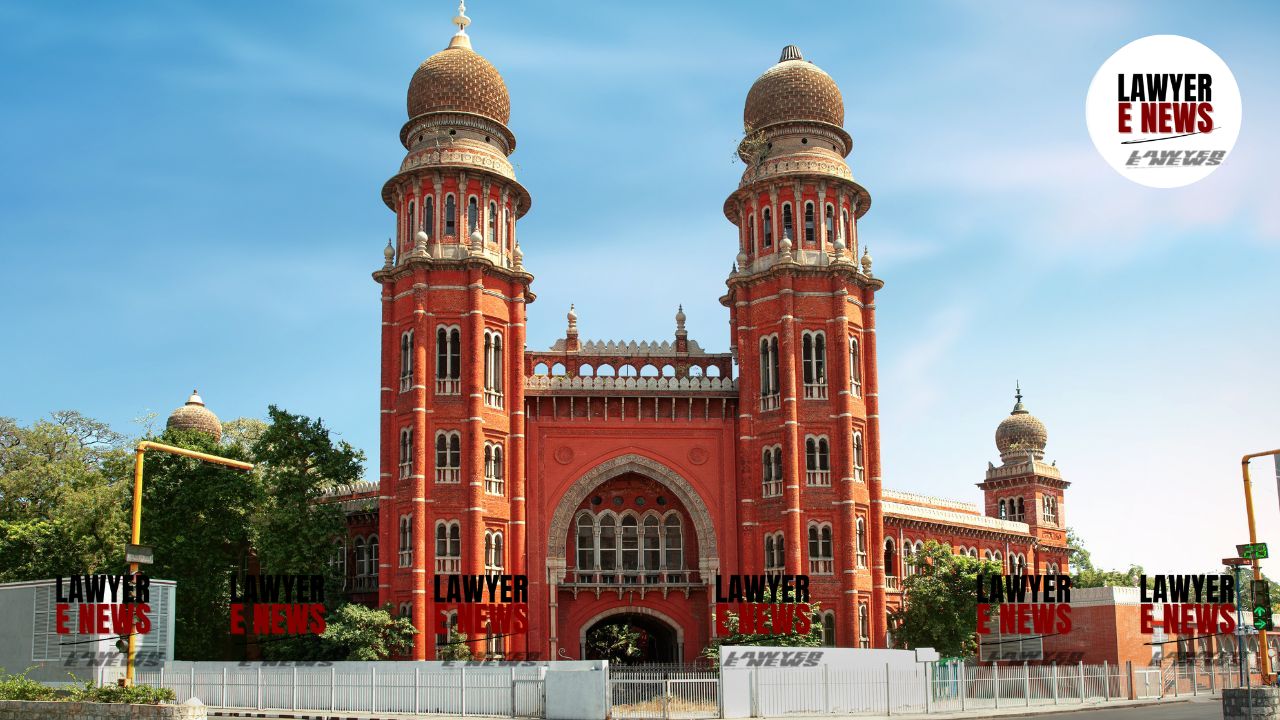
"To attract Section 16(1) of the Hindu Marriage Act, there must first have been a solemnisation of marriage between the parents. However, such a marriage may be null and void under Section 11... where no marriage at all was solemnised between the parents, the relationship cannot be treated as a void marriage merely for the purpose of invoking Section 16." Madras High Court, in a significant & latest ruling 6, held that biological paternity and long cohabitation cannot invoke the statutory legitimacy protections under Section 16 of the Hindu Marriage Act, 1955, unless the foundational factum of a solemnised marriage is strictly proved.
A bench of Dr. Justice A.D. Maria Clete observed that children born of a relationship cannot claim inheritance rights in ancestral or separate properties as children of a void marriage if no marriage ceremony ever took place between the parents.
The case originated from a partition suit filed in O.S. No. 47 of 2006 before the Additional District Judge (Fast Track Court), Villupuram. The plaintiffs claimed to be the daughters of late Sundarathirusangu, alleging he married their mother Savithri Ammal after his first marriage with Mrs. Marimuthu, and sought a two-thirds share in his estate. The trial court dismissed the suit, holding that the plaintiffs failed to prove the marriage, prompting the filing of A.S. No. 720 of 2019 along with C.M.P. No. 19560 of 2025 seeking to adduce additional evidence.
The primary questions before the court were whether the application under Order XLI Rule 27 CPC to receive additional documents and examine new witnesses at the appellate stage ought to be allowed, whether a valid marriage was solemnised between the deceased Sundarathirusangu and Savithri Ammal, and whether the plaintiffs were entitled to a share in the properties under Section 16 of the Hindu Marriage Act.
Appellate Court Rejects Additional Evidence
The high court observed that Order XLI Rule 27 CPC does not confer an unfettered right upon a party to adduce additional evidence at the appellate stage to fill up lacunae in their case. The bench noted that the plaintiffs' mother was a direct party to the lis and was readily available during the trial, meaning no due diligence was shown.
"Additional Evidence Cannot Fill Lacunae"
The court remarked that permitting such evidence at the appellate stage would in substance allow parties to patch up weak points noticed by the trial court. The civil miscellaneous petition seeking the reception of additional documents and examination of witnesses was accordingly dismissed.
Failure To Establish Factum Of Marriage
Addressing the core factual dispute, the court noted that the plaintiffs' plaint lacked basic particulars such as the date, year, place, or specific ceremonies of the alleged marriage. The court emphasized that introducing a specific plea of marriage at a temple during the evidence stage constituted a material improvement beyond the pleadings.
"No Amount Of Evidence Can Be Looked Into For A Case Not Pleaded"
The bench pointed out that the first defendant was the legally wedded wife whose marriage subsisted, and no service records or government conduct disclosures were ever made by the deceased. Furthermore, the non-examination of Savithri Ammal, the most competent natural witness, invited a strong adverse inference against the plaintiffs under civil jurisprudence.
Section 16 HMA Requires Proof Of Solemnisation
The court analyzed the statutory scheme of Section 16 of the Hindu Marriage Act, 1955, distinguishing between mere biological paternity and a marriage that is null and void under Section 11. The bench held that even if school records, community certificates, and cohabitation established that Sundarathirusangu was the biological father, such proof of paternity alone cannot attract statutory legitimacy.
"Proof Of Paternity Is Distinct From A Void Marriage"
The court reiterated that where no marriage at all was solemnised, the relationship cannot be converted into a void marriage fictionally to grant inheritance benefits. Had the plaintiffs established a formal marriage ceremony that subsequently became void due to a subsisting first marriage, protection would follow, but unsolemnized relationships remain outside Section 16.
Appeals Dismissed
Confirming the findings of the trial court, the high court held that the plaintiffs failed to prove either a valid marriage or entitlement to partition. The appeal suit along with the civil miscellaneous petition was ordered dismissed with no order as to costs.
Date of Decision: 10 August 2026