-
by sayum
12 August 2026 8:07 AM







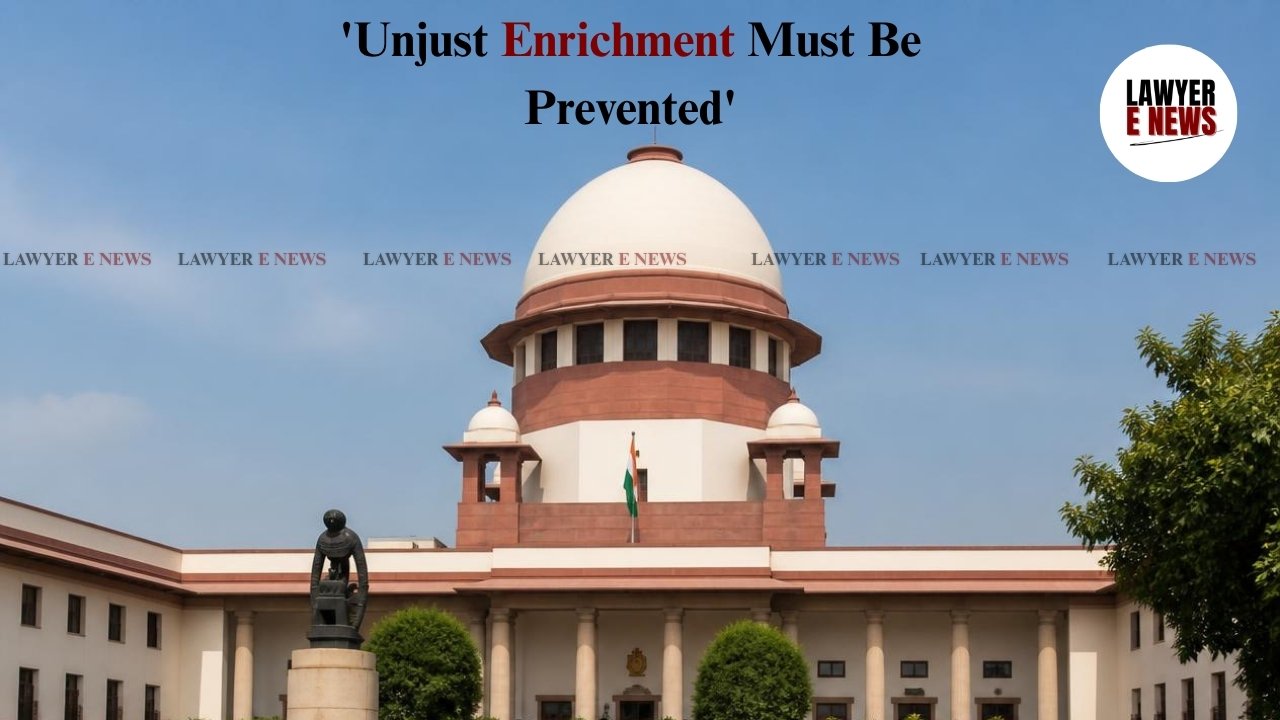
"…permitting the appellant to hold on the money pending Section 34 application, would be unjustly enriching the appellant and would also be in teeth of the order dated 15.12.2005 passed by the High Court...," Supreme Court of India, in a significant ruling dated August 11, 2026, held that an Award Debtor can seek interim measures under Section 9 of the Arbitration and Conciliation Act, 1996 (the '1996 Act'), in "rare and compelling cases" to prevent irreparable prejudice and unjust enrichment, particularly when challenging an arbitral award under Section 34.
A bench of Justices K.V. Viswanathan and Alok Aradhe upheld the Delhi High Court's direction for the appellant to deposit Rs. 3.5 crores, observing that "permitting the appellant to hold on the money pending Section 34 application, would be unjustly enriching the appellant and would also be in teeth of the order dated 15.12.2005 passed by the High Court..."
The dispute originated from a Memorandum of Understanding (MoU) dated August 16, 2002, between National Projects Construction Corporation Ltd. (appellant) and Ishvakoo (India) Pvt. Ltd. (respondent) for the development of bus termini and the Taj Trapezium Zone Heritage Corridor. The respondent was granted a mobilization advance of Rs. 3.5 crores against bank guarantees. Following the emergence of disputes, arbitration proceedings were initiated. A Section 9 application filed by the respondent in 2003 to restrain invocation of bank guarantees was disposed of by the High Court in 2005 with an undertaking by the appellant not to encash the bank guarantees, provided they were kept alive until the award became executable. The bank guarantees were subsequently encashed by the appellant in September 2017 when the respondent failed to keep them alive. The arbitrator dismissed the respondent's claims in December 2017 without a counter-claim from the appellant. Consequently, the respondent filed a fresh Section 9 petition, OMP(I)(COMM) No. 57/2019, seeking the return of the encashed amount, which was allowed by the learned Single Judge and confirmed by the Division Bench.
The primary question before the Supreme Court was whether the courts below were justified in directing the appellant to deposit a sum of Rs. 3.5 crores in the Registry of the High Court, pending disposal of the Section 34 application challenging the arbitral award. Ancillary to this was the broader question of the maintainability and scope of a Section 9 application filed by an Award Debtor (an unsuccessful party) post-award under the Arbitration and Conciliation Act, 1996.
Award Debtor Can Seek Interim Relief Under Section 9
The Supreme Court reiterated that the maintainability of a Section 9 application by an Award Debtor (unsuccessful party) post-award is no longer res integra. Citing its recent decision in Home Care Retail Marts Pvt. Ltd. vs. Haresh N. Sanghavi, 2026 SCC Online SC 670, the Court affirmed that "to deny interim relief under Section 9 would leave such a party remediless," even if the award is challenged and potentially set aside. The Court emphasized that the distinction between a 'winning' and a 'losing' party cannot govern access to the remedy under Section 9 of the Act.
Higher Threshold For Award Debtors
While allowing Award Debtors to invoke Section 9, the Court sounded a note of caution, stating that "the threshold for grant of interim relief will be higher in the case of an unsuccessful party in arbitration seeking such relief." It clarified that such relief is permissible only in "rare and compelling cases" to prevent "irreparable prejudice and preserve the efficacy of the challenge proceedings" under Section 34 of the Act. This principle ensures that the power is not misused but serves the underlying purpose of the arbitration law.
Guiding Principles For Interim Relief Under Section 9
The Court further referred to Essar House Private Limited v. Arcellor Mittal Nippon Steel India Limited, (2022) 20 SCC 178, which laid down the well-established principles for granting interim relief under Section 9. These include the existence of a prima facie case, the balance of convenience, and the likelihood of irreparable harm or injury. The Court also emphasized the importance of the applicant approaching the court with reasonable expedition.
Section 9 Not Strictly Bound By CPC Procedural Rigours
Referring to Jagdish Ahuja v. Cupino Ltd. [2020 SCC OnLine Bom 849], as endorsed in Essar House (supra), the Court observed that while considering relief under Section 9, the court is guided by the principles ordinarily employed by civil courts for interim relief (particularly Order XXXVIII Rule 5 and Order XXXIX Rules 1 and 2 of the Code of Civil Procedure, 1908), it is not "unduly bound by their texts." The primary objective is to promote the efficacy of arbitration as a form of dispute resolution, balancing procedural law with the paramount interests of justice.
Application To The Present Facts Justified Lower Courts' Order
Applying these principles to the facts of the case, the Supreme Court found that the respondent had "fulfilled in ample measure" the necessary parameters for obtaining relief under Section 9.
High Court's Conditional Order of 2005
Firstly, the Court noted that the initial High Court order dated December 15, 2005, which dealt with the respondent's Section 9 application, clearly stipulated that the appellant would be entitled to invoke bank guarantees only if the arbitrator found that the appellant had to recover the amount from the respondent after adjudication.
No Counter-Claim By Appellant
Secondly, it was established that the appellant had not filed any counter-claim before the Arbitrator, which was a crucial factor. This absence meant there was no adjudicated claim in the appellant's favour against the respondent.
Arbitrator's Obliviousness To Encashment
Thirdly, the Arbitrator, in dealing with Issue Nos. 3 and 4 (concerning discharge of bank guarantees and bank charges), appeared to be oblivious to the fact that the bank guarantees had already been invoked prior to the award. The Arbitrator had reserved the award on December 12, 2016, and pronounced it on December 5, 2017, without taking into account the September 2017 encashment.
Section 34 Court To Decide Mobilization Advance Issue
Fourthly, the Court acknowledged that the Section 34 Court is currently engaged with the issue of whether the Arbitrator made a finding regarding the respondent's failure to utilize the mobilization advance. While prima facie findings were recorded in the current proceedings that no such finding exists, the final determination rests with the Section 34 application.
Prior Order Not A Bar To Present Section 9
Fifthly, the order dated November 1, 2017, by the Single Judge (dismissing a prior Section 9 application post-encashment) would not prejudice the respondent in the current proceedings. This is because the present Section 9 application arises from circumstances where the Arbitrator was unaware of the bank guarantee encashment, thus necessitating a fresh look at the equities.
Prevention Of Unjust Enrichment
Sixthly, the Court affirmed the High Court's justification that permitting the appellant to retain the money, in the absence of a counter-claim and a specific finding on non-utilization of mobilization advance, would lead to unjust enrichment of the appellant. Such retention would also be contrary to the spirit of the High Court's order of December 15, 2005.
"Rare And Compelling Case" Met
Seventhly, the Supreme Court concluded that, applying the principles from Home Care Retail Marts (supra) and Essar House (supra), the respondent's case indeed presented a "rare and compelling" situation where, even with a higher threshold, interim directions were necessary to prevent irreparable prejudice and preserve the efficacy of the challenge under Section 34.
Judicious Exercise Of Discretion
Eighthly, the Court found that the High Court had not exercised its jurisdiction arbitrarily. The decision to direct the deposit was a judicious exercise, consistent with the parameters of prima facie case, balance of convenience, and irreparable prejudice, and the respondent had moved the court with reasonable expedition.
Efficacy Of Arbitration Promoted
Finally, the Court emphasized that the relief fashioned by the courts below was consistent with the purpose and object of interim measures contemplated under Section 9, thereby furthering the efficacy of arbitration as a form of dispute resolution.
The Supreme Court underscored that the observations made in these proceedings are solely for the purpose of deciding the Section 9 petition and the Section 34 application, and should not influence the merits of the Section 34 application.
The Supreme Court dismissed the appeal, affirming the Delhi High Court's order. The appellant has been granted four weeks to deposit the amount of Rs. 3.5 crores with the Registry of the High Court of Delhi. This amount is to be kept in an auto-renewable Fixed Deposit (FD) in any Nationalized Bank until the final disposal of the Section 34 application. This ruling firmly establishes the power of courts to grant interim relief to Award Debtors under Section 9 in exceptional circumstances to prevent unfair advantage and uphold the integrity of the arbitration process.
Date of Decision: August 11, 2026