
-
by sayum
25 August 2026 12:32 PM







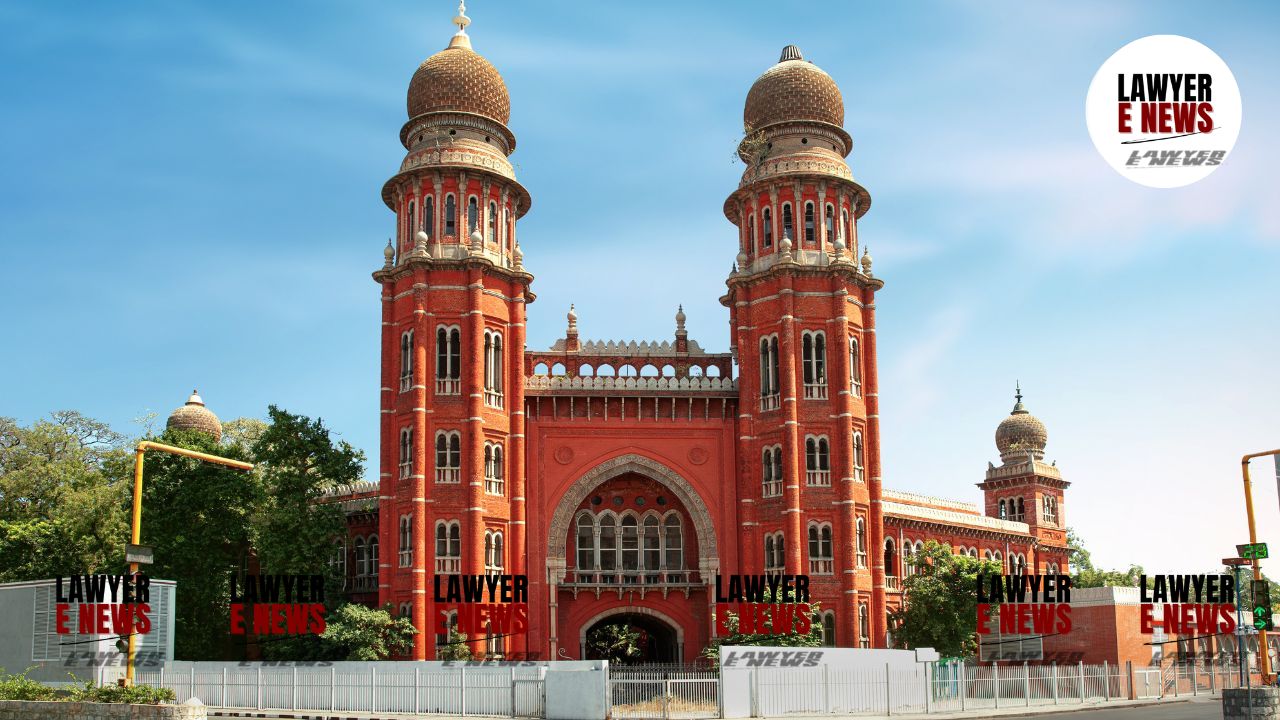
“No Agreement in Writing, No Right to Perpetual Commission” – In a judgment that reiterates the indispensable requirements of pleading, proof, and legal admissibility in civil money claims, the Madras High Court dismissed a civil appeal filed by a businessman seeking over ₹22.87 lakhs in commission, holding that “mere ad-hoc arrangements and unauthenticated photocopies do not make a concluded contract”.
The Division Bench comprising Justice N. Sathish Kumar and Justice R. Sakthivel delivered the verdict in A.S. No. 853 of 2018, confirming the trial court’s rejection of a suit for recovery of unpaid commission allegedly owed under an oral agreement that, according to the plaintiff, dated back to 1986.
The Court was categorical that the burden of proving a valid and enforceable contract—and the entitlement to money—rests squarely on the plaintiff, and it held that such a burden had not been discharged.
“A Contract That Never Was Cannot Be Enforced Forever” – Oral Agreement Rejected for Lack of Proof
The plaintiff, R.J. Mehta, Proprietor of Resource Engineers, had claimed that the defendant company, M/s. Elof Hansson (India) Pvt. Ltd., had agreed to pay him 5% commission on all sales of Eloguard, a chemical product, based on an oral agreement formed in 1986.
But the Court found no such agreement was ever concluded.
“The correspondence clearly shows that though the defendant proposed a formal contract in writing, the plaintiff refused to sign the same,” the Court observed, adding, “Insistence on continuing an alleged oral understanding, when a written agreement is explicitly refused, cannot establish a perpetual right.”
The Bench made it clear that “temporary and ad-hoc arrangements made during a trial period do not constitute a binding, enforceable contract, especially when both sides disagree on the terms.”
“Photocopies Without Pleading, Certificate, or Signature Cannot Be Considered Evidence” – Court Refuses to Accept Unauthenticated Invoices
Relying heavily on Exhibits P22 to P24, which were photocopies of invoices, the plaintiff had attempted to establish that sales were made and commission was due. But the Court rejected this reliance outright:
“There is not even a whisper in the plaint regarding the source of these photocopies or the loss of their originals,” the Court noted. It further remarked that “the plaintiff never issued notice to the defendant to produce the originals, nor did he file a certificate under Section 65B of the Indian Evidence Act”, which governs electronic and secondary evidence.
“These documents are not only photocopies but also unsigned, unauthenticated, and inadmissible in law,” the Court held. “They cannot support a money claim in a civil suit.”
The Court also observed that the documents were not produced in accordance with Order XII Rule 8 of the Civil Procedure Code, which enables a party to compel production of documents by notice.
“Even If There Was Some Past Payment, It Doesn’t Prove an Ongoing Contract” – Court Clarifies Legal Effect of Earlier Transactions
While the plaintiff had attempted to rely on some earlier payments to support the claim of continuing obligation, the Court firmly drew the legal line:
“Merely because certain amounts were paid earlier under an ad-hoc arrangement, it cannot be concluded that the defendant agreed to a binding, indefinite agency,” the Court said.
It further remarked, “If the plaintiff was serious about a long-term arrangement, he ought to have signed the written terms proposed in 1990. His refusal only strengthens the defendant’s case that no binding contract ever came into being.”
“No Ledger, No Tax Returns, No Accounts – Then No Claim” – Burden of Proof Must Be Discharged With Documents
The Court emphasized that the burden to prove entitlement to money lies with the claimant, especially in suits for commission:
“Though the plaintiff admitted to maintaining accounts, he failed to produce even a single ledger, income tax return, or statement of account to show receipt or entitlement,” the Court noted. “Assertion without corroboration is not proof.”
It found that even Ex.P15, a purported commission statement, lacked authentication and bore discrepancies that “destroy its evidentiary value.”
“Absence of a Witness Is Not Proof of a Contract” – No Adverse Inference Without Corroborative Evidence
Responding to the appellant’s claim that non-examination of a company officer who allegedly formed the agreement warranted adverse inference, the Court observed:
“Merely because one Rajagopalan did not testify does not shift the burden of proof. In the absence of minutes, correspondence, or documentation confirming a concluded contract, no inference can be drawn.”
The Court reiterated that “when a suit is based on an alleged oral contract, the burden to prove it is stringent, and cannot be bypassed by drawing inferences from silence.”
“Court Will Not Enforce What the Parties Never Agreed” – Appeal Dismissed Without Costs
Ultimately, the Court held that the plaintiff failed on every legal front—no written agreement, no conclusive oral terms, no admissible evidence, and no documents to support the quantum claimed.
“This Court finds no reason to interfere with the well-reasoned judgment of the trial court,” the Bench concluded, dismissing the appeal without costs.
Date of Decision: 03 February 2026





