-
by sayum
27 August 2026 3:32 PM







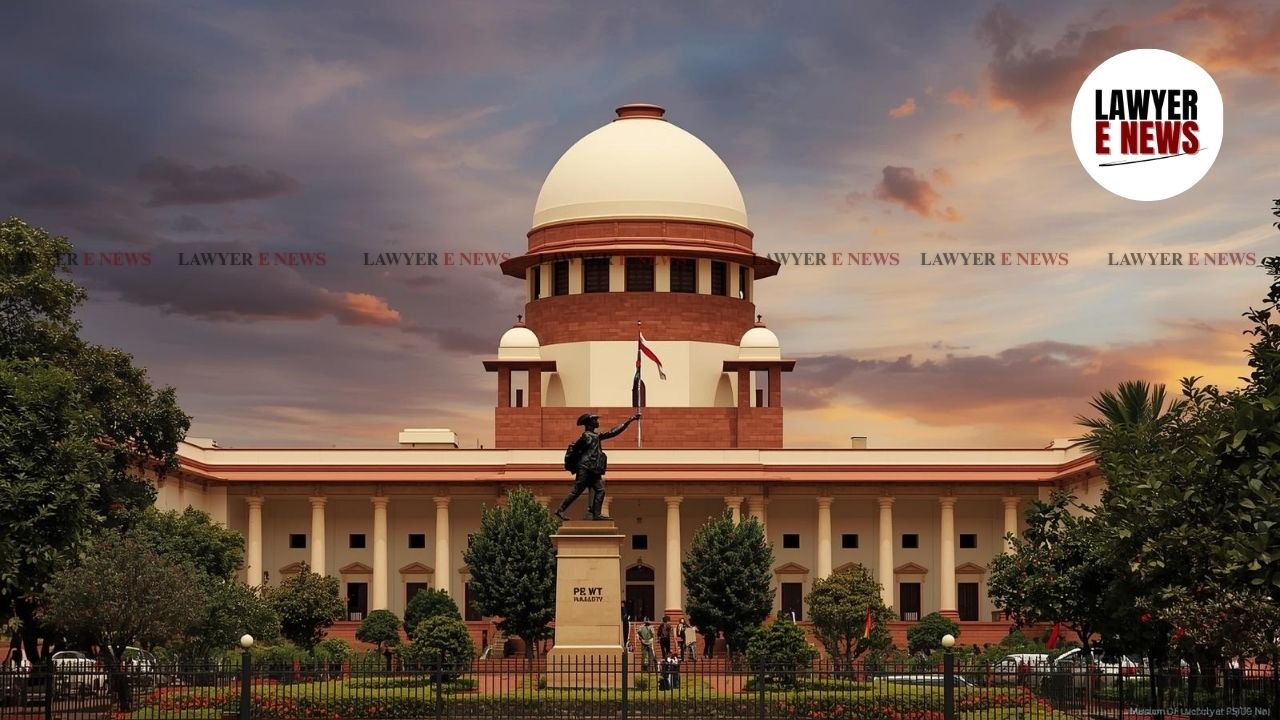
“A person governed by any other Act or Rules providing for gratuity does not come within the ambit of ‘employee’ under the PG Act”, In a significant ruling clarifying the scope of the Payment of Gratuity Act, 1972, the Supreme Court on February 11, 2026, held that employees of the Heavy Water Plant (HWP), Department of Atomic Energy (DAE), Government of India, are excluded from the definition of “employee” under Section 2(e) of the Payment of Gratuity Act, 1972.
The Bench comprising Justice Pankaj Mithal and Justice S.V.N. Bhatti dismissed the appeals filed by retired employees of HWP and upheld the Madras High Court’s decision that such employees are Central Government servants governed by the CCS (Pension) Rules, 1972, and therefore fall within the statutory exclusion clause of the Gratuity Act.
The judgment decisively settles the question whether employees of Heavy Water Plants are entitled to claim differential gratuity under the Payment of Gratuity Act in addition to gratuity paid under the Central Civil Services framework.
The dispute arose after certain retired employees of Heavy Water Plant, Tuticorin, claimed that gratuity payable under the Payment of Gratuity Act, 1972 (“PG Act”) was higher than the amount received under the CCS (Pension) Rules, 1972. One such employee, N. Manoharan, received a pension payment order dated 25.07.2014 under the CCS (Pension) Rules.
Contending that HWP was an “industry” under the Industrial Disputes Act, 1947, and therefore covered under Section 1(3)(b) of the PG Act, the employees approached the Controlling Authority under the PG Act seeking the differential amount.
The Controlling Authority allowed the claim and directed payment of the difference between gratuity payable under the CCS Rules and the PG Act. The Appellate Authority affirmed the order.
However, the Madras High Court, in writ proceedings, reversed the findings and held that the employees were excluded from the definition of “employee” under Section 2(e) of the PG Act since they held civil posts under the Central Government and were governed by the CCS (Pension) Rules.
Aggrieved, the employees approached the Supreme Court.
The central issue before the Court was whether employees of Heavy Water Plant, Department of Atomic Energy, are covered under the Payment of Gratuity Act, 1972.
The determination hinged upon interpretation of Section 2(e) of the PG Act, particularly its exclusionary clause which provides that “employee”:
“means any person… employed for wages… but does not include any such person who holds a post under the Central Government or a State Government and is governed by any other Act or by any rules providing for payment of gratuity.”
The employees argued that HWP functioned as an industrial establishment with administrative autonomy and had not been granted any exemption under Section 5 of the PG Act. They relied on the decision in Municipal Corporation of Delhi v. Dharam Prakash Sharma (1998) 7 SCC 22 to contend that even where CCS Rules applied, the PG Act could still be invoked.
On the other hand, the Union of India argued that HWP is not a separate corporate entity or PSU but merely a project under the Department of Atomic Energy, and its employees are Central Government servants governed by CCS Rules, which already provide for gratuity.
Supreme Court’s Observations On Jurisdictional Fact
The Court emphasised that applicability of the PG Act depends upon the existence of a “jurisdictional fact.”
Relying on Arun Kumar v. Union of India (2007) 1 SCC 732, the Court observed: “A jurisdictional fact is one on the existence or non-existence of which depends the jurisdiction of a court, a tribunal or an authority. If the jurisdictional fact does not exist, the court, authority or officer cannot act.”
The Court held that whether HWP employees fall within the inclusive or exclusionary definition under Section 2(e) is itself a jurisdictional fact.
Interpretation Of Section 2(e): Exhaustive And Exclusionary
The Court undertook a detailed interpretation of Section 2(e) and noted the significance of the words “means” and “does not include”.
It observed that coupling “means” with “does not include” makes the definition exhaustive and exclusionary in nature.
The Court categorically held:
“Consequently, a person who is governed by any other Act, or governed by any Rules providing for payment of gratuity, does not come within the ambit of the definition of ‘employee’ under the PG Act.”
The exclusionary clause was interpreted using the golden rule of construction, and the Court clarified that any person holding a post under the Central Government and governed by any other rules providing gratuity stands excluded at the threshold.
Status Of Heavy Water Plant: Not A PSU Or Separate Legal Entity
A crucial aspect of the judgment was the characterisation of HWP.
The Court examined the Atomic Energy Act, 1962 and the Office Memorandum dated 01.05.1969 constituting the Heavy Water Projects Board. It noted that HWP:
“is not incorporated under the Companies Act, is not recognised as a PSU, or functions as a Government Company.”
The Court further observed:
“In substance, without any ambiguity, the HWP is created to manage the projects of the DAE for the production of heavy water.”
It concluded that HWP is merely an adjunct or ancillary of the Department of Atomic Energy and cannot be separated as an autonomous industrial establishment.
Thus, employees of HWP hold civil posts under the Central Government.
Distinguishing The MCD Judgment
The appellants heavily relied on Municipal Corporation of Delhi v. Dharam Prakash Sharma. However, the Supreme Court rejected its applicability.
The Court observed:
“It is axiomatic that a decision is an authority for what it decides and not what can be logically deduced therefrom.”
It clarified that in the MCD case, employees were unquestionably employees of a statutory corporation which had adopted CCS Rules. In contrast, HWP employees were originally Central Government servants, which is a statutory exclusion under Section 2(e).
Sections 5 And 14 Of PG Act Held Inapplicable
The employees argued that since no exemption notification under Section 5 of the PG Act had been issued in favour of HWP, the Act would apply.
The Court rejected this argument, holding that Sections 5 and 14 come into play only if a person first qualifies as an “employee” under Section 2(e).
Since the employees were excluded at the definition stage itself, there was no question of invoking Section 14 (overriding effect) or requiring an exemption under Section 5.
The Court succinctly concluded:
“The result of such exclusion is that Sections 5 and 14 are not attracted in deciding on the applicability of the PG Act to the employees of HWP.”
In dismissing the appeals, the Supreme Court affirmed that employees of the Heavy Water Plant, Department of Atomic Energy, are Central Government servants governed by the CCS (Pension) Rules, 1972, and therefore excluded from the scope of the Payment of Gratuity Act, 1972.
The ruling reinforces the statutory bar under Section 2(e) and clarifies that employees cannot claim dual benefits under separate gratuity regimes when expressly excluded by law.
The Civil Appeals were dismissed, and the judgment of the Madras High Court was upheld.
Date of Decision: February 11, 2026