-
by sayum
27 August 2026 3:32 PM







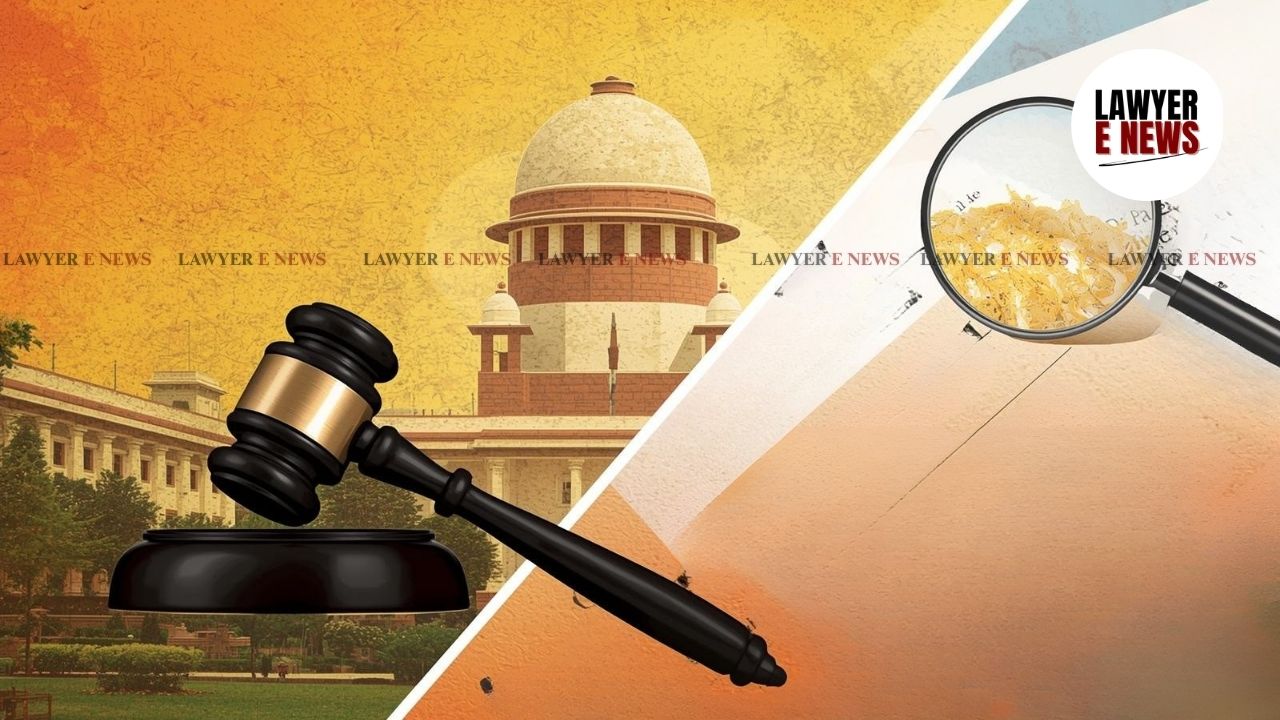
“When charges are grave, the caution and circumspection that should be exercised by the authorities should be greater” – Supreme Court rebukes disciplinary authority for failing to verify handwriting before dismissing employee
On February 11, 2026, the Supreme Court setting aside the dismissal of a court attender accused of fabricating a medical certificate to justify his absence from work. The two-judge Bench comprising Justices K. V. Viswanathan and Vipul M. Pancholi categorically held that the charge of forgery had “not been proved” and that the disciplinary findings were “perverse and based on no credible evidence.”
The judgment reinstates the appellant with all consequential benefits and stands as a reaffirmation of constitutional limits on departmental inquiries where livelihood is at stake.
“When a disputed document is fully handwritten and the signatory disputes authorship, prudence demands handwriting verification or expert opinion”
In a detailed and sharply-worded verdict, the Supreme Court has invalidated the dismissal of K. Rajaiah, a court attender in the judiciary of Telangana, who had been accused of submitting a forged medical certificate to justify five days of absence in August 2017. The Court emphasized the principle that judicial review is available even in departmental matters, especially where findings are “based on no evidence or are such as no reasonable person would have arrived at.”
Holding that the Inquiry Officer failed to conduct even a basic comparison of disputed and admitted signatures—and more importantly, did not refer the matter to a handwriting expert despite a serious charge of forgery—the Court ruled in favour of reinstating the employee with full service benefits.
K. Rajaiah had joined the judicial service as an attender in 1998. In early August 2017, he remained absent from work citing illness, later submitting a handwritten medical certificate issued by one Dr. Bommaraveni Swamy of Sai Teja Clinic, Manakondur. His explanation, along with the certificate, was submitted 13 days later, and his salary for the period of absence was deducted.
Initially, the Presiding Officer of the Court appeared to accept the explanation and orally warned Rajaiah not to repeat such conduct. However, the issue was revived two months later when Rajaiah again remained absent for a couple of days in October 2017. This prompted the Court to summon the doctor, who then gave a statement denying having issued the certificate.
This led to departmental proceedings under Rule 20 of the Andhra Pradesh Civil Services (Classification, Control and Appeal) Rules, 1991. The disciplinary authority framed two charges against the appellant: (1) unauthorized absence and (2) submission of a fabricated medical certificate. On November 13, 2018, Rajaiah was dismissed from service, which was upheld by the High Court of Telangana on February 12, 2024.
The crux of the case revolved around whether the medical certificate was forged and whether dismissal from service was warranted on such grounds.
The Court identified the following legal questions:
Justice Viswanathan, authoring the judgment, held:
“Having failed to verify the disputed and the undisputed signature, we find that the finding of the Inquiry Officer that Ex. P-7 was not genuine, is perverse and based on no credible evidence.” [Para 36]
The Court noted that the disciplinary authority relied entirely on the statement of the doctor, without seeking handwriting comparison or expert evidence—even though Ex. P-7 (the certificate) was a fully handwritten document.
“Reference to handwriting experts and examination of handwriting experts is not a procedure alien to disciplinary inquiries.” [Para 34]
Moreover, the doctor himself admitted in the enquiry that Rajaiah had indeed consulted him and was given tablets, though he claimed not to remember the date. He also did not deny that the certificate was on his own letterhead and bore his rubber stamp.
“The rubber stamp on Ex. P-7 is identical with the rubber stamp on the reverse of the copy of the notice dated 26.10.2017, which the doctor acknowledged.” [Para 39]
The Court went further to point out that even the doctor’s own signatures on other admitted documents (Ex. P-8, P-9) were “not identical though broadly similar”, thereby making it incumbent upon the inquiry officer to obtain expert verification before recording a conclusion of forgery.
Limits and Justification
Reiterating the settled position that judicial review is not an appellate process, the Court nonetheless underlined its duty to interfere when findings are patently unreasonable or unsupported by evidence.
“On the available material, no reasonable person would have reached the conclusion that the Enquiry Officer reached.” [Para 41]
The Court relied on a line of precedents including Yoginath D. Bagde v. State of Maharashtra, (1999) 7 SCC 739, Sawai Singh v. State of Rajasthan and Kuldeep Singh v. Commissioner of Police, to hold that judicial review is justified when conclusions are perverse, disproportionate, or arrived at without application of mind.
The Bench also cited V.M. Saudagar (2025) and Surath Chandra Chakrabarty v. State of W.B. (1970) to reinforce the principle that disciplinary authorities cannot avoid evidentiary obligations, especially in forgery cases.
On Punishment and Misuse of Disciplinary Powers
The Court was critical of the invocation of Rule 9(x) proviso, which mandates dismissal for proven cases of forgery. It clarified that such provisions only apply when the core charge is actually established.
“Since the charges themselves have not been established, the argument that the rules provided for a mandatory penalty of dismissal also does not require further consideration.” [Para 44]
Further, the Court was troubled by the “inexplicable peculiarities” in the conduct of the disciplinary authority—particularly the abrupt revival of proceedings after oral closure, and reliance on a doctor’s unverified denial, recorded behind the back of the appellant.
“There must be fair play in action; in respect of an order involving adverse or penal consequences against an employee, there must be investigations consistent with the requirement of the situation.” [Para 36]
The Supreme Court concluded that the dismissal of the appellant was unsustainable, directing immediate reinstatement:
“The appellant shall be reinstated in service forthwith with all consequential benefits including all arrears of salary and emoluments since the non-employment was not due to the appellant’s fault.” [Para 45]
The Court also directed compliance within three weeks from the date of judgment.
This judgment is a cautionary note to disciplinary authorities across India, especially in the judicial and government services, reinforcing that serious charges like forgery must be proved with concrete evidence and due process. Failure to do so renders even mandatory penalties unenforceable. The ruling also strengthens the jurisprudence on procedural fairness, proportionality, and judicial review in service law.
Date of Decision: 11th February, 2026