-
by sayum
26 August 2026 12:18 PM








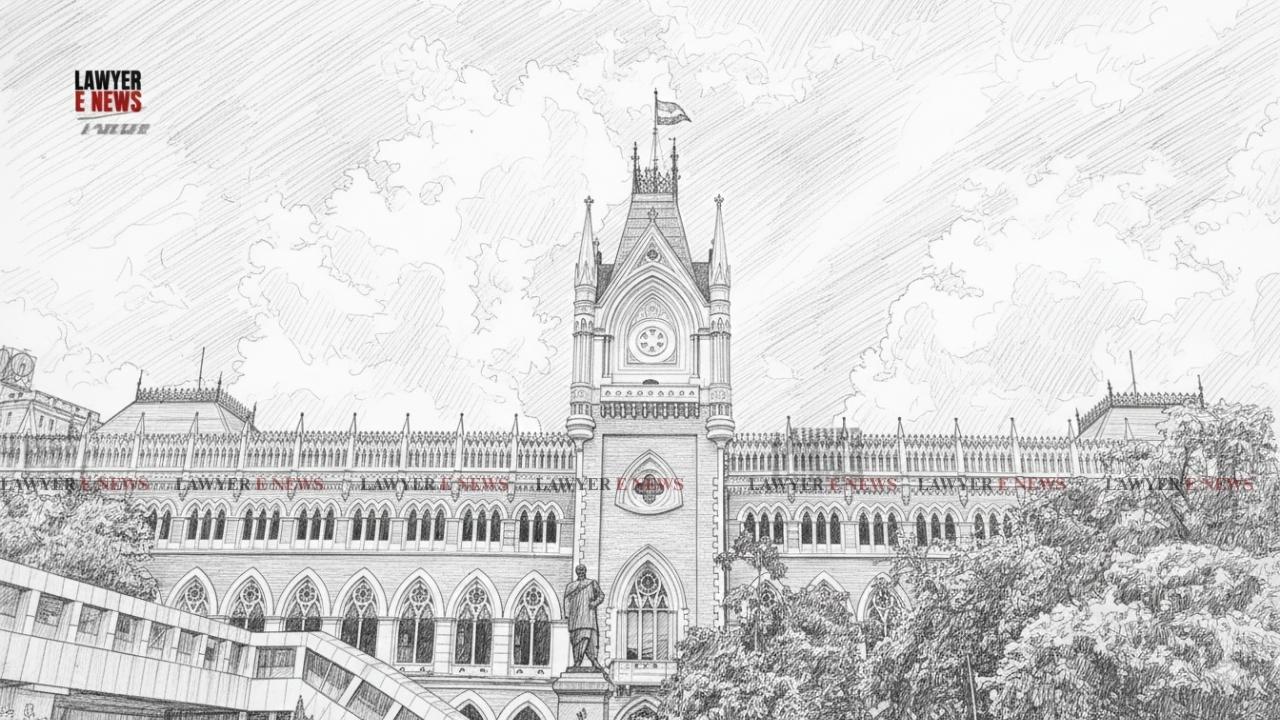
“To Attract Section 326, the Instrument Must Be Such That Death Is Probable by Its Very Nature”, In a nuanced judgment balancing medical evidence with statutory interpretation, the Calcutta High Court partly allowed a criminal revision and altered the conviction of the petitioners from Section 326/34 IPC to Section 325/34 IPC.
Dr. Justice Ajoy Kumar Mukherjee held that while the fracture sustained by the victim undeniably amounted to “grievous hurt” under Section 320 IPC, a bamboo stick or rod used to strike the elbow cannot, “by its very nature,” be termed an instrument “likely to cause death” so as to attract Section 326 IPC.
The sentence was accordingly modified to simple imprisonment for six months with a fine of Rs. 5,000/- each.
Assault Over Previous Grudge and Immediate FIR
The prosecution case began with a complaint lodged on 21.03.2010 at Amherst Street Police Station. The de facto complainant, Subir Nag, alleged that the accused persons, acting in furtherance of common intention, abused him and assaulted him with bamboo sticks and iron rods due to previous enmity. His wife and mother-in-law, who intervened, were also assaulted.
The FIR was lodged within 55 minutes of the incident, naming all the accused. The injured was taken to Medical College and Hospital, where an injury report was prepared the same night noting fracture at the right elbow on X-ray examination.
The Trial Court convicted the petitioners under Section 326/34 IPC and sentenced them to one year rigorous imprisonment with fine. The Appellate Court affirmed the conviction. Aggrieved, the petitioners invoked the revisional jurisdiction of the High Court.
“Interference Only in Exceptional Cases”
The High Court reiterated the settled principle that interference with concurrent findings of fact is permissible only in exceptional cases involving perversity or compelling circumstances.
Justice Mukherjee observed that both courts below had carefully scanned the evidence of PW1 (injured), PW2 (wife), and PW3 (mother-in-law), whose testimonies consistently established the presence and participation of the accused. Minor discrepancies regarding the time and exact address of occurrence were held immaterial, especially considering the lapse of time between occurrence and deposition.
The Court declined to re-appreciate evidence merely because another view was possible, affirming that the accused acted in furtherance of common intention under Section 34 IPC.
Medical Evidence: Fracture Clearly Established
Addressing the argument that fracture was not proved, the Court noted that the injury report prepared on the date of occurrence clearly recorded that “X-Ray of right elbow shows fracture at right elbow.” The document was marked as Exhibit 4 without objection, and the concerned doctor was examined as PW4.
The victim underwent surgical operation and was discharged on 13.04.2010, having been hospitalized for more than twenty days.
The Court held that the injury squarely attracted Clause Seventhly of Section 320 IPC, which defines grievous hurt as “fracture or dislocation of a bone,” and also Clause Eighthly, since the victim was unable to follow his ordinary pursuits for more than twenty days.
Thus, the finding that grievous hurt was caused required no interference.
Was It “Grievous Hurt by Dangerous Weapon”?
The turning point of the case lay in the interpretation of Section 326 IPC.
Justice Mukherjee meticulously analysed the ingredients of Section 326, emphasizing that conviction under the provision requires not merely grievous hurt but grievous hurt caused by specific categories of weapons, including “any instrument, if used as a weapon of offence likely to cause death.”
The Court observed:
“To attract Section 326 the instrument by virtue of its very nature should be such that one should reasonably predicate that by its use as weapon of offence, death would be probable and it is something inherent in the instrument which rendered death probable.”
In the present case, the prosecution consistently alleged assault with a bamboo stick (lathi) or rod, resulting in a fracture at the right elbow. The Court reasoned that a blow with a bamboo stick at the elbow, though causing fracture, can “hardly be said to cause death.”
The judgment clarified that the word “likely” in Section 326 implies that the instrument must be inherently capable of making death a probable consequence of its use. A bamboo stick used to strike an elbow does not satisfy that threshold.
The Court held that this aspect had not been properly considered by the courts below while applying Section 326 IPC.
Conviction Altered to Section 325 IPC
While affirming that the accused caused grievous hurt in furtherance of common intention, the High Court concluded that the prosecution failed to establish that such grievous hurt was caused by a “dangerous weapon” within the meaning of Section 326 IPC.
Accordingly, the conviction was altered from Section 326/34 IPC to Section 325/34 IPC.
The sentence was reduced to simple imprisonment for six months along with a fine of Rs. 5,000/- each, and in default, simple imprisonment for two months.
The petitioners were directed to surrender within four weeks, failing which the trial court was empowered to secure their attendance by issuance of warrant.
The judgment draws a clear doctrinal distinction between “grievous hurt” and “grievous hurt by dangerous weapon,” underscoring that not every fracture, even if serious, will automatically attract Section 326 IPC. The decision reinforces that the nature of the instrument and its inherent likelihood to cause death remain central to the application of the aggravated offence.
Date of Decision: 02/03/2026