Not A Mere Breach Of Contract: Telangana High Court Refuses To Quash FIR In ₹73 Crore Garment Investment Fraud Accused Not Entitled To Copies Of 'Unrelied' Upon Documents At The Stage Of Framing Of Charges Under Section 91 CrPC: Supreme Court Elected Representatives Have No Privilege To Resort To Violence; Criminal Antecedents Are Material For Bail Adjudication: Supreme Court Mere Absence Of Transport Documents Does Not Create A Presumption Of Violation Of Chhattisgarh Agricultural Cattle Preservation Act, 2004: Supreme Court Section 396 IPC | Conviction For 'Dacoity With Murder' Requires Proof That Murder Was Committed In The Course Of Dacoity: Allahabad High Court 'Developers Cannot Delay Conveyance For Eternity And Milk Additional FSI Benefits': Bombay High Court Upholds Societies' Deemed Conveyance Pre-Approval Statutory Dues Stand Extinguished Upon Approval Of Resolution Plan; GST Authorities Cannot Initiate Fresh Proceedings: Calcutta High Court Unregistered Agreement To Sell With Delivery Of Possession Is Admissible In A Suit For Specific Performance: Delhi High Court Stigmatic Order Discharging Probationer Without Inquiry Is Void For Violation Of Natural Justice: Gujarat High Court Execution Proceedings | Court Cannot Impose Arbitrary Financial Conditions Without Reason In Stay Applications: Himachal Pradesh High Court Section 528 BNSS | High Court Cannot Exercise Inherent Powers To Circumvent Statutory Bar Against Second Revision: Delhi High Court Advocate Empanelment | Restriction On Multiple Applications Is A Procedural Choice Within Employer’s Domain: Delhi High Court Acquittal Appeal | Double Presumption Of Innocence In Favour Of Accused Cannot Be Disturbed Merely Because Another View Is Possible: Gujarat High Court SC/ST Act | Offence Under Section 3(1)(g) Not Attracted If Dispossession Or Interference Is Not Due To Victim's Caste: Himachal Pradesh High Court Judicial Officer Must Maintain Distance From Practicing Advocates To Avoid Impropriety: Gujarat High Court Upholds Dismissal Section 183 BNSS | Investigating Officer Cannot Independently Record Further Statement Of Victim After Recording Before Magistrate: Karnataka High Court Non-Production Of Case Property And Missing Link Evidence In Seizure Cases Vitiates Prosecution: Himachal Pradesh High Court Employees Compensation Act | Death Due To Cardiac Arrest During Employment Is An 'Accident' Arising Out Of Stress And Strain Of Duty: J&K High Court Transfer Of Proceedings | Courts Must Issue Fresh Notice To Parties Even If They Had Appeared Before The Transferor Court: Kerala High Court Sets Aside Ex-Parte Award Section 80P(4) IT Act Does Not Deny Deduction To Regional Rural Banks As They Retain The 'Deemed Co-operative Society' Status Under Section 22 RRB Act: Madras High Court Property Purchased In Name Of Child For Family Benefit Is Not A 'Benami Transaction' Under Section 2(9) Of The 1988 Act: Madhya Pradesh High Court Person Without Caveatable Interest Cannot Challenge Will Or Seek Revocation Of Probate: Madras High Court Divorce | Cruelty Must Be Assessed By Cumulative Effect Of Matrimonial Conduct Rather Than Isolated Incidents: Orissa High Court Merely Labeling Insurance Policy As Comprehensive Does Not Create Unlimited Liability: MP High Court Order VII Rule 11 CPC | Plaint Must Be Rejected If Limitation Bar Is Apparent From Face Of Pleadings: Patna High Court Limitation Act | 'Sufficient Cause' Cannot Be Used To Revive Stale Or Dead Claims By State: Orissa High Court Quashes Order Condoning 53-Year Delay Employee Cannot Remain Dormant Like Rip Van Winkle & Awaken At Convenience: Punjab & Haryana High Court Dismisses Stale Service Plea With ₹25K Cost Section 29 NDPS Act | Mere Allegation Of 'Cooperation' Without Specific Overt Acts Cannot Sustain Charge Of Conspiracy: Rajasthan High Court Forest Land Status Does Not Extinguish Private Civil Title: Punjab & Haryana High Court Upholds Decree For Possession Once Admitted In Evidence, Document Cannot Be De-Marked On Grounds Of Insufficiency Of Stamp Duty: Telangana High Court Section 190 BNSS | Mere Presence In Unlawful Assembly With Active Intent Renders Member Vicariously Liable For Homicidal Act: Punjab & Haryana High Court Contributory Negligence Under Motor Vehicles Act Cannot Be Inferred Without Cogent Evidence: Telangana High Court Enhances Compensation

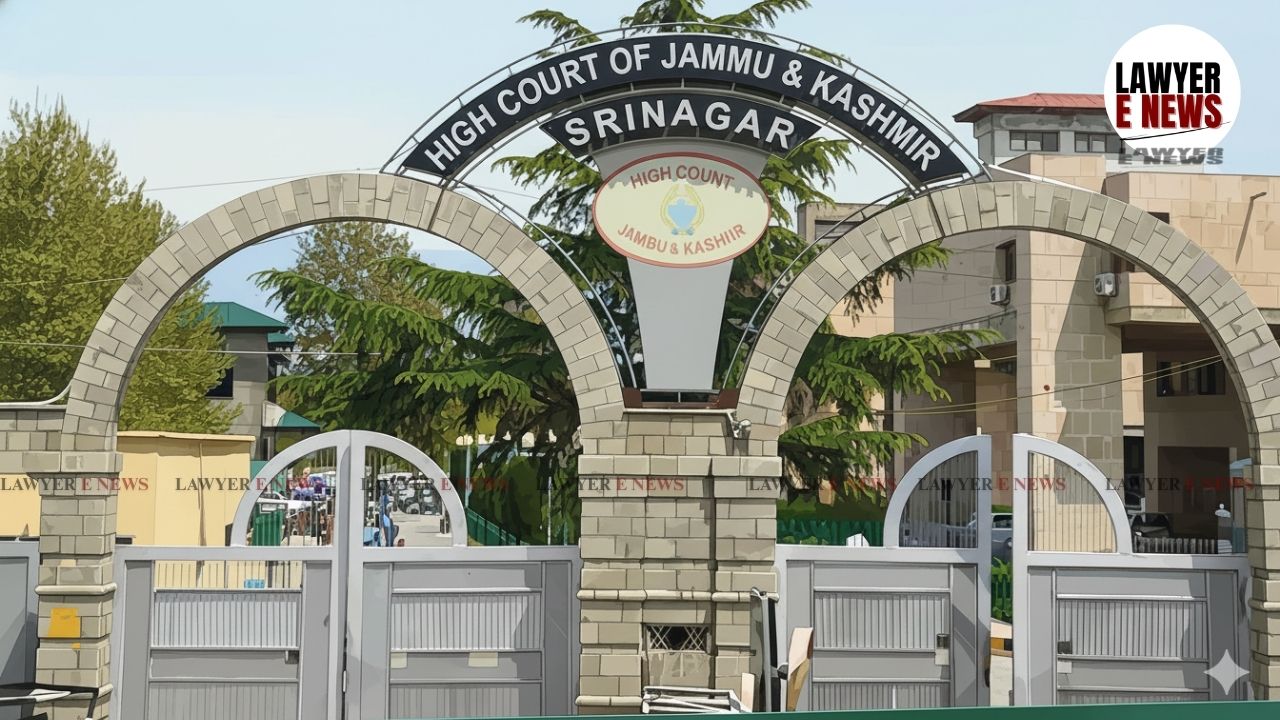
Employees Compensation Act | Death Due To Cardiac Arrest During Employment Is An 'Accident' Arising Out Of Stress And Strain Of Duty: J&K High Court

03 October 2026 1:56 PM

By: sayum


"The driver felt unconscious while on duty. The Supreme Court held that even if death had not occurred on account of any accident in the popular sense, long spells of driving were a material contributory factor, if not sole cause, accelerated unexpected death at a young age." High Court of Jammu & Kashmir and Ladakh has reaffirmed that the death of an employee due to cardiac arrest during the course of employment constitutes an "accident" under the Employees Compensation Act, 1923, provided a causal nexus is established between the occupational stress and the fatality.

A bench of Justice Shahzad Azeem held that when the nature of duties, such as long-distance tanker driving, contributes to physical strain, such death is clearly attributable to the employer’s trade and business.

The matter arose from a claim petition filed by the dependents of a deceased tanker driver who suffered a fatal cardiac arrest at Pampore while returning from a trip to Kashmir. The insurance company contested the claim, arguing that the death was a natural biological event and lacked the necessary proximity to employment to be classified as an accident. The Assistant Labour Commissioner had initially awarded compensation, prompting the insurer to appeal before the High Court.

The primary legal issue was whether a death caused by cardiac arrest during the course of employment could be legally classified as an "accident arising out of and in the course of employment" under the Act. The court was further tasked with determining whether the claimant had successfully established a nexus between the deceased's specific working conditions—characterized by prolonged driving—and the resultant heart failure.

Employment Nexus And Evidentiary Burden

The Court noted that the claimants provided consistent testimony regarding the long-haul nature of the deceased's duties and the subsequent physical exhaustion. By failing to lead any evidence to rebut these claims, the insurer failed to substantiate its defense of policy violation. The Court emphasized that when the claimants prove that the deceased was actively engaged in the employer’s business at the time of the incident, the evidentiary burden shifts to the insurer to prove otherwise.

Court Explains Doctrine Of Occupational Stress

The Court rejected the insurer’s reliance on Shakuntala Chandrakant Shresti, distinguishing it on the basis that the claimants in the present case had adequately pleaded and proved the stress-related nature of the employment. The bench observed that the testimony of the cleaner/conductor and the family members remained unimpeached, confirming the nexus between the deceased's duty cycle and his cardiac event.

Precedent Value Of Judicial Interpretation

The Court relied heavily on the Supreme Court’s dicta in Param Pal Singh v. National Insurance Co. and Smt. Dariyao Kanwar v. United India Insurance Co., which established that long spells of driving are a material contributory factor in accelerating death by cardiac arrest. These precedents clarify that the term "accident" is not confined to external trauma but encompasses physiological breakdowns directly caused by the rigors of professional duties.

Final Determination On Insurer’s Liability

Concluding that the findings of the Assistant Labour Commissioner were neither perverse nor contrary to settled law, the High Court upheld the award of compensation. The Court held that since the employment-related stress was the triggering factor for the cardiac arrest, the insurance company remains liable to indemnify the employer. The appeal was subsequently dismissed for lacking any substantial question of law.

Date of Decision: 28 September 2026

 

Latest Legal News