Mere Absence of Landowners’ Signatures on MOU Not Fatal When They Received Benefits Under Agreement: Bombay High Court Grants Injunction in Specific Performance Suit Involving Pre-Allotment Sale Election Certificate Has No Legal Sanctity Under Societies Act; Authority To Function Flows Only From Registered List Under Section 4(1): Allahabad High Court Silence After Legal Notice Fatal: Andhra Pradesh High Court Upholds Decree for Specific Performance Despite Allegation of Loan Transaction State Cannot Hijack Compensation for National Highways – Only Centre Can Decide Multiplier: Bombay High Court Quashes Maharashtra’s Attempt to Dilute Landowners’ Rights Recognition Of Trade Unions Is Not A Fundamental Right: Calcutta High Court Rejects Writ Seeking Bargaining Status Without Approaching Registrar Economic Offences Are Not Trivial Disputes—They Threaten National Integrity: Delhi High Court Rejects Anticipatory Bail in ₹65 Crore Crypto-Laundering Cyber Scam State Cannot Rewrite Recruitment Rules: Gujarat High Court Slams Denial of Applications Based on Misreading of Experience Requirement for Head Teacher Post Sanction Once Refused Under PC Act Cannot Be Overruled by Another Authority: Madhya Pradesh High Court Lex Non Cogit Ad Impossibilia – Law Does Not Compel Performance of Impossibility: Orissa High Court Quashes Rejection of Contractor's Claim for Price Escalation Due to Quarry Closure Uniformity in Compensation Must Prevail: Once Market Value Fixed by Common Judgment, It Can't Be Reopened or Reduced: Madras High Court Section 223 BNSS | Notice to Accused Only After Complainant's Oath: Gauhati High Court Clarifies New BNSS Mandate Nationality Alone Cannot Deny Bail: Karnataka High Court Grants Bail to Bangladeshi National Accused of Forged Passport and Aadhaar Creation Sole Eyewitness Not of “Sterling Quality”, Medical Evidence Contradicts Ocular Version: Kerala High Court Acquits Accused in 2015 Thodupuzha Murder Case Failure to Prove Victim's Age and Delay in FIR Fatal to Prosecution Under POCSO Act: Madras High Court Acquits Director Cannot Be Prosecuted Without Making Company an Accused: Calcutta High Court Failure to Explain Possession of Looted Items Strengthens Inference of Guilt: Calcutta High Court Upholds Life Sentence in Double Murder Dacoity Case Once Common Object to Commit Murder is Established, Individual Role Becomes Irrelevant: Allahabad High Court Plea of Non-Service Cannot Override Statutory Limitation When Dealer Sleeps Over Rights: Andhra Pradesh High Court Writ Against VAT Appellate Rejection Mutation Proceedings Not the Forum to Undo a Civil Court Decree: Bombay High Court Slams Revenue Authorities for Deleting Mutation Despite Registered Consent Decree Interpretation of Contract Is For The Arbitrator To Decide Unless No Fair-Minded Person Could Accept That View: Delhi High Court Identification Must Be Beyond Doubt, Not Beyond Hope: Delhi High Court Acquits Man Convicted for Attempt to Murder Owner-Driver Accused in NDPS Case Can’t Seek Vehicle Custody Till Trial: MP High Court Declines Supurdnama Plea Discretionary Powers Cannot Be Invoked to Cure Litigant’s Lapses: Andhra Pradesh High Court Refuses Reopening of Evidence After 3-Year Delay Section 38-B Expressly Excludes Res Juicata; Past Findings Cannot Bar Re-Trial Under Amended Ceiling Law: Allahabad High Court Ceiling Law Can Revisit the Past: 1964 Discharge Not a Shield Against Mandatory Re-Determination: Allahabad High Court High Courts Can’t Pick and Choose from Precedents: Supreme Court Reiterates Binding Force of Constitution Bench in Motor Accident Compensation Future Prospects Are Not Charity, They Are Law: Supreme Court Enhances Fatal Accident Compensation, Rejects ‘Love and Affection’ as Separate Head No Estoppel Against Statute, No Equity Against Vesting: Supreme Court Rejects ‘Amicable Settlement’ to Undo Land Reform Vesting Power Of Review Is Not Inherent; Executive Directions Cannot Confer Jurisdiction: Supreme Court Strikes Down Four-Decade Review as Unconstitutional “Expertise Over Formal Titles: Supreme Court Strengthens Transgender Rights Advisory Committee, Adds CLPR Representative Data Needs Science, Not Guesswork:  Supreme Court Brings Former Chief Statistician into National Task Force Once Parity is Statutorily Guaranteed, Government Cannot Withdraw Benefits Through Executive Memos: Andhra Pradesh High Court Even A Single Crime Is Sufficient To Invoke Gangster Act: Allahabad High Court Upholds Proceedings Despite Challenge Based On Solitary Case Non-Consummation Can’t Be Raised As Afterthought To Defeat Maintenance:  Madras High Court Cuts Quantum But Upholds Wife & Child’s Right Failure to Examine Who Actually Weighed the Paddy is Fatal—Stock Discrepancy Alone Cannot Sustain Conviction: Calcutta High Court on Essential Commodities Act Prosecution Net Salary is Not the Sole Determinant — Deductions Can’t Defeat Maintenance Obligations: Andhra Pradesh High Court Clarifies in Maintenance Appeal Order 7 Rule 11 CPC | Mere Designation as Director Does Not Create Civil Liability: Bombay High Court Rejects Suit Against Nominee Directors Once Witnesses Admit Signing Blank Papers and No Actual Seizure Is Proved, Conviction Cannot Stand : Calcutta High Court Admissions Made in Cross-Examination Are the Best Evidence: Bombay High Court Baseless Allegations on Fidelity Justify Wife Living Separately – Maintenance Cannot Be Denied on Grounds of Character Attacks Unsubstantiated by Evidence: Andhra Pradesh High Court Once Delay Is Found Not Attributable To Contractor, Everything Else Must Fall: Bombay High Court Upholds Arbitral Award Against Solapur Municipal Corporation

Baseless Allegations on Fidelity Justify Wife Living Separately – Maintenance Cannot Be Denied on Grounds of Character Attacks Unsubstantiated by Evidence: Andhra Pradesh High Court

07 February 2026 12:50 PM

By: sayum


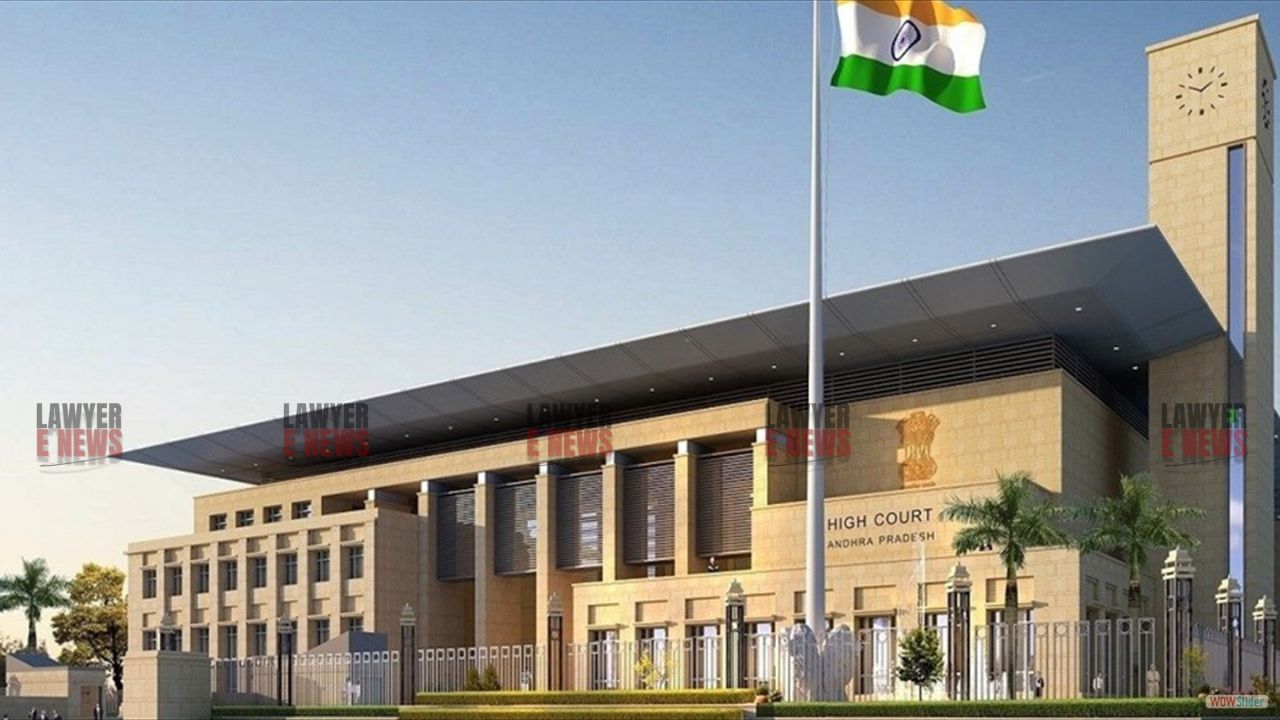
"Maintenance to Minor Child is Absolute and Unquestionable, Irrespective of Father's Objections", On 6th February 2026, the Andhra Pradesh High Court delivered a crucial judgment reaffirming the rights of a wife and minor child to maintenance under Section 18 of the Hindu Adoptions and Maintenance Act, 1956.

Division Bench comprising Justice Battu Devanand and Justice A. Hari Haranadha Sarma partially allowed the appeal filed by the husband, reducing the quantum of maintenance payable prospectively from ₹10,000 to ₹8,000 for the wife, and from ₹5,000 to ₹4,000 for the minor son, while upholding the entitlement and past maintenance as ordered by the Family Court, Visakhapatnam.

“Right of Minor Child to Maintenance is Absolute; No Objection to be Entertained Against It”: Court Affirms Undisputed Entitlement

The Bench opened its reasoning with a clear pronouncement that the minor child’s right to maintenance stands on an unshakeable legal foundation, irrespective of his living arrangements or the father's objections.

“There is no dispute that the 2nd petitioner is the minor son of the respondent. The 2nd petitioner, being a minor, is entitled for maintenance and the same need not be doubted. No objections can be entertained in respect of the entitlement of the 2nd petitioner,” the Court declared (Para 11).

The relationship between the parties was not disputed, and the husband’s income was established through payslip evidence (Ex.B1), revealing a gross salary of ₹44,249/- per month. The Family Court had originally fixed maintenance in varying slabs for different periods, including arrears from 2015 onwards.

Dowry Harassment, Desertion, and Domestic Discord

The case arose from an appeal against the order of the Additional Family Court, Visakhapatnam dated 27.06.2024 in F.C.O.P. No.1265 of 2017. The wife alleged harassment over dowry by the husband and his family, with specific claims of inappropriate behaviour by the husband’s brother and neglect during pregnancy, culminating in a criminal case under Sections 498A and 509 IPC, and Sections 3 and 4 of the Dowry Prohibition Act. She returned to her parental home during pregnancy and gave birth to their child there.

The husband admitted the marital relationship and paternity but denied all allegations. He also raised arguments around voluntary desertion by the wife, alleged extra-marital relationship, and sought to discredit her claim for maintenance based on non-disclosure of assets, citing the Rajnesh v. Neha guidelines.

“Allegations of Infidelity Without Proof Cannot Defeat Maintenance Claim”: Court Upholds Wife’s Right to Live Separately

The High Court sternly rejected the husband’s attempts to deny maintenance on the basis of unproven character attacks.

“The 1st petitioner is entitled to live separately. Baseless allegations on the fidelity of the 1st petitioner, coupled with the absence of any steps for restitution of conjugal rights, justify her separate residence and entitlement to maintenance,” the Court noted emphatically (Paras 13–14).

It further rejected the husband's invocation of the Rajnesh v. Neha guidelines at the appellate stage, observing that he himself had failed to comply with the disclosure requirements, rendering the objection nothing more than an attempt to derail proceedings.

Net Salary Not Decisive – Court Considers Gross Income and Earning Capacity

The Bench clarified that while the net take-home pay may be lesser due to deductions, such deductions could be voluntary and variable. The respondent, working as a Fireman at Naval Dockyard, was held to have the financial capacity to pay reasonable maintenance despite showing a net salary of ₹19,160/-.

“Net salary will depend on the deductions an employee opts for, and it may vary from time to time... Even if the admitted salary is taken as the basis, the respondent can contribute ₹8,000/- for the wife and ₹4,000/- for the son easily,” the Court reasoned (Para 16).

Partial Modification Only to Future Maintenance – Other Directions Stand Confirmed

While the Court found the maintenance awarded by the Family Court to be broadly reasonable, it considered the future quantum (from the date of order) to be slightly on the higher side and adjusted it downward.

“We are of the view that except with regard to the order for payment of maintenance at the rate of ₹10,000/- per month to the 1st petitioner and ₹5,000/- per month to the 2nd petitioner from 27.06.2024, modifying the same to ₹8,000/- and ₹4,000/- respectively, the impugned orders require no interference,” the Bench ruled (Para 17).

All previous directions, including arrears of maintenance and schedule of payments, were left undisturbed. The Court passed no order as to costs, and all pending miscellaneous applications were closed.

The Andhra Pradesh High Court’s judgment reinforces the settled principles of matrimonial law: a wife living separately due to cruelty or false allegations is entitled to maintenance, and a minor child’s claim is indisputable. Attempts to obstruct or delay maintenance obligations through procedural or speculative objections—especially when raised by a party in default—will not be entertained.

The ruling offers a clear message: “Character attacks without proof do not defeat the statutory right to maintenance.”

Date of Decision: 06.02.2026

 

Latest Legal News