-
by sayum
28 August 2026 10:07 AM







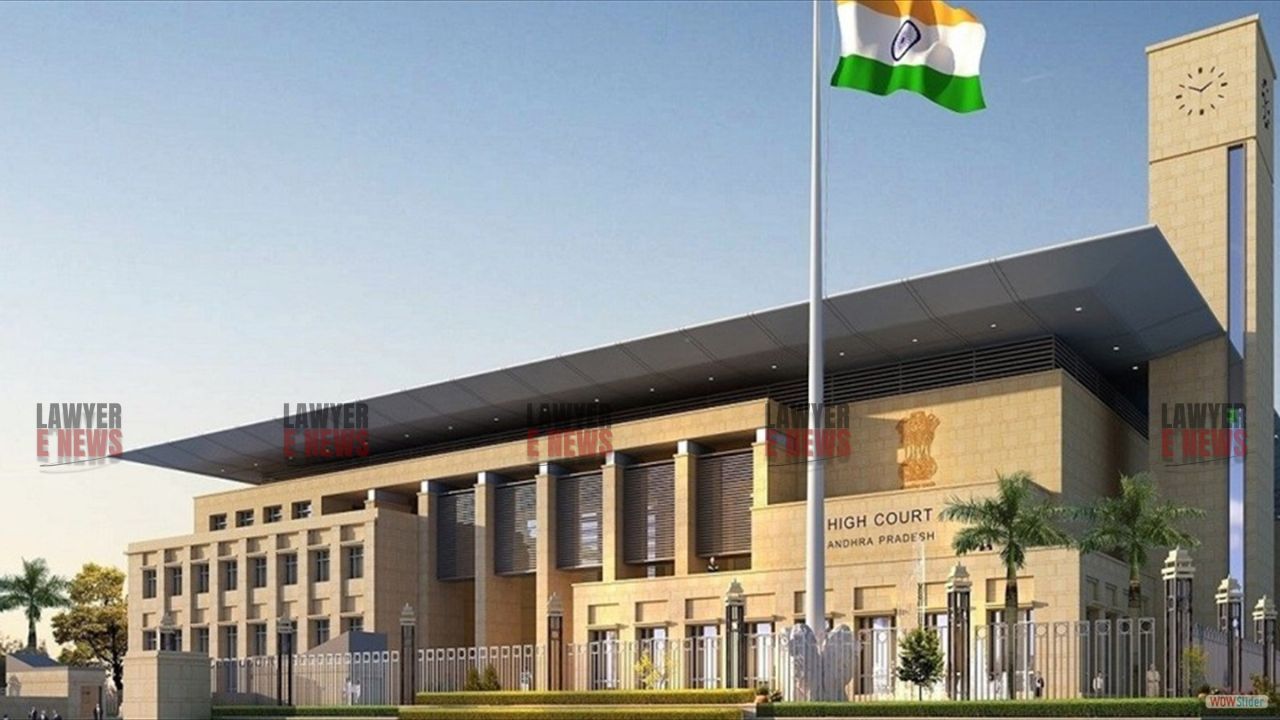
"This Court does not function as a site engineer, nor does it sit as a Court of Appeal over the decisions of contractual authorities. Writ jurisdiction is not available as a forum for enforcing or rewriting the terms of a contract," High Court of Andhra Pradesh, in a significant ruling, held that constitutional courts must exercise self-imposed restraint when dealing with administrative actions in public works contracts.
A bench of Dr. Justice Y. Lakshmana Rao observed that judicial review is limited to the decision-making process rather than the merit of the decision itself, particularly in projects involving complex technical issues and overwhelming public interest. The Court emphasized that "fair play in the joints" must be afforded to the State in contractual matters to prevent the disruption of essential public services.
The petitioner, Sri Sai Krishna Constructions, was awarded a contract for the repairs and restoration of damaged portions of the Somasila Dam in 2022. Disputes arose when the petitioner alleged non-payment of dues exceeding Rs. 5.76 Crores and a failure by the State to provide necessary designs, while the State contended the petitioner had abandoned seasonal works. The petitioner approached the Court challenging the State's move to withdraw certain critical components of the work under Clause 60(C) of the Preliminary Specifications to the A.P.D.S.S.
The primary question before the court was whether the High Court, under Article 226 of the Constitution of India, could interfere in a contractual dispute involving technical execution and measurements. The court was also called upon to determine whether an interim order restraining "coercive steps" was appropriate in the context of urgent public safety works.
Limited Scope of Judicial Review in Contracts
The Court observed that the power of judicial review in relation to administrative actions connected with the performance of contracts is wide but must be exercised with restraint. It was clarified that writ jurisdiction is not a forum for enforcing or rewriting the terms of a private agreement. The bench noted that disputed questions of fact regarding measurements, delays, and damages are better suited for arbitration or civil suits rather than extraordinary writ jurisdiction.
"This Court does not function as a site engineer, nor does it sit as a Court of Appeal over the decisions of contractual authorities."
State Entities Entitled to Fair Play in Technical Matters
Referring to the Supreme Court’s rulings in Tata Motors Ltd. v. BEST and Silppi Constructions Contractors v. Union of India, the Court reiterated that judges lack the technical expertise to scrutinize commercial contracts minutely. The bench emphasized that the authority floating the tender is the best judge of its requirements. It was held that interference is justified only in cases of manifest arbitrariness, mala fides, or irrationality, rather than over minor technical lapses.
Court Explains "Fair Play In The Joints"
The Court highlighted that the State must be allowed a degree of flexibility in managing contracts. It noted that unwarranted judicial intrusion may disrupt public interest and cause significant loss to the exchequer. The bench adopted the principle that courts should not use a "magnifying glass" to transform minor irregularities into major transgressions during the execution of public works.
"The courts must realise their limitations and the havoc which needless interference in commercial matters can cause."
Public Interest Overriding Private Contractual Grievances
The Court took serious note of the nature of the work, involving the Somasila Dam, which serves as a critical source for irrigation and drinking water for millions. The bench observed that the restoration of the dam and the protection of the nearby Sri Someshwara Swamy Temple were emergent seasonal tasks. It held that a contractor’s default should not be permitted to stall works of national importance under the guise of writ proceedings.
Vagueness of "No Coercive Steps" Interim Orders
Critiquing the previous interim order, the Court found that the expression “coercive steps” was uncertain and vague. The bench observed that such wide terminology has the potential to interdict the State from discharging its lawful contractual and statutory functions. It noted that the State’s action to delete certain urgent components from the petitioner’s scope did not amount to total termination but was a necessary intervention for public safety.
"The expression 'coercive steps' carries wide and indeterminate ramifications and has the potential to interdict the Respondents from discharging their lawful contractual and statutory functions."
Final Directions and Payment of Dues
While refusing to grant an absolute stay on the State's actions, the Court directed the Respondents to clear the petitioner’s outstanding bills to the tune of Rs. 5,76,30,768, subject to assessment, within three weeks. The Court modified the interim order, permitting the State to proceed strictly in accordance with the Agreement and Clause 60(C) of the A.P.D.S.S., provided the procedure was followed.
The Court concluded that while the State must act fairly under Article 14, it cannot be paralyzed by vague interim orders when executing critical infrastructure projects. The bench modified the earlier restraint, allowing the State to re-allocate urgent works to ensure the dam's structural integrity before the monsoon. The petition was posted for a comprehensive hearing after the summer vacation.
Date of Decision: 28 May 2026