-
by sayum
28 July 2026 9:28 AM







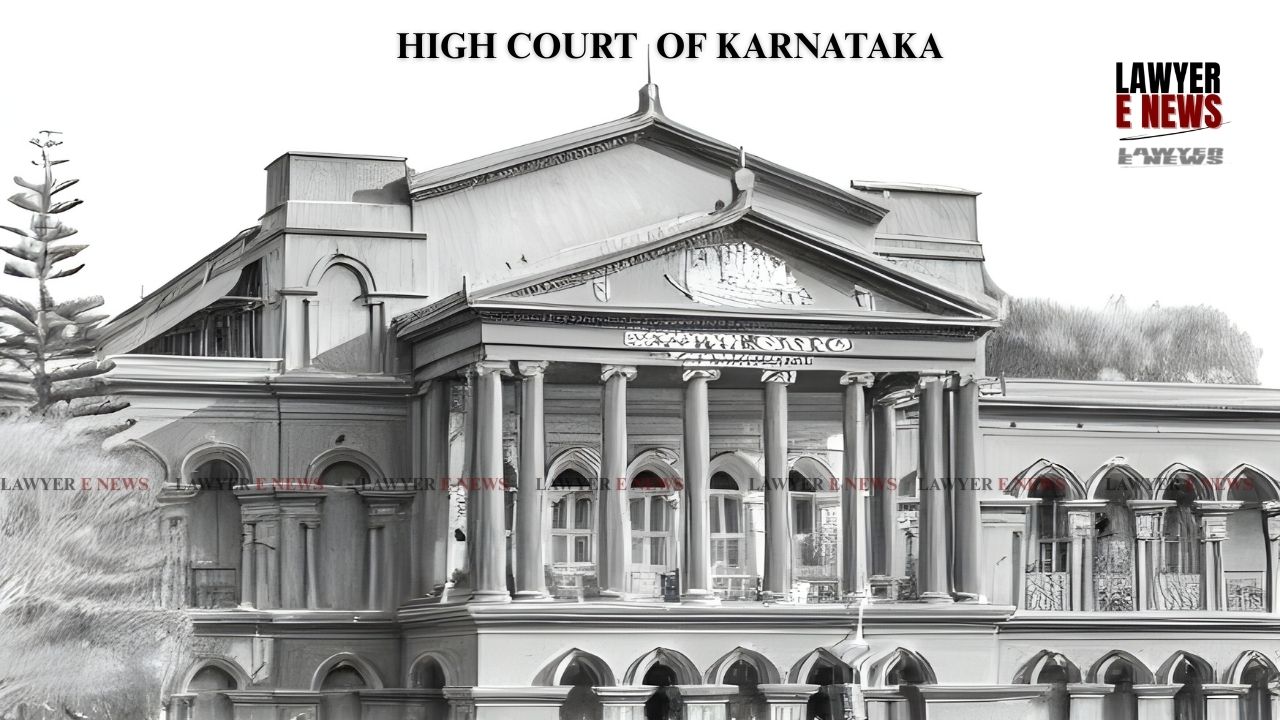
"Mere reproduction of evidence can never be equated with appreciation of evidence." High Court of Karnataka, in a significant ruling, held that an Enquiry Officer cannot merely reproduce oral testimony and pleadings to conclude that departmental charges against a delinquent official are proved.
A division bench comprising Justice Mohammad Nawaz and Justice G Basavaraja observed that a failure to independently assess evidence and record reasons violates statutory rules and renders the disciplinary proceedings legally unsustainable.
The petitioner, an Assistant Director of Town and Country Planning, faced a departmental enquiry alleging dereliction of duty regarding the processing of a land conversion proposal. Based on the Enquiry Officer's report, the Disciplinary Authority imposed a penalty of withholding one annual increment with cumulative effect. The petitioner approached the High Court after the Karnataka State Administrative Tribunal (KSAT) dismissed his original application and his subsequent review petition.
The primary question before the court was whether the Enquiry Officer's report was vitiated by non-application of mind, absence of reasons, and a failure to consider material defence evidence. The court was also called upon to determine whether the KSAT erred in refusing to exercise its power of judicial review by conflating the "sufficiency of evidence" with a complete "lack of evidence."
Statutory Mandate Ignored By Enquiry Officer
The High Court critically examined the enquiry report and found it conspicuously devoid of the statutory exercise mandated under Rule 11(23) of the Karnataka Civil Services (Classification, Control and Appeal) Rules, 1957. The bench noted that the Enquiry Officer merely reproduced pleadings and extracted the oral testimony of witnesses without assigning any reasons as to how the charges were actually established.
"Mere reproduction of evidence can never be equated with appreciation of evidence," the court firmly observed, highlighting the lack of independent analysis in the report.
Enquiry Officer Cannot Travel Beyond Charges
The bench also pointed out a fundamental flaw in the disciplinary proceedings, noting that the Enquiry Officer had recorded a finding that the petitioner indulged in "unnecessary correspondence." The court noted that this allegation was never a part of the original articles of charge. Emphasizing the boundaries of a departmental probe, the court reiterated that a finding founded upon a ground not forming part of the charge memo is liable to be set aside.
Crucial Defence Evidence Ignored
Delving into the merits of the evidence, the court highlighted that the prosecution's own witness (PW1) categorically admitted during cross-examination that the Department of Town and Country Planning had no authority to grant or refuse conversion proposals. The court noted that this authority vested exclusively with the Revenue Department, a fact which substantially weakened the foundation of the departmental charge.
Furthermore, the court observed that thirteen defence documents clearly established that the procedure adopted by the petitioner was accepted and explicitly approved by higher competent departmental authorities.
"Once the higher departmental authorities themselves have approved the procedure adopted by the petitioner, the allegation of dereliction of duty loses its very foundation," the bench stated, noting that neither the Enquiry Officer nor the Disciplinary Authority had even adverted to this crucial defence evidence.
"Once the foundation is found to be legally unsustainable, every consequential order resting thereon must necessarily collapse."
Tribunal Erred In Overlooking Lack Of Evidence
The High Court came down heavily on the KSAT for mechanically affirming the punishment order despite manifest infirmities. The bench observed that the Tribunal proceeded on the erroneous premise that the sufficiency of evidence was entirely beyond judicial scrutiny. The court clarified the well-settled distinction between the "lack of evidence" and the "adequacy of evidence," noting that the Tribunal failed to exercise the jurisdiction legally vested in it.
Foundation Removed, Structure Falls
Applying the Latin maxim Sublato fundamento cadit opus (if the foundation is removed, the structure falls), the court observed that since the enquiry report was vitiated by patent violations and a complete absence of reasons, every consequential order resting on it had to collapse. Relying on Supreme Court precedents including Allahabad Bank v. Krishna Narayan Tewari and Kranti Associates (P) Ltd. v. Masood Ahmed Khan, the bench reiterated that reasons are the heartbeat of every conclusion.
"Where the findings recorded in disciplinary proceedings are unsupported by evidence, or are such as no reasonable person could have arrived at, or where there is nonapplication of mind or failure to record reasons, the writ court would be justified, if not duty-bound, to exercise its power of judicial review," the court declared.
Allowing the writ petition, the High Court quashed the impugned orders of the KSAT and the penalty imposed by the Disciplinary Authority. The respondent-State was directed to restore all consequential service benefits to the petitioner, including the restoration of the increment, re-fixation of pay, and all attendant monetary benefits, within a period of twelve weeks.
Date of Decision: 24 July 2026