
-
by sayum
28 July 2026 10:19 AM







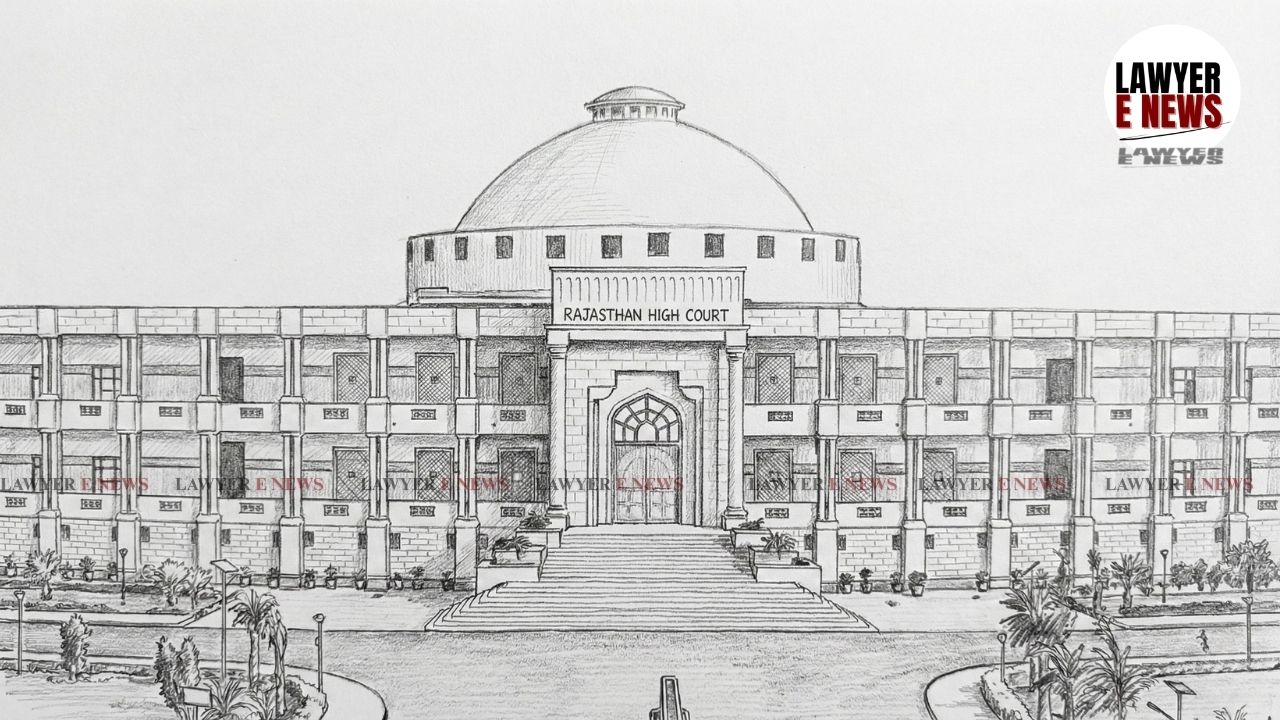
"A person, against whom an FIR is lodged, has the fundamental right to take care of his property or alienate the same by way of sale, in case, necessity so arises. He cannot be deprived to do so simply because he is a suspect in a criminal case and is lodged in the jail." Rajasthan High Court, in a significant ruling, held that mere incarceration does not result in the "civil death" of a person and that undertrial prisoners continue to enjoy the fundamental right to hold, own, and dispose of their property.
A single-judge bench of Justice Anoop Kumar Dhand observed that denying a prisoner permission to execute a Power of Attorney to sell property, merely because they are a suspect, is a direct violation of Article 21 of the Constitution of India.
The petitioner, an undertrial prisoner in an NDPS case lodged at Central Jail, Jaipur, sought permission to execute a General Power of Attorney (GPA) in favour of his brother to sell jointly owned property to alleviate his family's severe financial crisis. The Special Judge, NDPS Cases, Jaipur rejected this application on the hypothetical assumption that the property might have been purchased from the proceeds of crime. Aggrieved by this rejection, the petitioner approached the High Court to quash the impugned order.
The primary question before the court was whether a pre-convict or undertrial prisoner forfeits the right to execute a registered Power of Attorney to alienate property due to their incarceration. The court was also called upon to determine if a trial court could deny such permission based solely on an unproven presumption that the property was acquired through proceeds of crime.
No 'Civil Death' Upon Incarceration
The court strongly deprecated the trial court's approach, emphasizing that fundamental civil rights are not extinguished by the mere fact of imprisonment. Justice Dhand noted that under Articles 21 and 300A of the Constitution of India, a prisoner's fundamental right to property remains constitutionally protected.
The bench relied on the landmark Supreme Court judgments in State of Maharashtra vs. Prabhakar Pandurang Nagarkar and Sunil Batra vs. Delhi Administration, reiterating that a prisoner retains all civil rights which are not inconsistent with confinement. The court ruled that the capacity to contract and transfer property under Sections 5 and 7 of the Transfer of Property Act, 1882, and Section 1A of the Powers of Attorney Act, 1882, remains fully intact.
Imaginary Presumptions By Trial Court Flawed
Addressing the lower court's reasoning, the High Court observed that the investigating agency had not produced any evidence during the charge-sheet submission or the trial to prove the property was acquired illegally. The bench ruled that fundamental rights cannot be suspended based on mere conjecture.
Quoting the necessity of concrete proof, the court observed, "Unless and until such evidence is made available on record of the Trial Court, it cannot be presumed simply on the basis of one's imagination that the aforesaid property has been purchased by the petitioner from the proceeds of crime."
Statutory Mechanism For Registration In Jail
To resolve the practical impossibility of a prisoner visiting a Sub-Registrar's office, the court highlighted the statutory mechanism under Section 38(1)(b) of the Registration Act, 1908. The bench explained that the registering authority is legally empowered to depute an officer to the place of confinement to facilitate the registration of documents for individuals incarcerated under civil or criminal processes.
The court further examined Rule 202 of the Rajasthan Prison Rules, 2022, which explicitly lists the delegation of power of attorney as a statutory facility to be extended to undertrial prisoners. The jail superintendent is authorized to attest such documents after verifying the prisoner's identity through jail records and Aadhaar.
Drawing support from concurrent views of the Allahabad High Court and Calcutta High Court, the bench reiterated that a registrar cannot refuse registration solely on the ground that the executant is confined in a correctional home.
"In view of the above constitutional provisions, statutory framework and judicial pronouncements, the law is clear that a pre-convict/undertrial prisoner does not forfeit the right to alienate his property."
Right Subject To Court Attachment Rules
While affirming the prisoner's right to alienate property, the High Court introduced a critical caveat regarding restricted assets. The bench clarified that this fundamental right remains subject to statutory restrictions under special laws like the PMLA, NDPS Act, or general provisions of the CrPC.
If the property in question is categorized as "case property" or has been formally attached by a court under Section 102 or 83 of the CrPC, prior permission from the competent tribunal or court becomes mandatory before any transfer can take place. The court noted that the transaction remains valid provided the GPA specifically authorizes the sale and there is an absence of any court attachment.
Setting aside the trial court's order, the High Court allowed the petition and directed the Superintendent of Central Jail, Jaipur, to forthwith attest the General Power of Attorney signed by the petitioner and facilitate its prompt registration. However, synthesizing the legal position, the court clarified that before executing any actual sale deed, the petitioner must submit an application before the Trial Court seeking formal permission to sell the property in accordance with law.
Date of Decision: 20 July 2026