-
by sayum
28 July 2026 10:19 AM







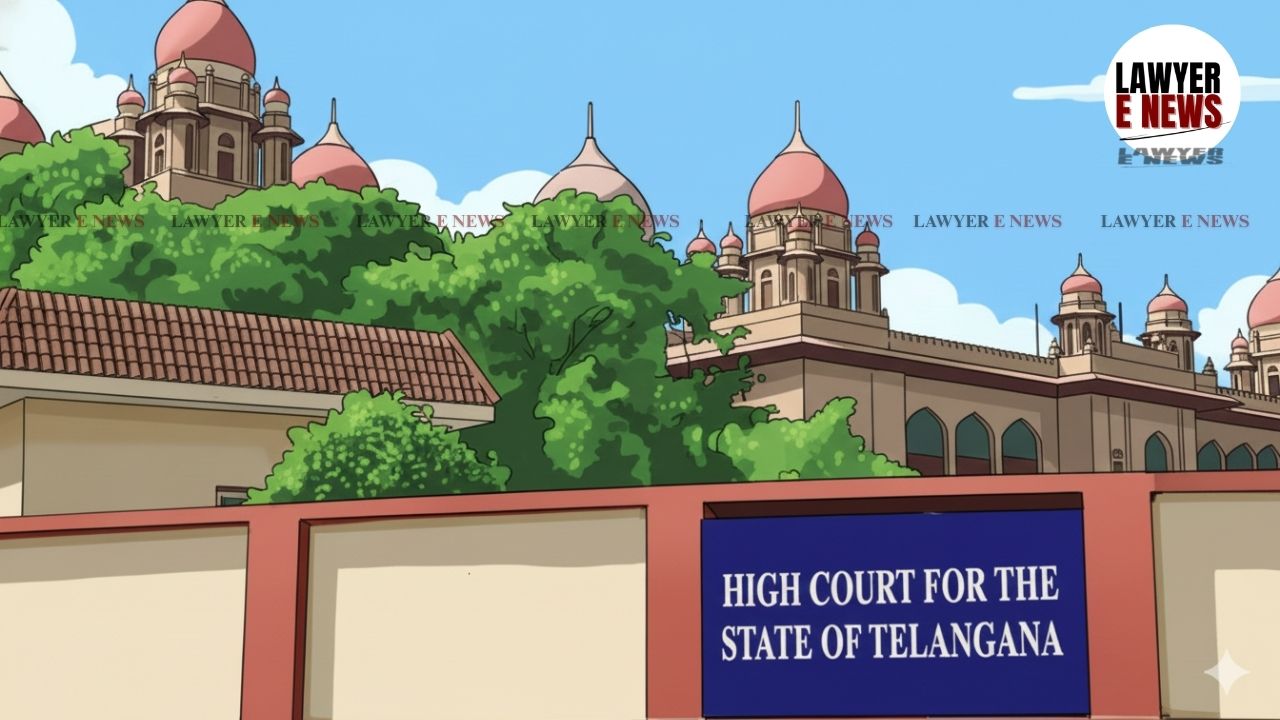
"These questions, in my view, are pure questions of fact, which can be answered one way or the other by the competent Civil Court in a properly instituted Civil suit... but not on the documents filed in the writ jurisdiction." Telangana High Court, in a significant ruling, reiterated that disputed questions of fact pertaining to the fabrication of property documents and land ownership cannot be adjudicated in a writ petition.
A single-judge bench of Justice Pulla Karthik observed that when rival parties present conflicting claims over land title that require the examination of evidence, the appropriate forum for redressal is a competent Civil Court, rather than revenue authorities or the High Court under Article 226 of the Constitution of India.
The petitioner approached the High Court challenging an order passed by a Special Tribunal which had set aside a Revenue Divisional Officer’s (RDO) directive issued in his favour. The dispute stemmed from allegations that the unofficial respondents had fabricated unregistered sale deeds and a partition deed to illegally mutate agricultural lands situated in Jangaon District into their names. The Special Tribunal had declined to interfere in the mutation, noting the complex title dispute, and instead directed the parties to approach a civil court, prompting the present writ petition.
The primary legal question before the Court was whether revenue tribunals or the High Court under writ jurisdiction can decide complex property disputes involving allegations of forged title documents. The Court was also called upon to determine if the Special Tribunal was legally justified in directing the contesting parties to seek remedies before a Civil Court instead of adjudicating the mutation dispute itself.
Disputed Facts Cannot Be Evaluated In Writ Proceedings
Delving into the merits of the writ petition, the High Court observed that the core of the dispute rested on entirely conflicting factual claims. While the petitioner alleged that the respondents had created forged documents to illegally mutate their names in the revenue records, the respondents maintained that the petitioner had already sold his share of the land and possessed no remaining title. Justice Karthik noted that resolving these claims would fundamentally require the detailed examination of both oral and documentary evidence.
Veracity Of Documents Must Be Tested Under Evidence Act
The bench emphasised that evaluating the authenticity of unregistered sale deeds and private partition agreements is strictly beyond the summary jurisdiction of writ courts. The judge pointed out that such verification must be conducted through a proper trial where witnesses can be cross-examined. The Court explicitly stated that the veracity of the documents relied upon by both parties has to be examined as per the stringent provisions of the Evidence Act.
Reliance On Supreme Court Precedents
To solidify its stance, the High Court relied heavily on settled jurisprudence from the Supreme Court regarding the limitations of writ jurisdiction. The bench cited the judgment in Municipal Corporation, Aurangabad through its Commissioner vs. State of Maharashtra, highlighting the apex court's ruling that High Courts consistently err when they exercise jurisdiction under Article 226 to decide disputed questions of fact regarding title over land raised by contesting parties.
Civil Court Is The Only Competent Forum For Title Disputes
Further reinforcing the jurisdictional boundaries, the bench referred to the Supreme Court's decision in Swati Ferro Alloys Private Limited vs. Orissa Industrial Infrastructure Development Corporation (IDCO). Drawing from this precedent, Justice Karthik reiterated that matters involving contested ownership of land must inevitably be resolved through civil litigation, and that statutory tribunals are well within their rights to refuse adjudication on such complex issues of title.
Unexplained Delay In Initiating Proceedings
Apart from the strict jurisdictional constraints, the High Court also took adverse note of the petitioner's conduct regarding the timeline of the revenue litigation. The Court observed that the initial mutation in favour of the respondents took place in the year 2006, yet the petitioner filed his first appeal before the revenue authorities only in 2017. The bench remarked that the petitioner approached the authorities after a lapse of 11 years, which he had failed to explain properly.
Finding no perversity or illegality in the Special Tribunal's order, the High Court dismissed the writ petition. The Court granted liberty to the petitioner to institute a proper civil suit before a competent court to seek redressal for his grievances regarding the land title and the alleged forged documents.
Date of Decision: 10 July 2026