-
by sayum
28 August 2026 12:24 PM







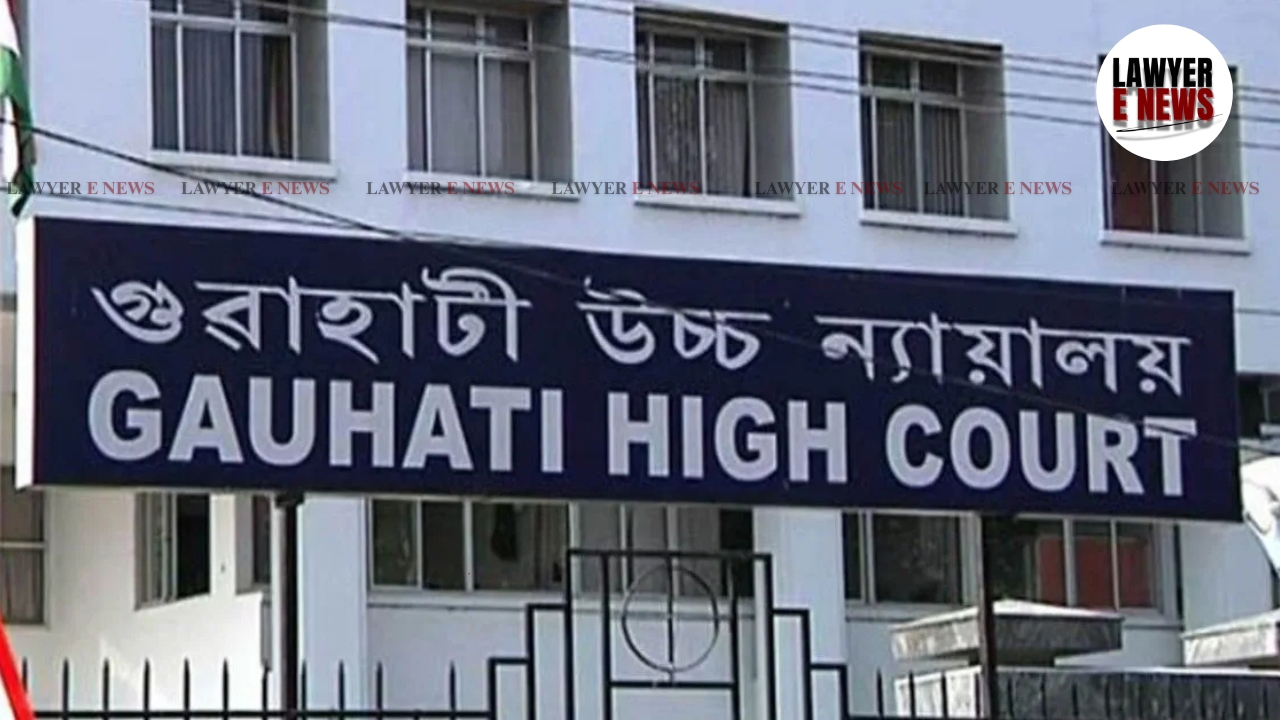
"It is a settled principle of criminal law that suspicion, however grave, cannot take the place of proof. The benefit of every reasonable doubt must necessarily go in favour of the accused," Gauhati High Court, in a significant judgment, has set aside the conviction and life sentence of a man accused of murdering a school teacher, ruling that a conviction cannot be sustained solely on uncorroborated confessional statements when the chain of circumstantial evidence is incomplete.
A division bench comprising Justice Robin Phukan and Justice Budi Habung observed that the prosecution’s failure to exhibit the weapon of offence and the absence of forensic evidence created a "glaring missing link" in the case.
The appellant, Tadap Tok, had been convicted by the Sessions Judge, Bomdila, for offences under Sections 120(B), 302, and 457 of the IPC in connection with the 2003 murder of Pramod Kumar Phukan, a junior teacher in Arunachal Pradesh. The prosecution alleged that the appellant and a co-accused, who died during the trial, conspired to rob the deceased of his stipend money and stabbed him to death at his residence.
The primary questions before the court were whether confessional statements recorded under Section 164 of the CrPC were voluntary and sufficient for conviction without independent corroboration. The court was also called upon to determine if the non-production of material exhibits and the lack of forensic linking evidence vitiated the trial court's findings.
Court Evaluates Evidentiary Value Of Confessional Statements
The bench first examined the reliability of the confessional statements recorded by the Judicial Magistrate First Class (PW-9). It noted that while a voluntary and truthful confession can form the basis of a conviction, the court must be satisfied that it was free from inducement or coercion. In this case, the appellant had remained in police custody for several days before the statement was recorded.
The Court found the Magistrate’s testimony regarding the "reflection time" granted to the accused to be vague. PW-9 merely stated during cross-examination that he "usually" granted half an hour for reflection but could not remember the exact period in this specific case. The bench held that such evidence does not satisfactorily establish compliance with the safeguards required under Section 164 of the CrPC.
Requirement Of Material Corroboration For Confessions
The Court emphasized that as a rule of prudence, courts should seek material corroboration before placing implicit reliance on confessions, particularly in cases involving serious charges like life imprisonment. It observed that except for the confessional statements, there was no substantive evidence directly connecting the appellant with the crime.
Relying on the precedent in Utpal Das & Anr. v. State of West Bengal (2010), the bench reiterated that a statement recorded under Section 164 of the CrPC is not substantive evidence of the truth of the facts but may be used for contradiction or corroboration. Since the confessions of both accused were substantially similar and lacked independent backing, they were deemed insufficient for a conviction.
"Suspicion, However Grave, Cannot Take The Place Of Proof"
Non-Production Of Murder Weapon Fatal To Prosecution
Turning to the alleged recovery of the weapon, the High Court noted serious infirmities in the investigation. The Investigating Officer (PW-8) admitted that the knife allegedly used in the crime was never exhibited before the trial court. Furthermore, the seizure witnesses had either turned hostile or were not examined by the prosecution.
The bench expressed concern that no bloodstains were found on the seized knife, and it was never sent for forensic examination. Referring to the Supreme Court’s ruling in Mohd. Aman & Anr. v. State of Rajasthan (1997), the court held that the non-production of the most important article—the weapon of offence—coupled with the lack of scientific evidence, made the prosecution’s version highly improbable.
Absence Of Motive And Failure Of 'Last Seen' Theory
The Court dismantled the prosecution's theory regarding motive and the "last seen together" circumstance. While the state claimed the appellant killed the teacher to rob him of stipend money, a colleague of the deceased (PW-10) testified that the money had actually been kept with him for safe custody on the evening prior to the incident.
This testimony, according to the Court, made the very foundation of the alleged motive doubtful. Additionally, the bench found that no witness had seen the appellant entering or leaving the house of the deceased on the night of the occurrence, meaning the prosecution failed to establish the "last seen together" link by cogent evidence.
Court Criticizes Lapses In Investigation
The bench observed that while medical evidence established the death was homicidal, it could not identify the assailant. It noted that no fingerprints, bloodstains, or other scientific materials were collected from the crime scene. The Court concluded that the chain of circumstances remained incomplete and did not point unerringly toward the guilt of the appellant.
Before parting with the record, the High Court expressed its displeasure over the "serious lapses" in the investigation. It specifically highlighted the failure to prove the recovery, the non-production of material exhibits, and the total absence of scientific examination as factors that materially weakened the case.
"Medical Evidence Alone Cannot Sustain A Conviction Without Reliable Connecting Evidence"
In its concluding remarks, the Court allowed the appeal and set aside the judgment of conviction dated May 29, 2023. The appellant was acquitted of all charges and ordered to be released forthwith. The bench reiterated that the prosecution failed to prove the case beyond a reasonable doubt, entitling the accused to the benefit of doubt.
Date of Decision: May 27, 2026