-
by sayum
28 August 2026 10:07 AM








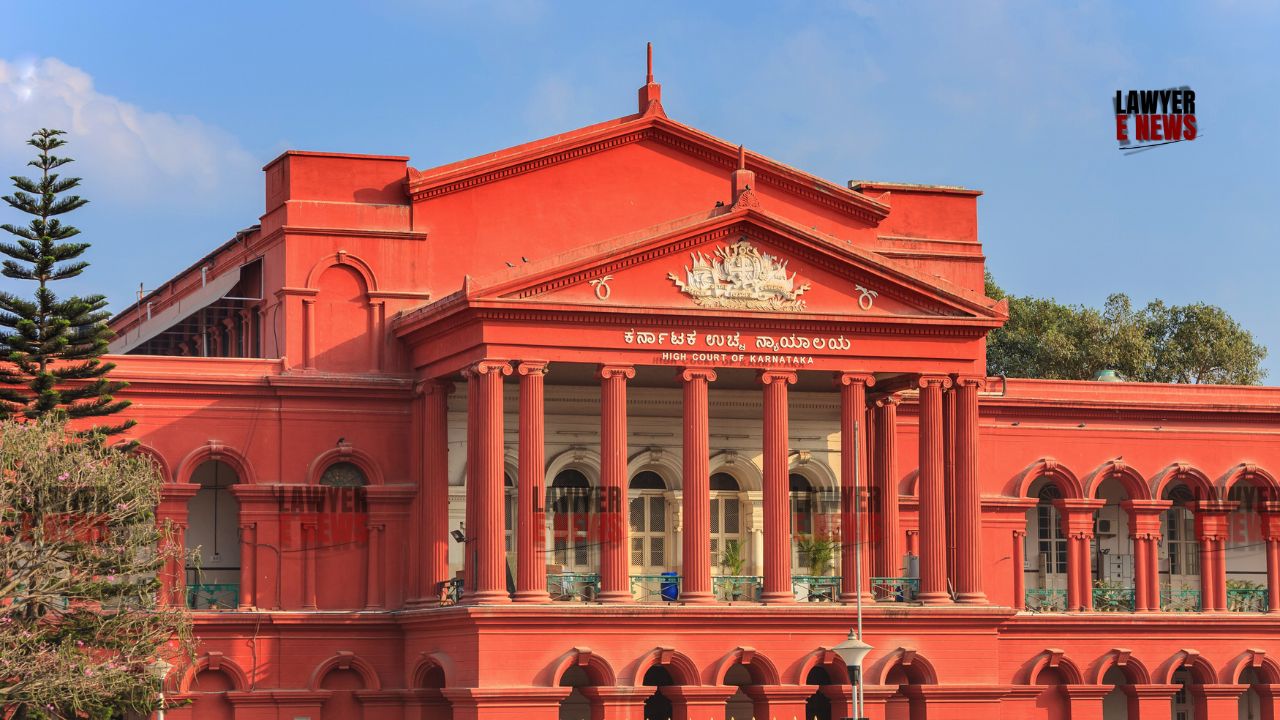
"Intention to make time the essence of the contract was expressed in writing in unmistakable language. The unambiguous language and intention employed in the Agreement of Sale provided that the time was the essence of the contract," Karnataka High Court, in a significant ruling, has held that while time is not ordinarily the essence of a contract for the sale of immovable property, it becomes essential if the parties expressly provide so in unequivocal language.
A bench of Justice D.K. Singh and Justice T.M. Nadaf observed that a purchaser who fails to pay the balance consideration within the stipulated time, despite the vendor’s readiness, cannot seek the discretionary relief of specific performance.
The court was dealing with a Regular First Appeal filed by a vendor (appellant) challenging a trial court decree that had allowed a suit for specific performance in favor of the purchasers (respondents). The bench emphasized that the failure of the purchasers to pay the balance consideration of over ₹50 Lakhs by the agreed deadline of November 15, 2005, constituted a fundamental breach that justified the termination of the agreement.
The appellant-defendant, a resident of Mumbai, entered into a registered Agreement of Sale on September 17, 2005, to sell agricultural lands in Ramanagara District for a total consideration of ₹60,41,875. The purchasers paid an advance of ₹10 Lakhs and were required to pay the balance on or before November 15, 2005, with the agreement explicitly stating that "time was the essence." While the vendor issued a termination notice for non-payment, the purchasers moved the trial court claiming that the vendor failed to provide a mandatory survey sketch and resolve boundary disputes, leading to the initial decree in their favor.
The primary question before the court was whether time was the essence of the contract and if the purchasers failed to perform their part within the stipulated period. The court was also called upon to determine whether the purchasers proved their "readiness and willingness" under Section 16(c) of the Specific Relief Act, 1963, and whether the vendor had breached any implied statutory obligations regarding survey sketches.
Time As Essence Of Contract Must Be Explicit
The Court observed that while Indian law generally presumes time is not of the essence in immovable property transactions, this presumption is rebuttable. The bench noted that whether time is the essence must be ascertained from the express terms of the contract, the nature of the property, and surrounding circumstances.
In this case, Clause 1(b) and Clause 8 of the Agreement of Sale used unequivocal language stating that the balance must be paid by a specific date and that time was the essence. The Court held that when parties provide for the consequence of termination and forfeiture upon failure to meet a deadline, the intention to make time essential is fortified.
Failure To Adhere To Stipulated Timelines Disentitles Relief
The bench highlighted that the purchasers did not approach the vendor with the balance amount until February 2006, months after the deadline had passed. The court rejected the purchasers' excuse that they were waiting for the vendor to conduct a survey.
It was noted that the purchasers never issued any notice demanding the execution of the sale deed before the expiry of the stipulated period. The Court found that the conduct of the purchasers, in sitting quiet until the vendor issued a termination notice, indicated they were not ready to perform their part.
Purchaser’s Duty To Prove Financial Readiness
Under Section 16(c) of the Specific Relief Act, the burden lies heavily on the plaintiff to prove readiness and willingness. The Court observed that the purchasers failed to produce any documentary evidence, such as bank statements or a "scheme of finance," to show they had ₹50.41 Lakhs available on the relevant date.
The bench clarified that even if a vendor admits in cross-examination that a purchaser is "financially capable" or "affluent," it does not relieve the purchaser of the obligation to prove the actual availability of funds for that specific transaction.
Survey Sketch Requirement Not An Excuse For Non-Performance
The purchasers argued that the vendor failed to obtain an '11-E' survey sketch, which was a statutory requirement for registration. However, the Court pointed out that the Agreement of Sale was on an "as is where is" and "as it is what it is" basis, with the purchasers having already verified the titles.
The bench held that at the relevant time in 2005, there was no mandatory requirement for an 11-E sketch for registration. Furthermore, the purchasers never demanded the sketch before the deadline, making their subsequent plea a mere "afterthought" to escape their own failure to pay.
Delayed Filing Of Suit Indicates Lack Of Readiness
The Court took serious note of the fact that the purchasers filed the suit for specific performance on September 1, 2008, just days before the three-year limitation period was set to expire.
Citing the Supreme Court in A.S. Vidyanadam v. Vairavan, the bench observed that even if time is not the essence, a party must perform within a reasonable time. Filing a suit at the tail end of the limitation period, especially in a rising real estate market, strongly suggests that the purchaser was not ready and willing.
The High Court concluded that the Trial Court had "completely misled itself" by ignoring the express terms of the agreement and the lack of evidence regarding the purchasers' financial readiness. Consequently, the High Court allowed the appeal, set aside the trial court's judgment, and dismissed the suit for specific performance with costs.
Date of Decision: June 3, 2026