-
by sayum
28 August 2026 10:07 AM







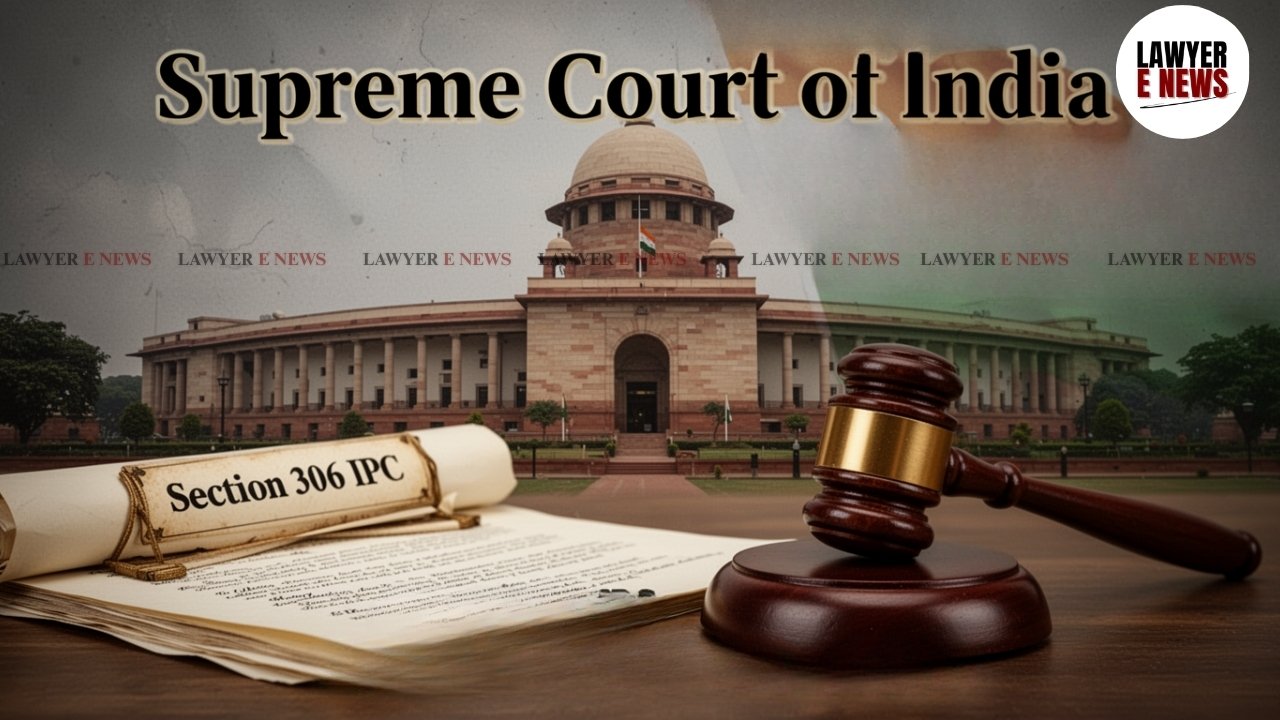
“Justice Is Served by Truth, Not Public Sentiment”, On 17 February 2026, the Supreme Court of India delivered a significant ruling on the scope of abetment of suicide in a suicide pact, evidentiary standards in circumstantial cases, and professional accountability in medico-legal reporting.
A Bench of Justice Rajesh Bindal and Justice Manmohan upheld the conviction of the accused under Sections 306 and 309 IPC, holding that participation in a suicide pact coupled with procurement of a lethal poison constitutes intentional aid under Section 107 IPC. The Court dismissed the mother’s appeal alleging rape and murder, conclusively ruling that the death was due to organophosphate poisoning and not strangulation.
The judgment stands as a precedent on the legal consequences of mutual suicide pacts and reinforces judicial intolerance toward premature and sensational expert opinions.
The deceased, Ms. Pratyusha, a young actress, and the accused, an engineering student, were in a long-standing relationship and intended to marry. While the deceased’s mother eventually consented, the accused’s parents strongly opposed the alliance, allegedly threatening suicide if the marriage proceeded.
On 23 February 2002, after emotional exchanges at a beauty parlour, both were last seen together leaving in the accused’s car. Later that evening, both were admitted to CARE Hospital, Hyderabad, after consuming poison. The deceased succumbed the next day; the accused survived.
Initially registered under Section 174 CrPC, the matter escalated after the postmortem surgeon, Dr. B. Muni Swamy, publicly claimed death by “manual strangulation” and “gang rape.” Following public outcry and PILs, the investigation was transferred to the CBI.
After extensive forensic and expert analysis, the CBI filed charges under Sections 306 and 309 IPC, concluding that the case was one of suicide pursuant to a mutual pact.
The Sessions Court convicted the accused. The High Court affirmed conviction under Section 306 IPC (reducing sentence to two years). The matter reached the Supreme Court.
Murder by Strangulation Ruled Out
The Supreme Court categorically rejected the theory of homicide.
The Court noted that the deceased was conscious and coherent at admission. She informed the treating doctor that she had consumed pesticide. The Bench observed that such a condition is “medically inconsistent with strangulation.”
The Court emphasized: “Taken together, these facts conclusively establish that the deceased was conscious at the time of admission, bore no injuries consistent with strangulation and herself disclosed poisoning.”
Multiple medical experts, including a three-member State Expert Committee and an AIIMS Committee, unanimously opined that the injuries noted in the postmortem were therapeutic in nature — caused during life-saving procedures such as catheterization, intubation, and DC shocks.
The AIIMS Committee clearly stated: “The Observations recorded in PM report… do not appear to be indicative of manual strangulation. The Opinion given… appears to be based on a misinterpretation of injuries produced by therapeutic procedures.”
Allegation of Rape Found “Devoid of Legal or Factual Foundation”
Forensic evidence proved decisive.
Both the AP FSL and CFSL reports found no semen or spermatozoa. Though CDFD detected a male DNA fraction, it did not match the accused or any suspected individuals.
The Court observed:
“In light of the deceased’s own statement, hospital records, forensic reports and expert opinions, allegations of rape or murder are devoid of legal or factual foundation.”
The Bench also noted that no protest petition was filed by the complainant when CBI filed the charge sheet under Sections 306 and 309 IPC. At the appellate stage, such allegations could not be revived.
Professional Misconduct of Autopsy Surgeon: Court Declares Conduct Contemptuous
The judgment strongly censured Dr. B. Muni Swamy for giving a sensational media interview before submitting his report and before receipt of FSL findings.
The Court found that he misinterpreted therapeutic injuries as signs of violence and prematurely claimed presence of semen without microscopic confirmation.
The Bench held: “The conduct of Dr. Muni Swamy in furnishing an erroneous report, publicising it prematurely and thereby violating professional ethics and the sub judice rule constitutes contempt of Court.”
However, no further action was taken due to his demise.
The Court warned that such conduct: “Spreads misinformation, erodes trust in investigative agencies… and undermines the rule of law.”
Chain of Circumstances Complete: Purchase of Poison Proved
The prosecution proved that the accused purchased Nuvacron, a highly toxic organophosphate pesticide, shortly before the incident.
Despite objections regarding billing discrepancies, the Court found the testimony of PW-34 credible and held that minor accounting practices did not undermine the identification.
The Court reiterated that Test Identification Parade is corroborative, not substantive evidence. Dock identification, supported by surrounding circumstances, was sufficient.
Adverse Inference Under Section 106 Evidence Act
The accused denied even being admitted to hospital, despite overwhelming evidence.
The Court held:
“Since the deceased is no more, it was for the Appellant-Accused to explain the circumstances in which the poison was purchased and consumed… an adverse inference has to be drawn.”
His complete denial strengthened the prosecution’s chain of circumstances.
Suicide Pact and Abetment: Landmark Interpretation
The most significant aspect of the judgment lies in its treatment of suicide pacts.
The Court held that participation in a suicide pact amounts to abetment under Section 107 IPC, even if both parties voluntarily decide to die.
The Bench observed: “A suicide pact involves mutual encouragement and reciprocal commitment to die together. The survivor’s presence and participation acts as a direct catalyst.”
Further, “It is the reciprocal commitment of each party to commit suicide which provides necessary impetus/support to the other to go through with the act.”
The Court clarified that abetment is not limited to supplying means — psychological assurance and mutual reinforcement also constitute intentional aid.
Thus, the surviving partner is legally culpable under Section 306 IPC.
Defence of Accidental Consumption Rejected
The accused argued that they may have consumed poison accidentally or merely to threaten families.
The Court rejected this as implausible, noting that Nuvacron is a highly toxic pesticide and the accused, being an engineering student, was aware of its lethal nature.
Probation Denied
Though conviction under Section 309 IPC was upheld, the Court held that benefit under the Probation of Offenders Act could not apply to conviction under Section 306 IPC, which carries punishment up to ten years.
The Supreme Court dismissed both appeals and directed the accused to surrender within four weeks.
This judgment establishes that in cases of suicide pact, the law treats mutual participation as abetment. It reinforces the principle that “assistance in ending life is treated as a crime against the State,” and underscores that courts must be guided by evidence — not media narratives or public sentiment.
Date of Decision: 17 February 2026