
-
by sayum
25 August 2026 12:32 PM







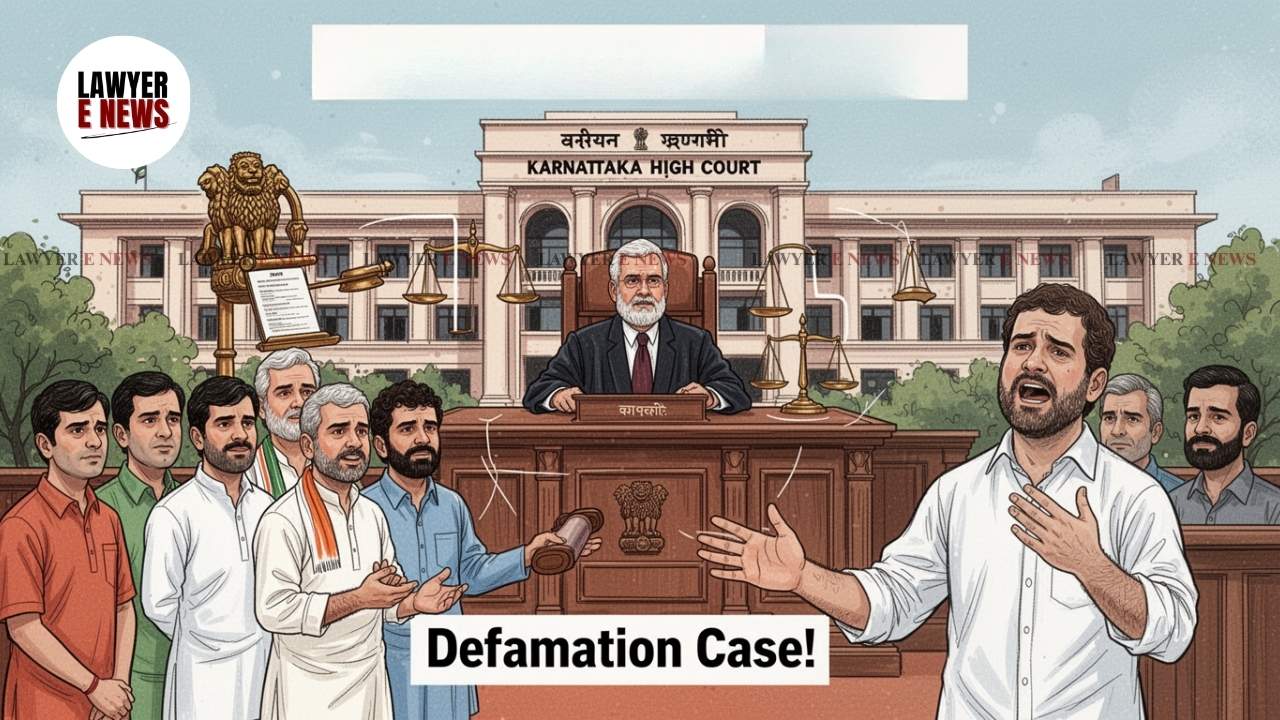
In a significant ruling on criminal defamation and procedural safeguards, the Karnataka High Court on 17/02/2026 held that a complaint under Sections 499 and 500 IPC must strictly comply with Section 199 Cr.P.C., and that absence of proper authorization and prima facie material vitiates proceedings at the threshold.
Justice S. Sunil Dutt Yadav quashed the criminal defamation case against accused No.4 (Rahul Gandhi), holding that continuation of proceedings would amount to “an abuse of the legal process.”
“Complaint Not by Competent Representative of the Alleged Aggrieved Party” – Proceedings Vitiated Under Section 199 Cr.P.C.
On 17 February 2026, the Karnataka High Court delivered a reportable order in Rahul Gandhi v. Bharatiya Janata Party, examining whether criminal defamation proceedings initiated by the Bharatiya Janata Party (BJP), represented by its State Secretary, were maintainable in law.
The principal questions before the Court were whether the complainant qualified as a “person aggrieved” under Section 199 Cr.P.C., whether there was sufficient prima facie material to issue process against accused No.4, and whether procedural lapses under Sections 202 Cr.P.C. and 65B of the Evidence Act vitiated the proceedings.
The Court answered all these issues in favour of the petitioner and set aside the proceedings insofar as accused No.4 was concerned.
The complaint was filed under Sections 190 and 200 Cr.P.C. by the Bharatiya Janata Party, represented by its State Secretary. It alleged that an advertisement published on 05.05.2023 by leaders of the Congress Party contained defamatory imputations referring to the period 2019–2023, thereby tarnishing the image of the complainant’s Government.
It was further alleged that accused No.4 had shared the advertisement on his Twitter account and had directed publication of the same.
The Magistrate, after recording sworn statements and marking documents Ex.C1 to C14, issued summons under Section 204 Cr.P.C. for offences under Sections 499 and 500 IPC.
Accused No.4 approached the High Court under Section 482 Cr.P.C. seeking quashing of proceedings.
“Some Person Aggrieved” – Mandatory Requirement Under Section 199 Cr.P.C.
The Court began by emphasizing that initiation of defamation proceedings is conditioned upon compliance with Section 199(1) Cr.P.C., which mandates:
“No Court shall take cognizance of an offence punishable under Chapter XXI of the Indian Penal Code… except upon a complaint made by some person aggrieved by the offence.”
Relying on Subramanian Swamy v. Union of India and other precedents, the Court reiterated that absence of a complaint by a legally competent “person aggrieved” renders proceedings void.
The complaint was filed in the name of the Bharatiya Janata Party (National Party), but authorization was issued by the President of the State Unit to its State Secretary.
The Court held:
“Such authorisation of the President of the State Unit cannot be accepted as legal authorisation to represent the BJP as a National Party.”
There was no material to show that the National Party had authorized initiation of proceedings. Consequently, the complaint was not instituted by a competent representative, vitiating the proceedings at inception.
“Imputation Must Be Against an Identifiable Body” – No Defamation of Party Made Out
The Court examined Explanation 2 to Section 499 IPC, which permits defamation of a “company or an association or collection of persons.”
However, the Court clarified that such a collection must be identifiable. Quoting S. Khushboo v. Kanniammal, it reiterated:
“Such a collection of persons must be an identifiable body so that it is possible to say with precision that a group of particular persons… stood defamed.”
The advertisement in question referred to constitutional functionaries, beneficiaries, and alleged irregularities in Government schemes. It did not specifically refer to the political party as an identifiable body.
The Court observed:
“Sans the tweet the advertisement by itself makes no reference to the party but rather makes an imputation to the functionaries mentioned in the advertisement.”
Accordingly, the political party could not be treated as the “person aggrieved.”
“Mere Photograph Insufficient to Fasten Criminal Liability” – No Mens Rea Shown
The Court stressed that Section 499 IPC requires intention to harm or knowledge/reason to believe that harm would result.
It held:
“A mere photograph on the advertisement would not be sufficient to indicate that the advertisement was at the instance of accused No.4 when the legal provision stipulates that the person must have requisite mens rea.”
There was no material to show that the advertisement was published at the instance of accused No.4 or that he possessed the requisite intention to defame.
“Tweet Not Marked – No Section 65B Certificate” – Material Deficiency at Cognizance Stage
The complaint relied heavily on an alleged tweet by accused No.4 forwarding the advertisement. However, the tweet was neither marked as an exhibit nor accompanied by a certificate under Section 65B of the Evidence Act.
The Court noted:
“The trial Judge when taking cognizance has made reference to documents at Exs.C1 to C14 which does not include the said tweet.”
It held that absence of the tweet from the record at the stage of issuance of process rendered the material insufficient to connect accused No.4 with the alleged offence.
The Court rejected the argument that the tweet could be marked later, observing that such subsequent production could not cure the foundational defect at the stage of cognizance.
“Mandatory Enquiry Under Section 202 Cr.P.C. Not Conducted” – Summons Issued Casually
The petitioner resided outside the territorial jurisdiction of the Magistrate. Under Section 202 Cr.P.C., enquiry is mandatory before issuance of summons in such circumstances.
The Court observed:
“Considering that accused No.4 resides outside the territorial limits of the Court, non following of Section 202 of Cr.P.C. procedure has prejudiced the said accused and would also reveal a very casual approach…”
This procedural lapse constituted an additional ground to quash proceedings.
Abuse of Process – Section 482 Cr.P.C. Invoked
Having found lack of proper authorization, absence of identifiable defamation against the party, lack of prima facie material showing mens rea, non-marking of crucial electronic evidence, and non-compliance with Section 202 Cr.P.C., the Court concluded:
“The continuance of the proceedings would amount to an abuse of the legal process…”
Accordingly, proceedings in C.C. No.7399/2024 (P.C.R. No.3878/2023) were set aside insofar as accused No.4 was concerned.
The Karnataka High Court’s ruling underscores that criminal defamation proceedings must strictly adhere to statutory safeguards. A political party must be properly represented by an authorized person to qualify as a “person aggrieved.” Vague or inferential allegations cannot sustain prosecution.
Further, issuance of process demands prima facie material demonstrating mens rea, and compliance with procedural safeguards such as Section 202 Cr.P.C. and Section 65B of the Evidence Act is not optional.
The judgment serves as a reminder that criminal law cannot be invoked casually, and courts must guard against abuse of process at the threshold.
Date of Decision: 17/02/2026





