-
by sayum
28 August 2026 10:07 AM







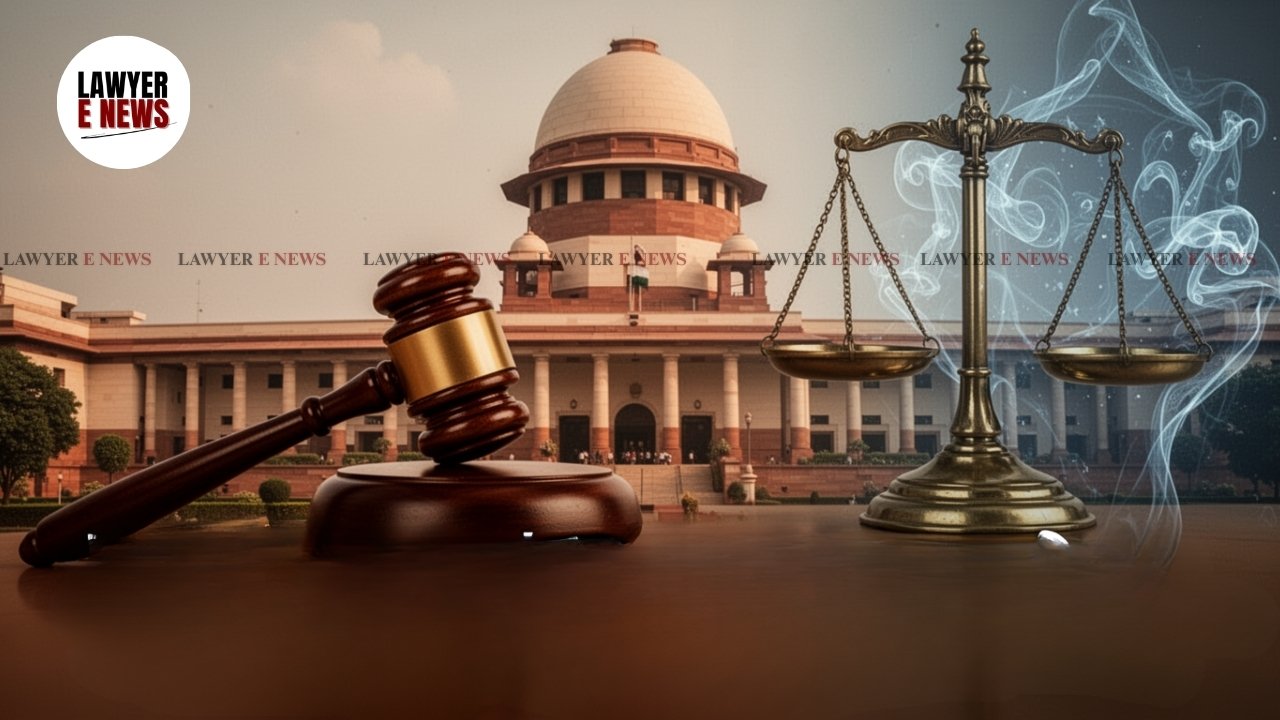
“Parity Cannot Be Applied Mechanically”, In a significant ruling reinforcing the limits of the parity principle in bail jurisprudence, the Supreme Court on 17 February 2026 set aside the Allahabad High Court’s order granting bail to an accused allegedly involved in a ₹6.5 crore economic fraud involving forged identity documents and multiple aliases.
Bench comprising Justice Sanjay Kumar and Justice K. Vinod Chandran held that the High Court’s order was “unsustainable either on facts or in law,” as it failed to consider the accused’s criminal antecedents, prolonged abscondence and the gravity of offences under Sections 409 and 467 IPC, which are punishable up to life imprisonment.
The Supreme Court restored custody of the accused and directed the State to expedite the trial.
Allegations: ₹11.52 Crore Deal, Forged Documents and Multiple Fake Identities
The complainant alleged that he supplied foodgrains worth over ₹11.52 crores to the accused and his associates, but received only about ₹5.02 crores. Cheques issued towards the balance were dishonoured.
Investigation revealed that forged documents and fabricated Aadhaar cards were used. Respondent No.1 allegedly operated under 8 to 10 aliases, including “Ajay Pal Gupta,” “Sonu Chaudhary,” “Gautam Agarwal,” and others. Three Aadhaar cards and a PAN card bearing different names and even different father’s names were recovered from him.
The State asserted that he was the “principal offender and the mastermind behind the offence.”
High Court Granted Bail on Parity and “Triable by Magistrate” Assumption
The High Court granted bail primarily on four considerations: that co-accused had secured bail; that the chargesheet had been filed; that the accused had spent some time in custody; and that the offence was triable by a Magistrate.
The Supreme Court found this reasoning deeply flawed.
It noted that offences under Sections 409 and 467 IPC carry punishment up to life imprisonment or ten years. Under Section 29 CrPC, a Magistrate of First Class cannot award imprisonment beyond three years, and even a Chief Judicial Magistrate cannot impose life imprisonment.
The Court clarified that under Sections 209 and 323 CrPC, a Magistrate may commit the case to the Sessions Court even during trial. Therefore, the High Court’s assumption that the case was “triable by Magistrate” was termed “premature.”
“Past Criminal Record and Conduct Were Completely Ignored”
The Supreme Court emphasized that this was not a simple case of cancellation of bail due to supervening circumstances, but a challenge to the validity of the grant itself.
Citing Dolat Ram v. State of Haryana, the Court reiterated that bail can be set aside where “the past criminal record and the conduct of the accused are completely ignored.”
Material on record showed multiple FIRs registered against the accused in Uttar Pradesh and Delhi. In an earlier case (FIR No. 229 of 2017), he had secured bail but later absconded, resulting in issuance of a non-bailable warrant. His surety’s address was found to be fictitious.
The Court observed that his “diverse and unconnected aliases, fake IDs and deliberate changes of identity, including his father’s name, clearly manifest his nefarious intention to dupe innocent victims.”
“Liberty Is a Priceless Treasure — But Not When One Becomes a Menace”
Relying on Neeru Yadav v. State of Uttar Pradesh and Sudha Singh v. State of Uttar Pradesh, the Court reiterated that liberty, though fundamental, is not absolute.
It observed that “liberty of an individual would however not be absolute as society, by its collective wisdom and through the process of law, can withdraw liberty that has been sanctioned to an individual when such an individual becomes a danger to the collective and to the societal order.”
The Court emphasized that crimes do not merely affect individuals; “in the ultimate eventuate, it is the society which is the victim.”
Though acknowledging that this was not a violent crime against the person, the Court expanded the societal perspective, holding that “the value of life and liberty of members of society is not limited only to their ‘person’ but would also extend to the quality of their life, including their economic well-being.”
Economic Offences and Societal Impact
The Bench made a pointed observation on economic offences, stating that where innocent people are cheated of their “hard-earned monies by conmen,” courts must weigh the risk posed to society while considering bail.
It concluded that the accused was a “career criminal and a menace to society,” and that “letting him loose on society would only pose a risk and hazard to others.”
Parity Principle Not a Mechanical Formula
The Supreme Court strongly deprecated the High Court’s reliance on parity without examining the individual role and conduct of the accused.
It held that the High Court “ought not to have blindly extended the parity principle to him without considering the particular and distinctive features of his individual case.”
Parity, the Court clarified, cannot override criminal antecedents, abscondence or the likelihood of repeated offences.
Finding that relevant considerations were ignored and irrelevant assumptions were relied upon, the Supreme Court set aside the bail order dated 12.11.2025.
The State has been directed to ensure expeditious trial by taking necessary measures.
The ruling serves as a strong reaffirmation that bail discretion must be exercised with due regard to antecedents, societal interest and the gravity of economic offences, and that liberty cannot be claimed as a shield by habitual offenders operating under layers of deception.
Date of Decision: 17 February 2026