-
by sayum
28 July 2026 1:44 PM







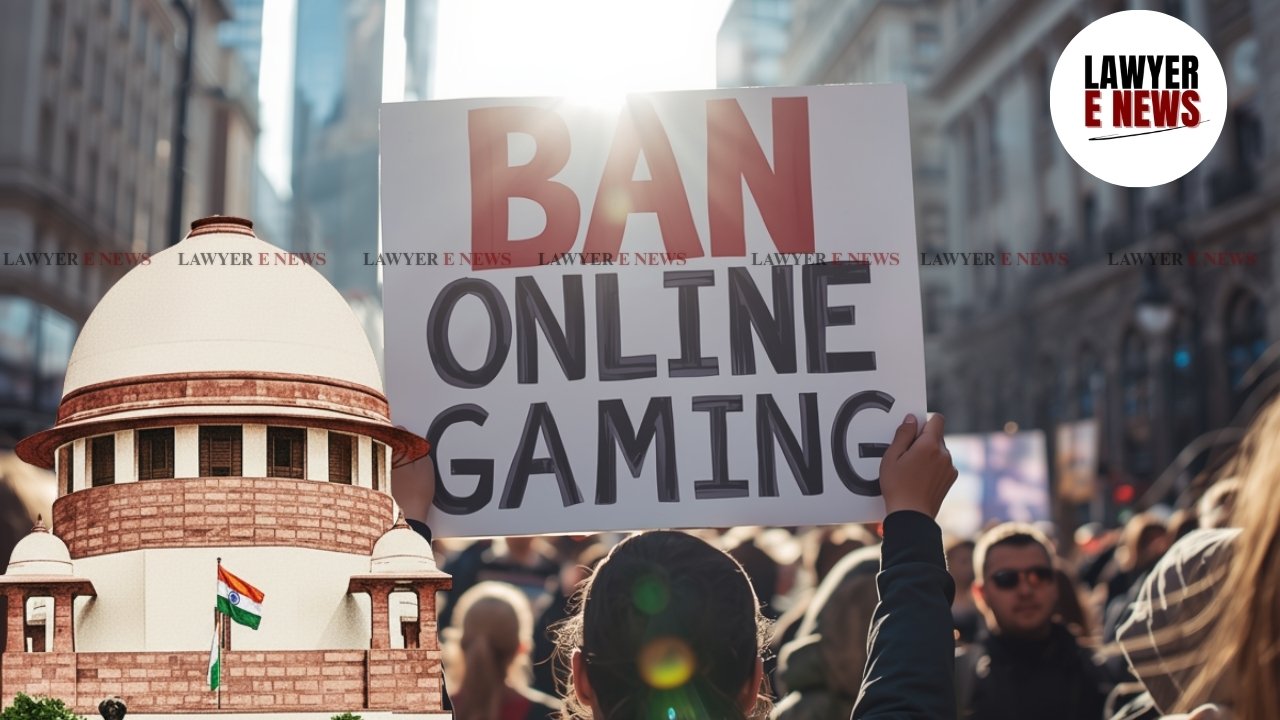
"Ruining of families and suicide deaths due to online gaming addiction affects public health, disturbs social order and prejudices the maintenance of public order," Supreme Court, in a landmark judgment, held that State Legislatures possess the constitutional competence to regulate or prohibit online gaming involving monetary stakes by invoking the heads of "Public Order" and "Public Health."
A bench comprising Justice J.B. Pardiwala and Justice R. Mahadevan observed that the "even tempo of community life" is severely impacted by the addictive nature of digital wagering. The Court emphasized that when digital activities cause widespread societal harm, they fall squarely within the State's regulatory domain under Entry 1 and Entry 6 of List II of the Seventh Schedule.
The appeals were preferred by the States of Tamil Nadu and Karnataka against judgments of the Madras and Karnataka High Courts, which had struck down legislative amendments banning online gaming for stakes. The High Courts had primarily held that "betting and gambling" under Entry 34 List II only covered games of chance, thereby protecting games of skill like Rummy and Poker from state interference. The States contended that the rapid rise of virtual gambling houses created a menace that necessitated a complete ban to prevent suicides and financial distress among the youth.
The primary question before the Court was whether the competence of the State Legislature to ban online gaming is derived solely from Entry 34 List II (Betting and Gambling), or if other entries like "Public Order," "Police," and "Public Health" also empower such legislation. The Court was also called upon to determine if the "even tempo of life" of the community is disturbed by the prevalence of online gaming platforms allowing betting with real money.
Wide Connotation Of Public Order In The Digital Age
The Supreme Court began its analysis by emphasizing that "Public Order" under Entry 1 of List II is an expression of wide connotation. It signifies the state of tranquility that prevails among members of a political society as a result of internal regulations. The bench relied on the foundational ruling in Romesh Thappar v. State of Madras, noting that public order is not merely the absence of disorder but the existence of peaceful social conditions enabling normal civic life.
Public Order Includes Prevention Of Social Unrest
The Court observed that in the context of online gaming, public order includes the State's compelling interest in preventing digitally mediated social unrest. The bench noted that the physical sense of public order must be interpreted broadly to address the cross-border and exponential impact of online gaming platforms. Justice Pardiwala remarked that "preventive legislation can be justified under 'public order' without epidemic evidence of harm" if the activity has the potential to disturb communal harmony or social stability.
The Potentiality Test: Disturbing The 'Even Tempo' Of Life
"Public order is the even tempo of the life of the community."
Applying the test laid down in Arun Ghosh v. State of West Bengal, the Court held that the true distinction between a 'law and order' issue and a 'public order' issue lies in the "potentiality" of the act. The bench observed that while a stray act might only affect an individual, the rampant prevalence of online gambling affects large sections of the community. This widespread impact on the "even tempo" of life justifies the invocation of public order powers by the State.
Addiction And Suicides As Grounds For Invoking Public Order
The bench took judicial notice of the factual basis provided by the States, including suicides linked to online gaming addiction and the resulting financial distress of families. The Court held that an activity that induces fear or panic or causes the abandonment of ordinary pursuits of life becomes a matter of public order. "The ruining of families and suicide deaths due to online gaming addiction affects public health, disturbs social order and prejudices the maintenance of public order," the Court noted.
Mental Health Is A Facet Of Public Health Powers
"States can justify legislative competence under public order since the mischief poses a threat to public mental health at large."
The Court further linked the ban to Entry 6 of List II, which deals with "Public Health." Referring to Sukdeb Saha v. State of Andhra Pradesh, the bench reiterated that the right to mental health is an integral part of the right to life under Article 21. It held that any activity detrimental to public health or constituting a manifest nuisance falls squarely within the State's competence. The "gaming disorder" recognized by the WHO as a persistent pattern of behavior warrants robust state intervention.
Social And Economic Disorder Justifies State Intervention
The bench drew a parallel with the S. Bagavathy case regarding the protection of depositors, noting that social and economic disorders which shake the public order are within the State's legislative field. The Court observed that online gaming platforms use "systematic inducement techniques" to ensure players bet more, leading to a "moral and material abandonment" of the youth. The State, acting as parens patriae, is obligated to protect vulnerable populations from such predatory online practices.
Online Platforms As Virtual Gambling Houses
The Court rejected the argument that games of skill are immune from regulation when played for stakes. It observed that every mobile phone has now become a "virtual common gambling house." Since the "algorithm for the random generators is known to the developers" and can be manipulated by AI, the distinction between skill and chance becomes blurred in the online environment. The bench held that the moment stakes are involved, the activity partakes the character of betting and gambling, making it res extra commercium.
Final Directions
The Supreme Court allowed the appeals and set aside the judgments of the Madras and Karnataka High Courts. It declared Part II of the 2021 TN Amendment Act and the 2021 Karnataka Amendment Act to be intra-vires the Constitution. The Court concluded that the States are empowered under Entry 1, 6, and 34 of List II to prohibit online gambling and regulate online games to protect the "future and livelihood of the population."
The ruling reinforces the sovereign power of States to police digital spaces when they threaten the socio-economic fabric of society. By expanding the definitions of "Public Order" and "Public Health" to include the management of digital addiction and financial exploitation, the Supreme Court has provided a robust constitutional framework for state-led tech regulation.
Date of Decision: 27 May 2026