
-
by sayum
28 August 2026 8:01 AM







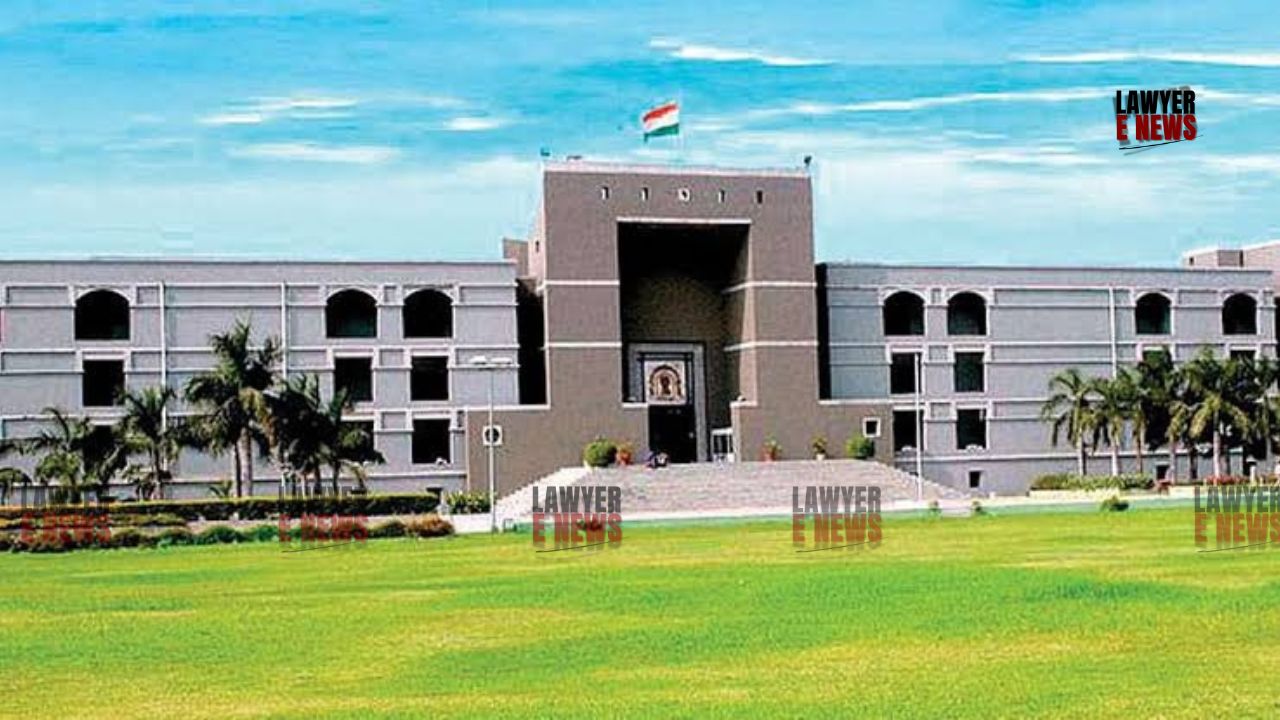
"In absence of the certificate under Section 65B(4) of the Evidence Act or Section 63(4) of the BSA, the Court cannot take decision in regards to admissibility of electronic evidence, the tape record in the present case, " Gujarat High Court, in a significant ruling, held that a Trial Court cannot order the Forensic Science Laboratory (FSL) to examine an audio recording or direct parties to provide voice samples without first determining the admissibility of such electronic evidence.
Justice J. C. Doshi observed that the production of a certificate under Section 65B(4) of the Evidence Act (now Section 63(4) of the BSA) is a "condition precedent" for the court to even consider secondary electronic records as admissible information.
The dispute arose from a Special Civil Suit for the specific performance of an oral agreement regarding the sale of a bungalow. The plaintiffs (respondents) claimed to have recorded telephonic conversations with the defendants (petitioners) to establish the existence of a concluded contract. The plaintiffs filed an application (Exh. 119) seeking to appoint the FSL Director to record voice samples of the defendants and compare them with the audio cassette produced on record.
The primary question before the High Court was whether the Trial Court could direct FSL examination and voice identification of an audio recording without first verifying compliance with mandatory certification requirements for electronic evidence. The court also examined whether an audio cassette, being a copy of a recording from a telephone instrument, constitutes secondary evidence requiring a certificate under Section 65B(4) of the Evidence Act.
Tape Recordings Fall Under The Definition Of 'Documents'
The High Court began by reiterating the established legal position that tape-recorded conversations are considered "documents" under Section 3 of the Evidence Act. Citing the Supreme Court’s decision in Tukaram S. Dighole v. Manikrao Shivaji Kokate, the bench noted that audio technology is a powerful medium for evidence but must be handled with extreme caution due to its susceptibility to tampering and doctoring.
Section 65B(4) Certificate Is A Condition Precedent For Admissibility
The court observed that the plaintiffs had not produced the original telephone instrument but had instead produced a tape record, which qualifies as "secondary evidence." Justice Doshi emphasized that the Trial Court had overlooked a vital issue: the mandatory nature of the certificate required for secondary electronic evidence. The bench noted that before admitting such evidence, the certificate is "necessary, essential, and mandatory."
Court Relies On Landmark Precedents Regarding Electronic Records
The bench referred to the Supreme Court's ruling in Arjun Panditrao Khotkar v. Kailash Kushanrao Gorantyal, which settled the law by holding that the issuance of a certificate under Section 65B(4) is a non-negotiable prerequisite. The court noted that even the recently enacted Bharatiya Sakshya Adhiniyam, 2023 (BSA), maintains this requirement under Section 63(4).
Trial Court Erred In Ordering FSL Examination Prematurely
The High Court found that the Trial Court committed a "patent illegality" by ordering the audio tape to be sent to the FSL for examination and directing the defendants to provide voice samples before the evidence was even proven admissible. The bench held that without the requisite certification, the court cannot take any decision regarding the admissibility of the electronic record.
"Production and proving of certificate under Section 65B(4) of the ‘Evidence Act’ would be a prerequisite for the Court to consider the electronic evidence as an admissible information."
Stringent Standards Of Proof For Voice Identification
Relying on Nilesh Dinkar Paradkar v. State of Maharashtra, the court highlighted that voice identification is often "suspect" and "unreliable" compared to visual identification. The bench noted that accuracy must be proved beyond reasonable doubt, and the court must be satisfied that the record has not been tampered with before placing any reliance on it.
"Evidence of voice identification is at best suspect, if not, wholly unreliable. Accurate voice identification is much more difficult than visual identification. It is prone to such extensive and sophisticated tampering."
The High Court concluded that the Trial Court's order was passed in ignorance of binding precedents and procedural requirements. Consequently, the High Court quashed the impugned order dated December 30, 2022, and remanded the application back to the Trial Court for a fresh decision in accordance with the law.
The ruling reinforces the mandatory nature of Section 65B(4) certification for electronic evidence in civil proceedings. It clarifies that expert examination and voice identification processes cannot bypass the fundamental legal requirement of proving the admissibility of secondary electronic records first.
Date of Decision: 08 May 2026





