
-
by sayum
28 July 2026 1:44 PM







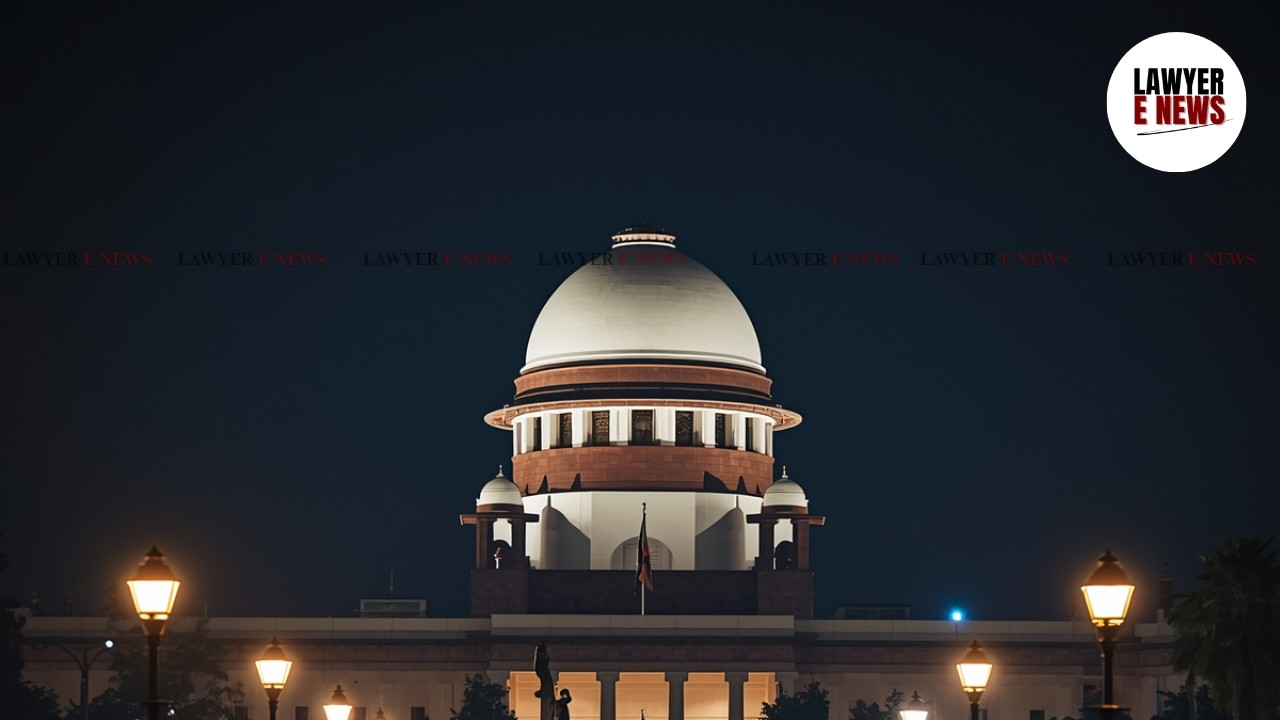
"Legislature in its wisdom has defined the grounds for disqualification in expansive terms... with the object of discouraging the practice of financial patronage that is inherently beneficial to the elected representatives," Supreme Court, in a significant ruling, held that a Sarpanch awarding contracts to a firm where their spouse is a partner constitutes a misuse of official authority warranting removal from office.
A bench of Justice Manoj Misra and Justice Vipul M. Pancholi observed that disqualification provisions in panchayat laws must be interpreted broadly to ensure administrative purity and discourage "financial patronage" by elected representatives. The Court emphasized that "probity in such financial transactions should be the rule rather than the exception."
The petitioner, Rekhaben Abhalbhai Bambhaniya, was removed from the post of Sarpanch under Section 57(1) of the Gujarat Panchayat Act, 1993, following allegations of misusing her authority. The primary charges involved awarding contracts to 'Maruti Stone', a firm where her husband was a partner, resulting in personal benefits amounting to over ₹13 lakh. Both the Single Judge and the Division Bench of the Gujarat High Court upheld the removal order, leading to the present Special Leave Petition.
The primary question before the Court was whether the award of a contract to a family member’s firm, even if through a public tender process, constitutes a misuse of the position of Sarpanch. The Court was also called upon to determine whether the non-supply of an internal inquiry report to the petitioner amounted to a violation of the principles of natural justice sufficient to set aside the removal.
Natural Justice Not A Mechanical Tool Where Facts Are Admitted
The petitioner contended that the District Development Officer (DDO) relied on a report from the Taluka Development Officer without providing her a copy, violating natural justice. The Supreme Court rejected this, noting that the underlying fact—the award of contracts to her husband's firm—was not denied. The bench observed that natural justice cannot be applied in a vacuum or in a mechanical manner.
The Court held that if the ultimate decision is sustainable on the admitted position and no prejudice is caused by the non-supply of material, interference with the final decision is not required. The High Court's finding that the petitioner suffered no prejudice because the core charge remained undisputed was upheld as correct and legally sound.
"Interference with the final decision is not required if no prejudice is caused by non-supply of any material, and the ultimate decision is sustainable on the admitted position."
Expansive Interpretation Of Disqualification Clauses
The petitioner argued that since the contracts were awarded after inviting public tenders and the husband's firm was the lowest bidder, no misuse of position occurred. The Court, however, pointed to Section 30(1)(g) of the Gujarat Panchayats Act, which disqualifies any member who "has directly or indirectly, by himself or his partner, any share or interest in any work done... or in any contract with" the panchayat.
The bench relied on the precedent in Virendrasing vs. Additional Commissioner and Ors. (2023) 18 SCC 438, which interpreted similar disqualification clauses. It noted that the use of terminology like "directly or indirectly" and "by himself or by his partner" was intended to cover all eventualities where an elected official might have a financial connection with the work of the local body.
"Too restrictive an interpretation to the disqualification clause would frustrate the very object for which it is incorporated in the statute."
Ensuring Purity Of Local Administration
The Court highlighted that the salutary purpose of Section 30 is to ensure the purity of administration in local bodies. It held that an elected representative has a "greater responsibility" to ensure that their close family members do not enter into contracts sanctioned by the very body they lead. The Court noted that nothing was on record to show any separation of residence between the petitioner and her husband.
In such circumstances, the bench found that the authorities were justified in concluding that the petitioner misused her position. The Court remarked that the objective of the statute is to discourage financial patronage that inherently benefits elected representatives, even if the husband's firm was technically the lowest bidder in a tender.
"Probity in such financial transactions should be the rule rather than the exception."
The Supreme Court concluded that based on the admitted position of the contractual awards to the spouse's firm, there was no fit case to interfere with the findings of the lower authorities. The bench held that the High Court was correct in refusing to intervene in the petitioner's removal. Consequently, the Special Leave Petition was dismissed.
Date of Decision: May 18, 2026