-
by sayum
24 October 2026 7:15 PM







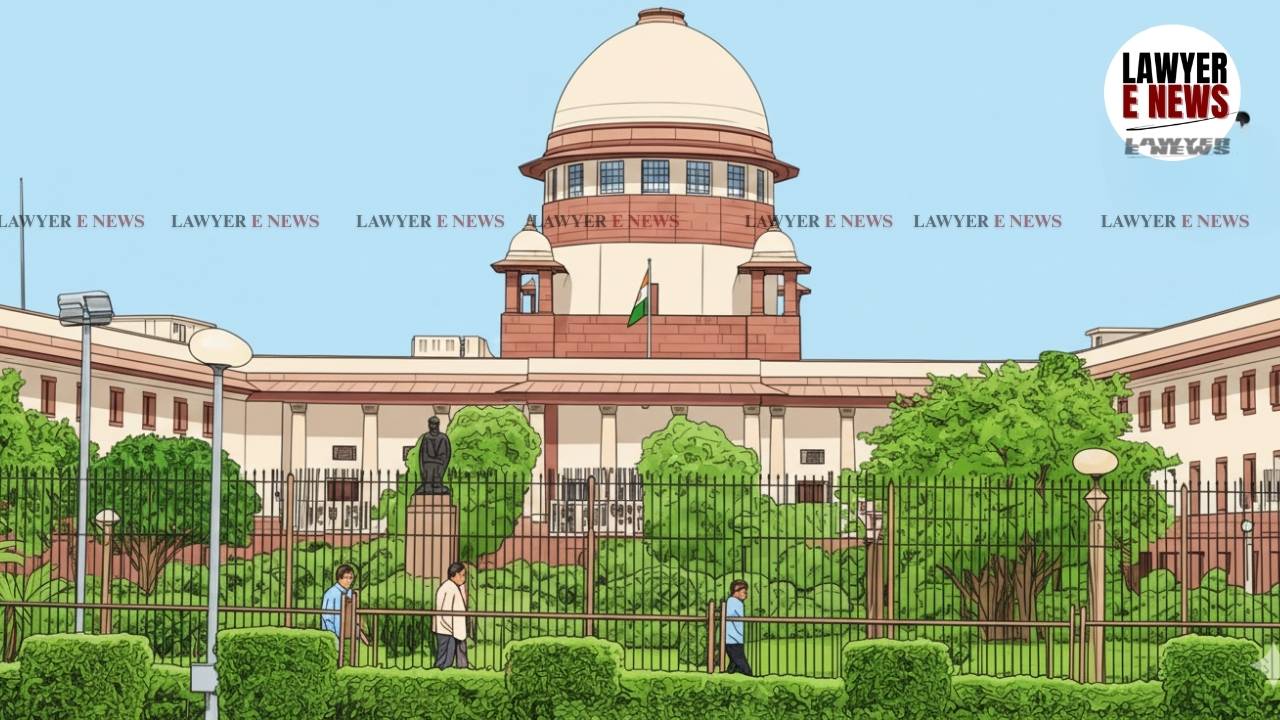
"Sanctity is the reward of legality, not a substitute for it. The principle of finality presupposes an auction conducted in accordance with law." Supreme Court, in a judgment dated September 30, 2026, held that an auction process initiated under the SARFAESI Act, 2002, which is marred by material irregularities and violates mandatory statutory procedures, cannot be sustained even after the confirmation of sale.
A bench comprising Justice Pamidighantam Sri Narasimha and Justice Alok Aradhe emphasized that the "extraordinary power" conferred upon a secured creditor to sell a property without court intervention is strictly hedged by procedural safeguards designed to protect the borrower. The Court observed that "a sale that disregards the procedure mandated by the statute is not a deprivation by the authority of law."
The litigation concerned the sale of a resort property by the Industrial Finance Corporation of India Limited (IFCI) following the borrower's default. During the protracted legal battle, the Debts Recovery Appellate Tribunal (DRAT) had issued a restraint order against the Authorized Officer (AO) from proceeding further under the SARFAESI Act, subject to certain conditions. Despite this, the AO accepted bids, concluded the sale, and issued a sale certificate in favor of a partnership firm that was not even in existence at the time of the auction. The High Court had initially upheld the sale, prompting the present appeal before the Supreme Court.
The pivotal question before the Court was whether the auction process, culminating in the issuance of a sale certificate, was conducted in strict conformity with the statutory framework governing such sales. The Court was further required to determine whether an auction sale, once confirmed and a certificate issued, can be set aside if it is found that the process was initiated or conducted in violation of a subsisting judicial restraint and mandatory rules under the SARFAESI Act and the Security Interest (Enforcement) Rules, 2002.
Receipt of Bids During Restraint Operates as Legal Nullity
The Court observed that the DRAT’s restraint order was of the "widest amplitude," and receiving bids in defiance of this order constituted a forbidden step. Relying on the principle that an act done in violation of a court order is bereft of legal effect, the bench noted that a subsequent favorable judgment could not retrospectively validate acts done during the currency of a restraint. "A bid received in contravention of a subsisting restraint cannot form the foundation of a valid sale," the Court ruled.
Violation of Mandatory Thirty-Day Notice Period
Analyzing the timeline, the Court found that the sale was concluded before the expiry of the mandatory thirty-day notice period prescribed under Rule 9(1) of the Security Interest (Enforcement) Rules. The Court held that the period of the judicial restraint must be excluded when computing this time, invoking the maxim actus curiae neminem gravabit. By failing to allow the borrower the full statutory window to redeem the asset, the AO struck at the "substantive right" protected under Section 13(8) of the SARFAESI Act.
Auction Certificate Issued to Non-Bidder Entity
The Court further noted a critical infirmity in the issuance of the sale certificate to a partnership firm that was not in existence at the time the bids were invited. Under Clause 2.1 of the auction notice and Rule 9(2) of the Rules, the sale must be confirmed in favor of the successful bidder who offered the highest price. Allowing a nominee, especially an entity that did not exist during the auction, to receive the certificate was held to be an indirect permission for an action that could not have been done directly.
"The cumulative effect of the foregoing infirmities is unmistakable. The bid was received in defiance of a subsisting restraint; the sale was concluded before the expiry of the mandatory thirty days’ period; the certificate was issued to an entity that neither submitted the bid nor existed on the date of the auction."
Finality of Auction Sales Subject to Legality
While the Court acknowledged that it has consistently cautioned against lightly setting aside confirmed auction sales to maintain public confidence, it clarified that this principle is not absolute. The Court observed that the sanctity of an auction sale is contingent upon its adherence to law. Where material irregularities or non-compliance with mandatory procedures are demonstrated, the court is not precluded from setting aside the sale, even after confirmation, to prevent the miscarriage of justice.
In its final direction, the Supreme Court quashed the High Court's judgment, allowed the borrower’s appeals, and dismissed the purchaser's appeals. Consequent to the finding that the entire auction process was vitiated by illegality, the Court declined to entertain the related contempt petitions and dismissed the special leave petition regarding the amalgamation scheme as it no longer survived for consideration.
Date of Decision: 30 September 2026