-
by sayum
26 October 2026 4:04 PM







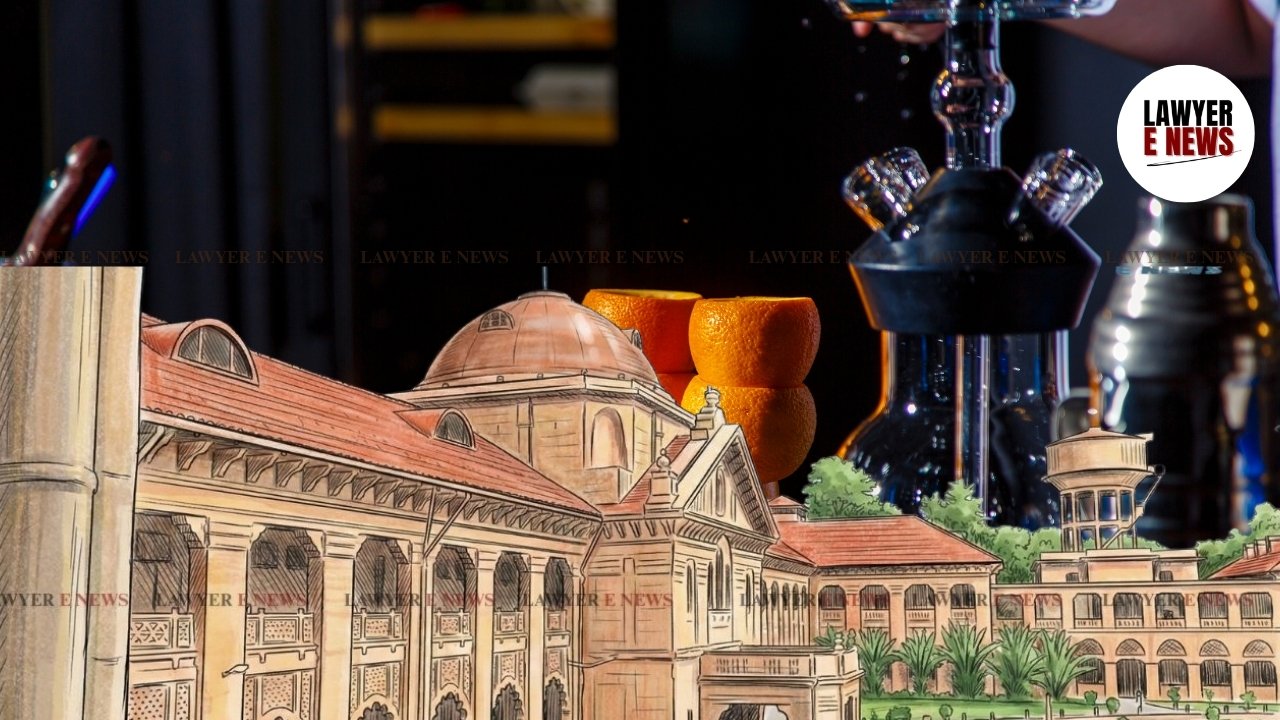
"The service of hookah in a Designated Smoking Area is, categorically, unconditionally, and absolutely prohibited under Rule 4(3) of Rules, 2008. Any establishment rendering such service is in clear and direct violation of the law." Allahabad High Court, in a significant judgment, held that the service of hookah in restaurants and hospitality establishments, even within designated smoking areas, constitutes a flagrant violation of the Cigarettes and Other Tobacco Products (Prohibition of Advertisement and Regulation of Trade and Commerce, Production, Supply and Distribution) Act, 2003 (COTPA).
A bench comprising Justice Shekhar B. Saraf and Justice Abdhesh Kumar Chaudhary observed that the 2017 amendment to Rule 4(3) of the Prohibition of Smoking in Public Places Rules, 2008, established an absolute and unqualified prohibition on any form of service within smoking areas.
Court Rejects 'Self-Service' and 'Rental' Arguments
The court emphatically rejected the petitioners' contention that providing hookah equipment under a "self-service" or "rental" model falls outside the ambit of "service." The bench observed that the preparation, assembly, lighting, and maintenance of a hookah require specialized human intervention and constant attention, which directly contravenes the "no service" mandate introduced by the 2017 amendment.
Court Finds Hookah Service Inseparable from Human Assistance
Addressing the "human hands doctrine," the court noted that the process of consuming hookah cannot be compared to smoking a cigarette, which requires minimal effort by the user. The bench stated that the "service" of hookah involves an elaborate procedure that is "intrinsically linked to smoking" and cannot be sanitized by merely reclassifying it as a rental transaction.
Interpretation of 'Regulation' Includes 'Prohibition'
The bench clarified that the power to "regulate" an activity under COTPA necessarily and inherently includes the power to "prohibit" that activity altogether when public health demands it. Relying on the precedent in G.K. Krishnan v. State of T.N., the court held that the legislature has the authority to impose progressive restrictions to protect non-smokers and public health, which is a fundamental duty under Article 47 of the Constitution.
"No Service" Amendment Overrides Previous Precedents
The court further ruled that the 2017 amendment to Rule 4(3) was a deliberate and rigorous legislative intervention that superseded the interpretation in Narinder S. Chadha v. Municipal Corpn. of Greater Mumbai. By removing the word "other" from the rule, the government intended to close any legal ambiguity that had previously enabled the proliferation of commercial hookah bars.
Designated Smoking Area is not a Commercial Service Zone
The bench emphasized that the exception provided in the proviso to Section 4 of COTPA for designated smoking areas must be read strictly and narrowly. The smoking area is not an extension of the restaurant's commercial service area; rather, it is a limited statutory exception designed solely to protect non-smokers from involuntary exposure to toxic substances.
Fundamental Right to Trade Subject to Public Health
The court underscored that the fundamental right to carry on trade or business under Article 19(1)(g) of the Constitution is not absolute and must yield to the more fundamental right of non-smokers to breathe clean air, as guaranteed under Article 21. The ruling dismissed all 80 connected writ petitions, effectively declaring the operation of hookah bars in restaurants across Uttar Pradesh to be illegal.
Call for Stringent Legislative Action
In a pointed epilogue, the court urged the State of Uttar Pradesh to follow the example of other states that have enacted specific, more stringent amendments to ban hookah bars and impose severe penal consequences. The judges observed that a single session of hookah smoking is equivalent in harm to 100 cigarettes, highlighting a regulatory gap that warrants immediate and urgent legislative attention to safeguard the youth.