-
by sayum
26 August 2026 12:18 PM







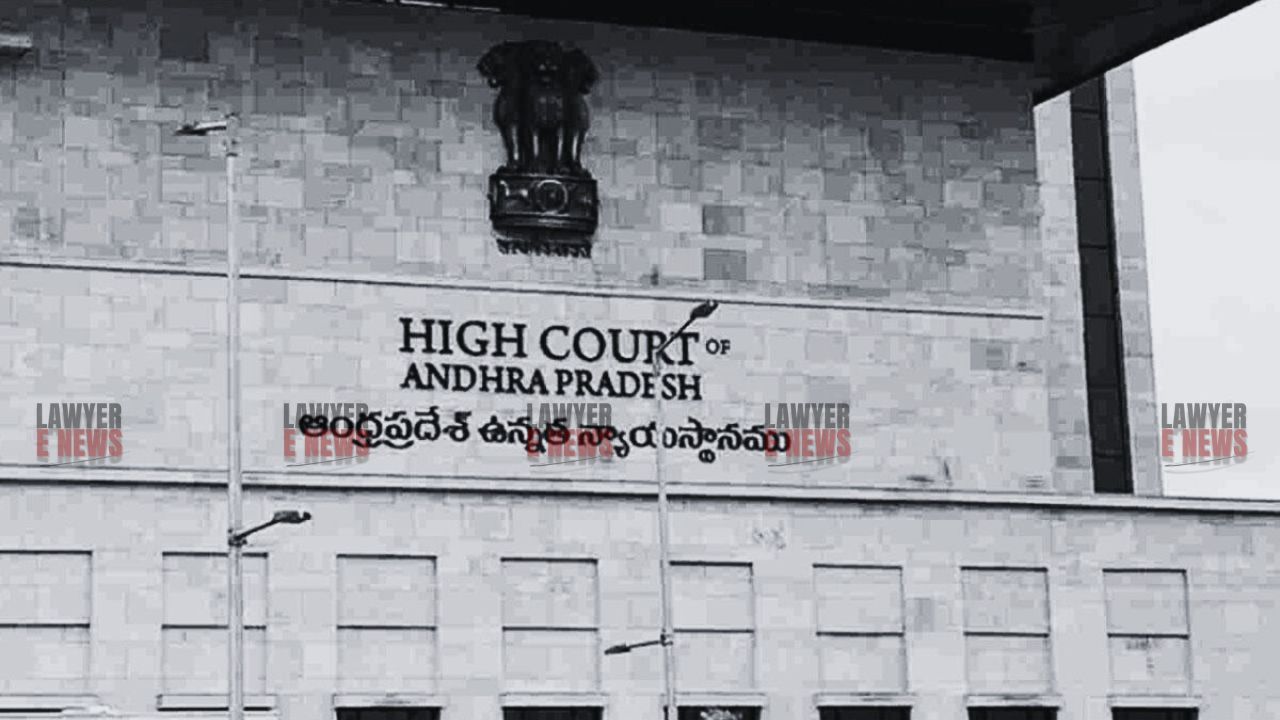
“Statutory Rules Introduced Midway Cannot Apply Retrospectively to a Recruitment Process Already in Motion”— In a recent Judgement Andhra Pradesh High Court restoring eligibility for over 50 in-service candidates who were suddenly rendered ineligible five days before their scheduled examination for the post of Village Horticulture Assistant (VHA). In a detailed and precedent-setting judgment, Justice Gannamaneni Ramakrishna Prasad declared the withdrawal of previously granted eligibility relaxations—through Corrigendum dated 30.01.2020 and Memo dated 01.05.2020—as "arbitrary, illegal and violative of Article 14 of the Constitution."
The Court emphatically held that the recruitment process, initiated when no statutory rules were in force, could not be altered retrospectively by the government through subsequent statutory amendments. “The rules of the game must remain constant once the process begins,” the Court reiterated, underscoring the sanctity of procedural fairness in public employment.
“State Cannot Shift Goalposts Midway” – Court Upholds Doctrine of Legitimate Expectation and Non-Arbitrariness in Public Recruitment
The genesis of the controversy lies in the recruitment drive for VHAs initiated by the Andhra Pradesh Government in 2019 under G.O.Ms.No.110, which introduced Village Secretariats to replace Gram Panchayats. Since no cadre or service rules existed at that time for VHAs, recruitment was carried out solely through executive instructions.
The first notification in 2019 sought to fill 4000 posts but concluded with only 2217 appointments. The Government then issued Notification No.1/Horti/2020 dated 10.01.2020 to fill the remaining 1783 posts. Originally, only candidates with 4-year B.Sc (Horticulture) or a 2-year Diploma in Horticulture were eligible. However, through a Corrigendum dated 30.01.2020, the Government relaxed these norms, allowing in-service candidates with B.Sc (BZC), B.Sc/M.Sc with Horticulture as one subject, and even 37 MPEOs with B.Sc (Agriculture) to apply.
These relaxations were later reaffirmed via Memo dated 01.05.2020, which specifically permitted B.Sc (Agriculture) MPEOs to participate. Candidates applied, received hall tickets, and prepared to write the exam scheduled for 25.09.2020.
Yet, on 20.09.2020, just five days before the examination, the Government abruptly withdrew the relaxations through a public memo. Another unpublished memo dated 06.10.2020 secretly revoked the earlier 01.05.2020 memo, without even notifying the public. These sudden reversals triggered a wave of litigation.
“Executive Instructions Were Binding in Absence of Rules—Mid-Process Changes Violate Article 14”
Justice Ramakrishna Prasad observed that as of the date of the 2020 notification, no statutory service rules existed for the newly created VHA posts. These rules came into force only on 19.06.2020, via G.O.Ms.No.64, published in the Gazette on 20.06.2020.
The Court noted:
“The above facts would clearly indicate that as on the date of notification, there were no statutory Rules in force. On the contrary, the Government contemplated to make recruitment to the newly created cadre of Village Horticulture Assistants only by way of Executive Instructions.”
The Court relied on multiple precedents, including Tej Prakash Pathak v. Rajasthan High Court [(2025) 2 SCC 1], P. Mahendran v. State of Karnataka [(1990) 1 SCC 411], and Union of India v. Uzair Imran [2023 SCC OnLine SC 1308], to hold that eligibility norms cannot be changed after the recruitment process has begun. Quoting from P. Mahendran, the Court affirmed:
“Since the amending Rules were not retrospective, they could not adversely affect the right of those candidates who were qualified for selection and appointment on the date they applied.”
The government’s last-minute revocation of relaxations was therefore termed “a clear breach of constitutional fairness” and an “impermissible shifting of goalposts”.
“Unpublished Withdrawal of Eligibility Memo is Unconstitutional and Void”—Opaque Governance Rejected
While examining the Memo dated 06.10.2020, through which the Government rescinded its earlier approval to allow 37 B.Sc (Agriculture) MPEOs to participate, the Court found that the memo had never been published in any public forum or newspaper.
“The cancellation of the Memo dated 01.05.2020 was not made known to the public by publication in the newspapers. This Court has no hesitation in holding that the publication of the said Memo was improper and suffers from non-transparency.”
Calling the withdrawal “clandestine” and “procedurally defective”, the Court held it void for non-compliance with principles of natural justice. It stressed that state action impacting rights of individuals must be transparent, fair, and notified.
“Recruitment Must Be Based on Merit—Petitioners Who Wrote Exam Under Court Orders Are Entitled to Selection”
A significant observation was made regarding the right of the petitioners who appeared in the exam under interim orders of the Court. The High Court held:
“The ultimate merit of a candidate coupled with suitability is reflected from the result obtained… This Court sees no reason to keep them out or deprive them from availing such opportunity since their capability is reflected through the marks and the ranking obtained.”
The Court relied on Uzair Imran, where the Supreme Court held that a candidate who has undergone the entire selection process and made it to the merit list acquires a "limited right of fair and non-discriminatory treatment", even if the employer is not bound to appoint him.
"Earlier Judgments Not a Bar—Present Legal Issues Are New and Not Previously Decided"
The Government argued that the matter had already been adjudicated in W.P. No. 16670 of 2019 and W.P. No. 1908 of 2020, with review petitions also dismissed. However, the Court clarified:
“This Court is of the view that the issues that arise in the present batch of Writ Petitions are completely different… and therefore, the issue of res judicata does not arise.”
It pointed out that the earlier petitions had not dealt with the legal validity of the withdrawal of relaxations or the impact of applying newly framed statutory rules to a prior process, and thus those rulings were not binding precedents on these specific questions.
Relaxations Restored, Selection to Proceed on Merit—No Back Wages but Notional Seniority Granted
In the concluding part of its 175-page judgment, the High Court ruled:
“The Corrigendum dated 30.01.2020 and Memo dated 01.05.2020 are held to be legally valid. It is also held that the statutory Rules (G.O. Ms. No. 64 dated 19.06.2020) shall not have any bearing on the recruitment process undertaken under Notification No. 1 of 2020 dated 10.01.2020.”
The Court directed that:
The merit list must be published for the petitioners, if not already done.
Results must be processed and selection finalised based on merit.
Seniority must be accorded notionally from the date of appointment.
However, no back wages shall be paid.
The entire process must be completed within 12 weeks.
A Victory for Constitutional Fairness and Transparency in Public Employment
This judgment reinforces a long-standing constitutional principle—that public employment must be governed by fairness, transparency, and the rule of law. By restoring the eligibility of candidates whose rights were curtailed just days before the examination, the Andhra Pradesh High Court has sent a clear message that administrative convenience cannot override legal certainty and that recruitment processes are not a game of shifting goalposts.
As Justice Ramakrishna Prasad observed, “Once a process of selection starts, the prescribed selection criteria cannot be changed. The logic behind this is based on fair play.”
Date of Decision: 27.10.2025