-
by sayum
26 August 2026 4:43 AM







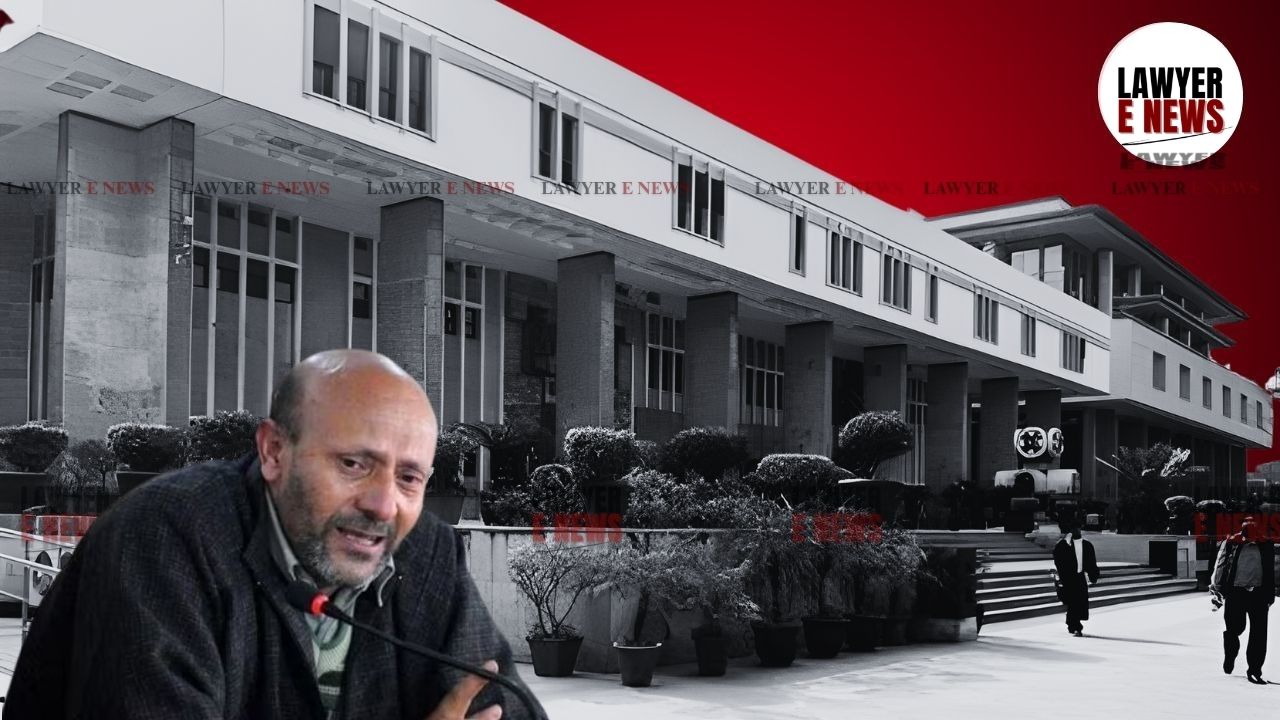
“A Parliamentarian in valid judicial custody has no special right or privilege to attend legislative sessions. Freedom of speech in Parliament exists only when present within the House.” — In a significant judgment rendered on 7 November 2025, a Division Bench of the Delhi High Court comprising Justice Vivek Chaudhary and Justice Anup Jairam Bhambhani dismissed criminal appeals filed by Abdul Rashid Sheikh, a sitting Member of Parliament from Jammu & Kashmir, against the imposition of escort-related expenses while he was permitted custody parole to attend Lok Sabha sessions under the Unlawful Activities (Prevention) Act, 1967.
In CRL. A. No. 299/2025, CRL.A. No. 1045/2025, and accompanying application CRL. M.A. 9483/2025, the Court examined whether a detained MP has a legal or constitutional entitlement to attend Parliament sessions, and whether the State can impose costs for custodial travel and security arrangements.
The Court held no such right exists under the Constitution or law once a Member is under valid judicial custody. It further clarified that parliamentary privileges under Article 105 do not protect a detained MP's absence, and his “public duty” to represent constituents does not override custodial restrictions.
“No Fundamental or Constitutional Right to Attend Parliament While in Custody” – Parliamentary Privileges Don’t Override Judicial Detention
Justice Vivek Chaudhary, in a separate but concurring judgment, traced the jurisprudence from K. Ananda Nambiar v. Chief Secretary to the Govt. of Madras (AIR 1966 SC 657) to reaffirm that lawful custody overrides any claim to legislative participation. The Court stated:
“Once a Member is in valid custody, no constitutional or statutory provision guarantees him the right to attend parliamentary proceedings.”
Quoting extensively from Ananda Nambiar, the Court rejected arguments based on Article 105 (freedom of speech in Parliament), Article 99 (oath), or Article 102 (disqualification) of the Constitution, stating:
“The rights of a Member under Articles 99 and 105 arise only when he is physically present in the House. A lawful detention prevents such participation and there is no breach of privilege in such a case.”
The Court also relied on Suresh Kalmadi v. Union of India, where a similar plea was rejected. It held that courts should not grant parole solely on the basis of a Member’s representative character when no constitutional right is involved.
“Parole Is Not for Politics — Delhi Prison Rules Do Not Recognize Parliamentary Duties as Emergent Grounds”
The Court examined Rules 1203 to 1206 of the Delhi Prison Rules, 2018, and noted that custody parole is permissible only in emergent and personal circumstances, such as death, marriage, or serious illness in the family.
“Parliament sittings in the regular course do not constitute emergent situations under Rule 1203,” the Court held.
Thus, granting custody parole for political purposes would be an indirect circumvention of settled law, invoking the principle “quando aliquid prohibetur ex directo, prohibetur et per obliquum” — what cannot be done directly, cannot be done indirectly.
The Court noted that both the 25.03.2025 order of the Division Bench and the later 22.07.2025 order of the Special Judge allowing Sheikh to attend Parliament were discretionary, not rights-based, and cannot be treated as binding precedents for future sessions.
“Costs Imposed Cannot Include Police Salaries – Escort Expense Limited to ₹2,056 per Day”
While dismissing Sheikh's request to completely waive the expense imposed for availing custody parole, Justice Anup Jairam Bhambhani allowed modification of the cost condition, holding that the State’s demand of ₹1.45 lakh/day — including per diem salaries of 14 police officials — was legally unsustainable.
“The appellant shall only be liable to pay the actual cost of jail van and escort vehicle — ₹1,036 + ₹1,020 = ₹2,056 per day,” the Court clarified.
Rejecting the State's reliance on Sections 38, 39, and 40 of the Delhi Police Act, 1978, the Court ruled these provisions apply only when additional police are deployed for public order or on request by private parties, not when the State itself insists on escorting an undertrial to Parliament.
It observed:
“The State cannot charge the accused for deploying police whose salaries are anyway paid from public funds. To ask for such payment amounts to seeking a double salary for public officials.”
“Review Bar Under BNSS Does Not Apply to Condition Modification” — Court Invokes Inherent Powers Under Section 528 BNSS
The State argued that any modification of the earlier order would violate Section 403 of the BNSS (analogous to Section 362 CrPC), which bars review of criminal judgments.
Justice Bhambhani rejected this argument:
“The appellant is not challenging the merits of the order. He is seeking clarification of a condition, which does not constitute review.”
Relying on Usmanbhai Dawoodbhai Memon (1988) 2 SCC 271, and Ramadhar Sahu v. State of Madhya Pradesh, the Court ruled that conditions of bail or parole can be varied, and that such powers are inherently available under Section 528 BNSS, akin to Section 482 CrPC.
“No Refund for Earlier Payments – Future Parole Requests Must Follow Law”
While limiting future cost liability, the Court refused to refund past payments made by Sheikh for attending Parliament in March-April 2025, clarifying that benefit already availed cannot be undone retrospectively.
Further, the Court noted that nothing in this judgment prevents Sheikh from seeking fresh custody parole or interim bail in the future, which must be considered on its own merits and within existing legal frameworks.
Public Duty Cannot Trump Judicial Custody – No Special Privilege to Attend Parliament While Under Trial for UAPA Offences
This judgment is a clear assertion of constitutional limits on parliamentary privileges and public duties when juxtaposed with criminal custody under grave charges. The Delhi High Court has struck a balance — affirming the court’s discretion to permit attendance, while categorically denying any legal or constitutional entitlement to it.
It also establishes that while States may recover reasonable costs, they cannot commercialize constitutional processes by demanding exaggerated sums under the guise of security.
“The duty of a Member of Parliament, however solemn, cannot be performed at the cost of statutory limitations and public justice,” the Court said.
Date of Decision: 07 November 2025