-
by sayum
28 August 2026 8:44 AM







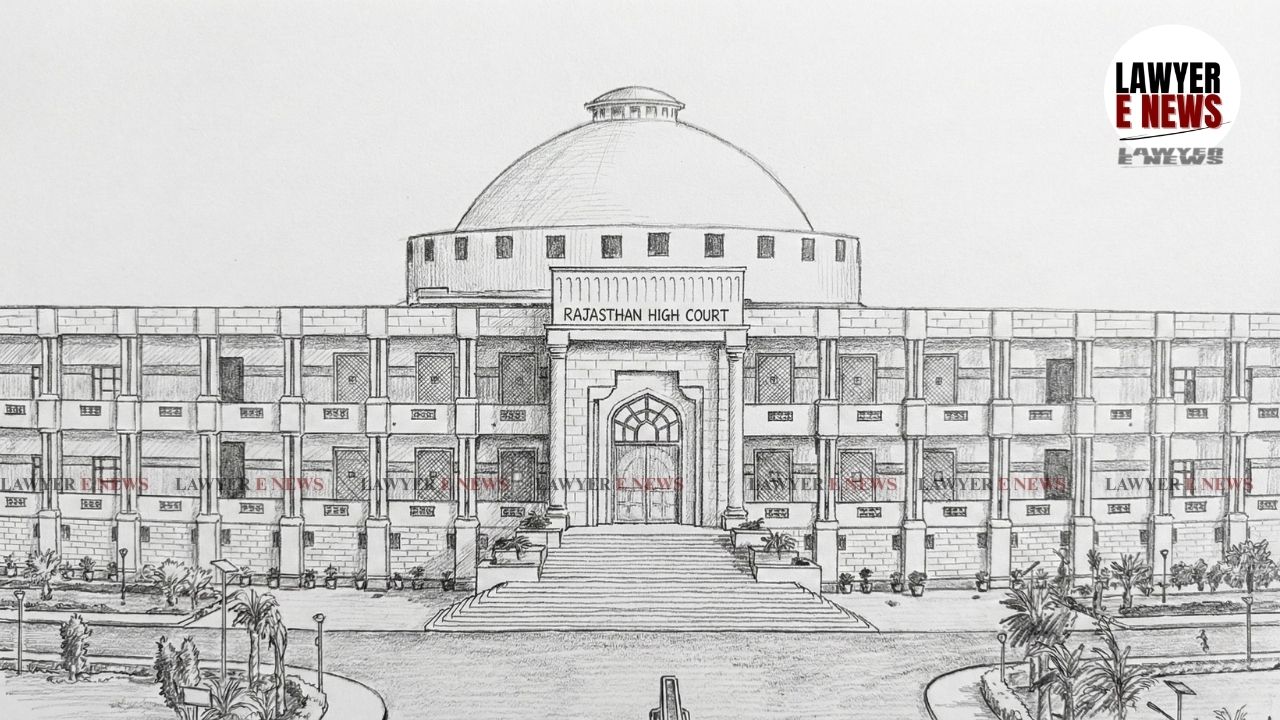
"Practice of subjecting an accused to public condemnation through media exposure, staged photographs, or other such acts amounts to an extra-legal penalty. It is neither contemplated nor recognised by law," Rajasthan High Court, in a significant judgment, has ruled that the police have no authority to subject accused persons to public humiliation, parading, or "media trials," labeling such acts as unconstitutional usurping of judicial power.
A Single Judge Bench of Justice Farjand Ali observed that the right to life under Article 21 of the Constitution of India encompasses the right to live with dignity, which cannot be sacrificed at the altar of sensationalism or "police-driven media narratives."
The petitioner, Puranmal, approached the High Court alleging that after being picked up by police in plain clothes, he was taken to Police Station Merta City, where officials forcibly shaved his head, dressed him in women’s clothing, and paraded him through a crowded marketplace. Photographs and videos of the incident were subsequently circulated on social media, which the petitioner claimed caused irreparable damage to his reputation and dignity.
The primary question before the court was whether the police, under the guise of investigation, possess the authority to subject an arrestee to public humiliation or parading. The court was also called upon to determine if orchestrated media exposure by law enforcement agencies constitutes an extra-judicial punishment that violates the fundamental rights guaranteed under Articles 14, 19, and 21 of the Constitution.
Court Rejects Police Explanation As Illogical
The Superintendent of Police (SP), Nagaur, appearing in person, contended that the petitioner was already wearing female attire at the time of arrest to evade identification. However, the Court found this explanation "wholly implausible" and contrary to ordinary human conduct.
Justice Farjand Ali noted that it does not appeal to reason that a person seeking to avoid identification would voluntarily shave his head, wear women's clothing, and then permit himself to be paraded through a crowded market. The bench remarked that such an explanation appeared to be a prima facie attempt to "gloss over" an incident that strikes at the core of human dignity.
Police Cannot Arrogate The Role Of A Judge
The Court emphasized that the doctrine of separation of powers prevents the Executive from encroaching upon the domain of the Judiciary. The function of determining guilt and awarding punishment is the exclusive domain of the courts, and any attempt by the police to subject an accused to public opprobrium amounts to a "manifest abuse of authority."
Confidence in the justice system is built upon adherence to due process, not upon the "spectacle" of public humiliation. The police, being an instrumentality of the State, are bound by constitutional discipline and cannot assume the role of a judge in the court of public opinion.
The Pernicious Impact Of Police-Driven Media Trials
The bench took a stern view of "media trials by police," describing them as State-engineered narratives where police machinery seeks to project an accused as culpable even before the due process of law begins. Such conduct transgresses the presumption of innocence, which stands as a bulwark against arbitrary State action.
The court observed that in the digital age, the consequences of such institutional humiliation are neither fleeting nor reversible. Referring to the Greek concept of the "Ship of Theseus," the court noted that a person once exposed to such degradation does not remain the same, as digital records inflict deep and irreparable psychological scars.
Reputation Is An Intrinsic Part Of Right To Life
Citing the Supreme Court’s ruling in Umesh Kumar v. State of Andhra Pradesh, the High Court reiterated that the right to reputation is a facet of personal security protected under Article 21. While the freedom of the press under Article 19(1)(a) is a cherished right, it must yield when its exercise results in the denial of a fair trial or the contamination of witness testimony.
Court Condemns "Perp Walks" And Extra-Legal Penalties
The Court noted that Section 53 of the IPC (now Section 4 of the Bharatiya Nyaya Sanhita) exhaustively prescribes the nature of punishments that can be imposed by law. Public parading, disrobing, or forced posing with self-incriminating placards find no sanction in the statutory framework and constitute "extra-legal penalties."
Punishment must follow conviction and cannot precede it. The power to investigate does not encompass the power to declare guilt, and any act of social media condemnation facilitated by police authorities must be construed as an illegal form of punishment that erodes public trust.
Mandatory Guidelines For Law Enforcement
In view of the recurring instances of custodial humiliation, the Court issued a series of mandatory directions. It ordered that no individual with an unblemished record shall be subjected to public parading or degrading treatment. Furthermore, police officials are expressly prohibited from engaging in or abetting social media condemnation of arrestees.
The Court directed that these guidelines be prominently displayed at all police stations and official web portals as "Do's and Don'ts." Any deviation from these Standard Operating Procedures (SOPs) will invite appropriate and proportionate action against the erring police officials.
Disposing of the petition, the Court refrained from proceeding further against the officials after receiving an assurance from the SP Nagaur that such incidents would not be repeated. However, it reserved liberty for the petitioner to institute separate proceedings for damages and compensation for the violation of his fundamental rights.
Date of Decision: 27 May 2026