
-
by sayum
25 August 2026 12:32 PM







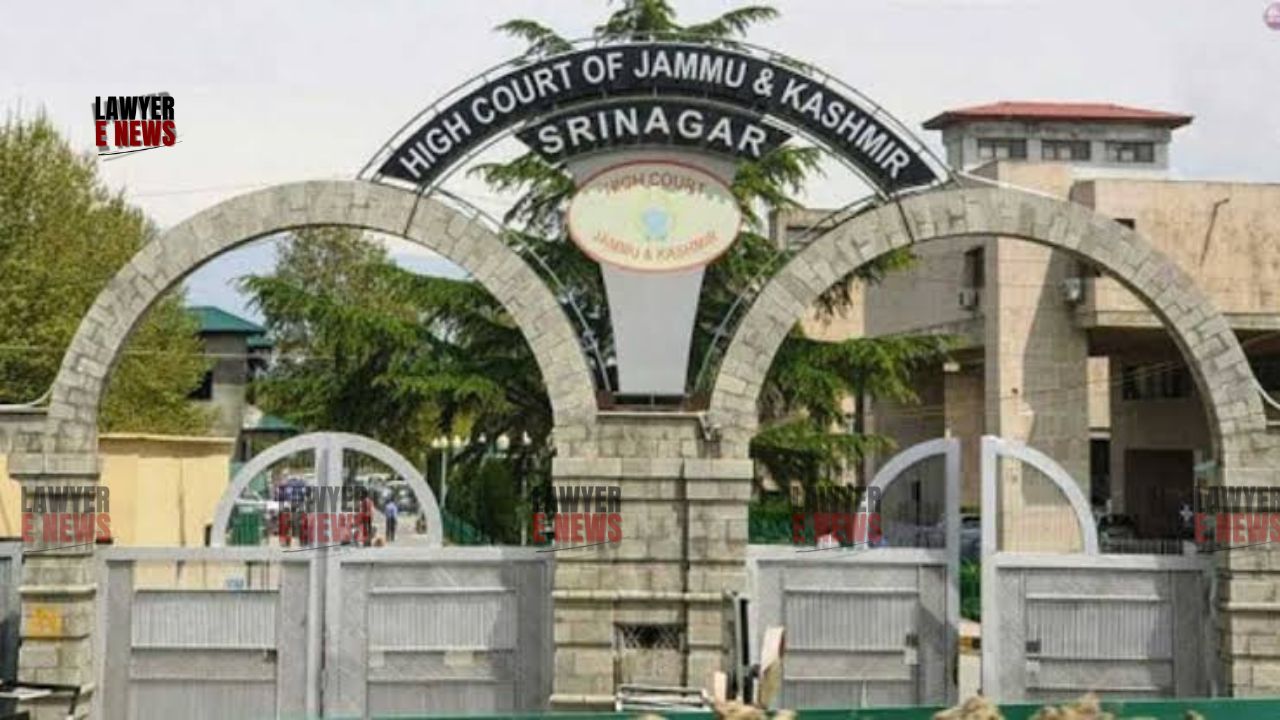
In a judgment underscoring the foundational principle of service jurisprudence, the High Court of Jammu & Kashmir and Ladakh at Jammu has ruled that dependents of a dismissed Central Reserve Police Force (CRPF) officer are not entitled to back wages for the period of his unauthorized absence. The Court clarified that the earlier direction to release pensionary benefits did not imply a mandate for back wages, which are not automatic unless actual service is rendered.
Division Bench comprising Chief Justice Arun Palli and Justice Rajnesh Oswal dismissed an intra-court appeal challenging the denial of back wages and reiterating a limited direction to consider compassionate appointment of the deceased officer’s daughter.
The case revolved around key service law doctrines — particularly the application of the “No Work – No Pay” rule, the limits of relief under Article 226 of the Constitution, and the scope of pensionary and compassionate benefits under CRPF service rules.
“Only Relief That Would Now Flow Is the Monetary Benefits to the Dependents”: Court Clarifies Scope of Earlier LPA Judgment
The High Court was called upon to decide whether the dependents of deceased CRPF Inspector Ram Parkash Singh, who was dismissed for unauthorized absence, were entitled to back wages from 9 June 2001 to 22 October 2007 — a period during which he did not render any service.
The Court traced the procedural history, noting that Singh’s dismissal on 18 March 2004 for prolonged unauthorized absence was initially challenged before the Writ Court in SWP No. S650/2005, which directed the respondents to pass fresh orders in compliance with service rules. That judgment was upheld in LPA(SW) No. 169/2011 on 22 November 2011, with the Division Bench merely directing the release of monetary benefits as per Annexure-F (Pension Calculation Chart).
Rejecting the appellant’s argument that this amounted to a direction for back wages, the Court held:
“There is no direction by the Division Bench in its judgment dated 22.11.2011 in respect of payment of back wages. This is an admitted fact that the husband of the appellant did not perform any duty w.e.f. 09.06.2001 to 18.03.2004... the only relief which the appellant and other dependents of the deceased were held entitled to, was the monetary benefits in terms of Annexure-F (Pension Calculation Chart).”
“No Work – No Pay” Principle Reaffirmed Even After Quashing of Dismissal
Crucially, the Court reaffirmed that the “No Work – No Pay” principle survives even where a dismissal is subsequently quashed or modified, especially where the employee was admittedly absent from service. In this case, since the deceased officer had not rendered any service between 2001 and 2007 — and died before any fresh inquiry could be initiated — the Court found no justification for awarding salary for that period.
“We do not find any error... by rejecting the claim of the appellant for back wages for the period, the husband of the appellant did not perform any work... Having already accepted the pensionary benefits... the appellant now cannot turn around and claim the salary for the period her husband did not work.”
Further, the respondents had already treated the absence from 9.6.2001 to 22.10.2007 as “duty without wages” purely for the purpose of calculating pension, which the Court deemed both lawful and appropriate.
Compassionate Appointment Can Only Be Considered, Not Guaranteed: Court Declines to Issue Mandamus
The appellant had also sought enforcement of a compassionate appointment for her daughter, citing earlier observations of the Writ Court. However, the Division Bench held that no mandamus (binding direction to appoint) could be issued and that consideration under the applicable policy was the appropriate remedy.
The Court examined the steps already taken by the authorities, including multiple communications inviting the deceased officer’s daughter to apply for recruitment to eligible Group-C posts in lieu of the unavailable Group-B post (SI/Crypto) she originally sought. The daughter had appeared in a 2021 recruitment but failed the test.
“The daughter of the appellant, if eligible, can still be considered in terms of the policy of the respondents.”
Reiterating the Writ Court's direction without modifying it, the Bench clarified:
“We dispose of this appeal by reiterating the direction issued by the learned Writ Court in respect of providing compassionate appointment to the family member of the deceased employee but of course, if the said member is found to be eligible in accordance with applicable service rules.”
Pensionary Relief Upheld, Back Wages Denied, Compassionate Appointment Open to Consideration
With this judgment, the High Court has reinforced the established service law doctrine that entitlement to wages must be based on actual service, and that pensionary relief does not equate to salary for periods of unauthorized absence. The judgment also carefully distinguishes between consideration for compassionate appointment and an automatic right to be appointed, thus preserving the sanctity of service regulations while ensuring procedural fairness.
The appeal was accordingly disposed of, with no interference in the lower court's refusal to grant back wages, and with a reiteration — not expansion — of the direction to consider a dependent family member for compassionate appointment, subject to eligibility.
Date of Decision: 13 November 2025





