-
by sayum
25 August 2026 12:32 PM







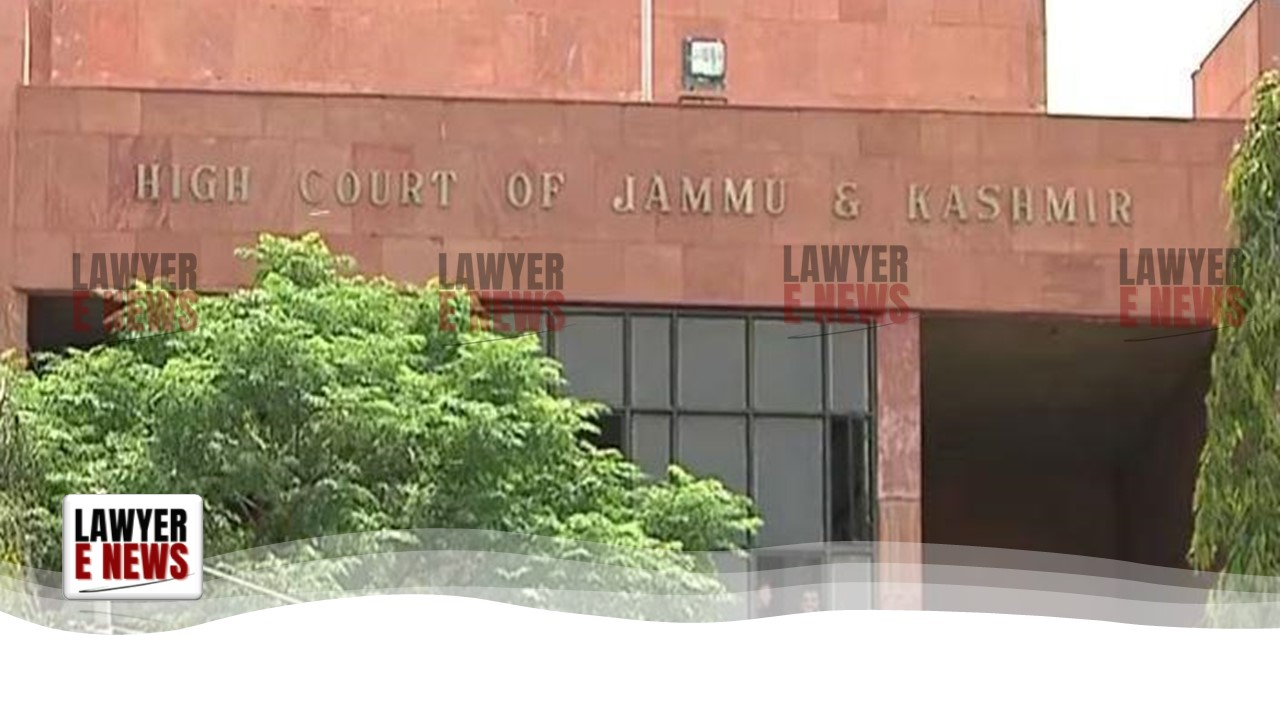
“Plaintiff’s Claims Are Self-Defeating, Entire Pleadings Vague and Unsupported by Legal Right” - In a significant ruling reinforcing the foundational requirement of locus standi and cause of action in civil litigation, the High Court of Jammu & Kashmir and Ladakh dismissed an appeal challenging the trial court’s rejection of a suit under Order VII Rule 11 of the Code of Civil Procedure, 1908, for failing to disclose any legal right or actionable claim. Justice Rahul Bharti holding that the appellant had “nowhere pleaded and shown as to how the suit property is legally related to him so as to earn a right to sue.”
The judgment underscores that right to sue is the sine qua non of a valid civil action, and in the absence of a clear connection to the disputed property, “the plaint is self-inviting its rejection.” The Court found that the suit was devoid of any factual assertion establishing ownership, title, or even a legitimate claim, rendering the entire litigation legally hollow and procedurally unsustainable.
“Entire Reading of the Plaint Yields Not a Single Line Connecting Plaintiff to the Property”: Court Finds No Locus or Title Pleaded
The case originated from a suit filed by Sunil Singh, seeking a declaration that a series of gift deeds and powers of attorney involving various relatives concerning a residential property in Talab Tillo, Jammu, were null and void. The appellant sought to invalidate transactions made by or between his father, uncle, and other family members, alleging fraud, and further claimed entitlement to the suit property.
However, the trial court rejected the suit at the threshold under Order VII Rule 11 CPC on 2 August 2021, holding that the plaint did not disclose how the plaintiff was legally connected to the property or had any cause of action to sue.
Upon appeal, Justice Rahul Bharti conducted a detailed analysis of the plaint, only to find that the appellant had “lost himself in his own jugglery of averments,” making vague, self-contradictory, and unsubstantiated claims without legally grounding his standing.
The Court observed:“Entire reading of the plaint inside out nowhere comes up with a single line whisper as to how the appellant/plaintiff is to be reckoned as owner/claimant of the suit property.”
The Court further stated that: “Right to sue is an essential ingredient of cause of action. If there is no right to sue, there cannot be a disclosure of a cause of action. This proposition of law is as simple as it can be.”
“Courts Must Prevent Misuse of Judicial Time on Suits Destined to Fail”: Reiterates Supreme Court Precedents
In reinforcing the principle that Order VII Rule 11 CPC acts as a judicial filter to prevent frivolous or baseless litigation, the Court extensively relied on landmark judgments of the Supreme Court including:
Raj Narain Sarin v. Laxmi Devi (2002) 10 SCC 501
Dahiben v. Arvindbhai Kalyanji Bhanusali (2020) 7 SCC 366
Kuldeep Singh Pathania v. Bikram Singh Jaryal (2017) 5 SCC 345
Azhar Hussain v. Rajiv Gandhi, 1986 (Supp) SCC 315
Vishnu Dutt Sharma v. Daya Sapra (2009) 13 SCC 729
The Court noted: “The power under Order VII Rule 11 CPC... is to ensure that a litigation which is meaningless and bound to prove abortive should not be permitted to waste judicial time of the court.”
The Court held that although rejection of a plaint is a drastic step, it becomes a judicial necessity when the plaint fails to plead even the foundational facts to establish a cause of action, and that civil suits are not to proceed based on presumptions or implied connections.
The Court clarified that a plaintiff cannot challenge documents or seek invalidation of legal transactions between third parties without establishing his own standing. Mere allegations of fraud, however emotionally compelling, do not confer a right to sue unless tied to a legal relationship or ownership claim.
No Legal Foundation, No Right to Relief
In dismissing the appeal, the Court categorically affirmed the trial court’s approach and upheld the application of Order VII Rule 11 CPC, declaring that the rejection of the suit was legally sound and procedurally correct. All connected contempt petitions and interlocutory applications were also dismissed.
Justice Bharti summed up the judicial rationale in unmistakable terms:“If the facts put up in a factual statement in the plaint are presenting or introducing no cause of action, then a civil court has no discretion reserved to it... the plaint is self-warranting its rejection.”
The judgment serves as a judicial reminder that access to civil courts under Section 9 CPC is not unfettered, and that the burden lies on the plaintiff to plead a clear, legally viable cause of action. Failing that, the courts are not obliged to expend time and resources on litigation that is destined to fail at inception.
Date of Decision: 08.11.2025