-
by sayum
25 August 2026 11:12 PM







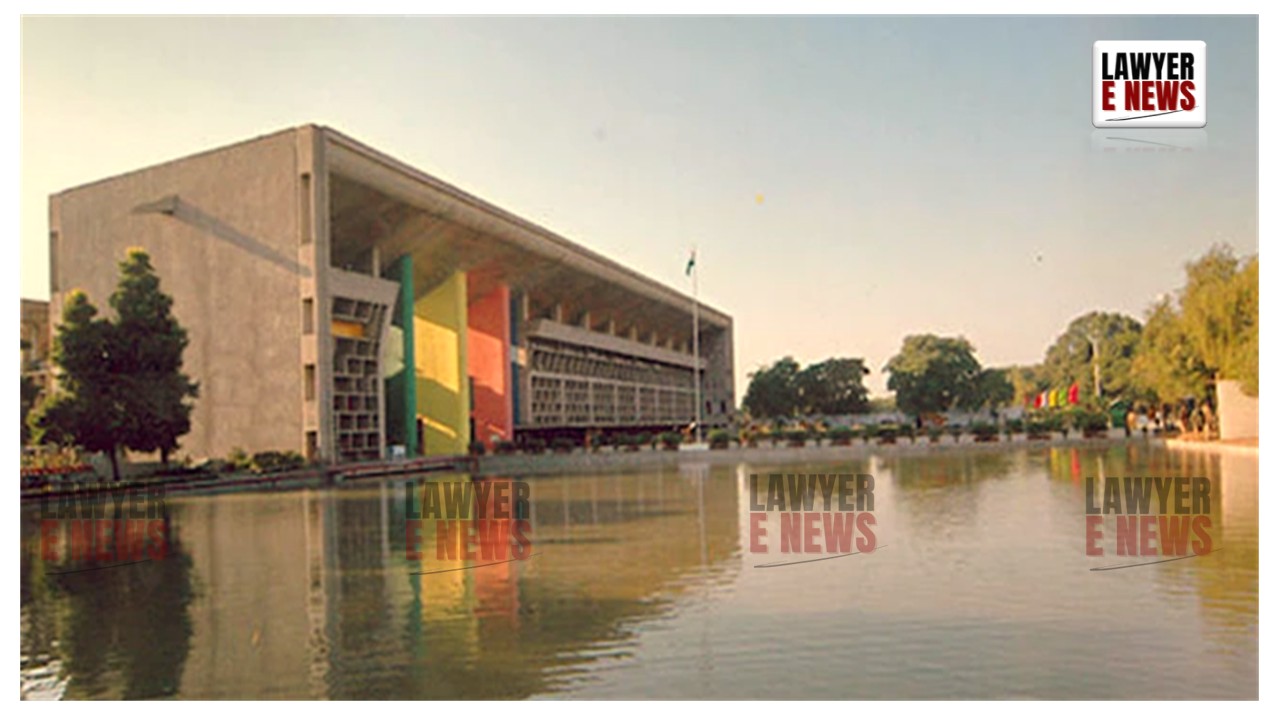
“When the Agreement Is Silent on Earnest Money, Courts Cannot Fill the Blanks” - In a decisive ruling Punjab and Haryana High Court dismissed a second appeal seeking refund of ₹46.38 lakhs allegedly paid as earnest money under a land sale agreement. Justice Alka Sarin, upholding concurrent decisions of the Trial Court and First Appellate Court, held that in the absence of any mention of such payment in the written agreement, no refund can be ordered.
“When the edifice of the plaintiff-appellant viz. the agreement to sell makes no mention of the amount paid by him as earnest money, it is impossible for the Court to order a refund.” [Para 7]
The Court further held that the appellant had failed to establish any payment through cogent or credible evidence, and no substantial question of law arose from the case to warrant interference under Section 100 of the Code of Civil Procedure.
“A Party Cannot Claim What Is Neither Recorded Nor Proved: Plea for Refund Fails Without Written or Admitted Basis”
The case revolved around a disputed land transaction that began with an agreement to sell executed on 04 December 2007, wherein the appellant (plaintiff before the Trial Court) alleged he paid over ₹85.78 lakhs as earnest money for repurchase of land he had previously sold to the defendant. The agreement to sell was followed by a reaffirming affidavit dated 23 June 2008, and the plaintiff eventually restricted his relief in court only to the refund of ₹46.38 lakhs, after abandoning his claim for specific performance.
Both the Trial Court and the First Appellate Court, however, found no merit in the plaintiff’s claim, noting the complete absence of any mention of earnest money in the agreement. The High Court upheld those conclusions and rejected the second appeal in its entirety.
The plaintiff-appellant, Nishan Singh, had earlier sold land to the primary defendant, Gurdeep Bedi, in 2006. Later, the parties allegedly entered into an agreement for resale of part of the land (measuring 5288 square yards) to the plaintiff, for which the plaintiff claimed he paid ₹85.78 lakhs as earnest money. However, as per his own pleading, the agreement did not mention the earnest money or even the full sale consideration—a critical omission.
When the sale failed to materialize, and the defendant sold parts of the land to third parties, the plaintiff filed a civil suit seeking possession, permanent injunction, and refund of ₹46.38 lakhs.
The defendant denied receiving such amounts and contended that the agreement was conditional and that the plaintiff had cancelled the arrangement through a writing dated 07.07.2008 after receiving some payments.
Legal Issues and Findings by the Trial and First Appellate Courts
The Trial Court framed several issues, including those relating to specific performance, injunction, refund, readiness and willingness, and valuation. The plaintiff’s entire suit was dismissed, particularly on the ground that the agreement to sell was vague and silent on essential aspects like earnest money and full consideration.
Before the First Appellate Court, the plaintiff chose not to challenge the findings regarding specific performance and injunction, and restricted his appeal only to the claim of refund (Issue No.3). Even this limited challenge was rejected, with the Court observing:
“The agreement to sell Ex.P1 itself was not clear with regard to the total sale consideration as well as with regard to the payment of earnest money. The payment of earnest money by the plaintiff-appellant was not supported by any evidence.” [Para 4]
Importantly, the appellate court also found an inexplicable inconsistency between the plaintiff’s stand that he paid ₹85.78 lakhs and his claim for refund of only ₹46.38 lakhs, observing that such contradictions severely undermined the credibility of his claim.
Before the High Court, the plaintiff attempted to revive the refund claim by arguing that the admitted agreement to sell entitled him to return of the earnest money. However, the Court rejected this contention outright:
“A perusal of the agreement to sell Ex.P1 reveals that there is not a whisper in it about this amount of earnest money… It is impossible for the Court to order a refund.” [Para 7]
Justice Sarin emphasized that the Court cannot infer financial transactions based on oral claims or unsubstantiated averments when written agreements are silent on such crucial details.
The Court further noted that the plaintiff had been unable to explain why the refund claim was limited to ₹46.38 lakhs, despite asserting payment of ₹85.78 lakhs. Such inconsistency, the Court observed, only added to the implausibility of the entire case.
“The entire case set-up by the plaintiff-appellant does not inspire confidence and is not supported by cogent and reliable evidence.” [Para 7]
No Substantial Question of Law Under Section 100 CPC
The High Court reiterated the limited scope of interference in second appeals under Section 100 of the Civil Procedure Code:
“No cogent and reliable evidence has been highlighted by the counsel for the plaintiff-appellant for this Court to take a contrary view… No question of law, much less any substantial question of law, arises.” [Paras 8–9]
The Court concluded that both lower courts had examined the evidence thoroughly and drawn consistent findings based on facts and documents on record.
When Agreements Are Silent, Claims Cannot Be Built on Oral Assertions
The judgment is a sharp reminder that real estate transactions, particularly those involving crores of rupees, must be documented with clarity and precision. Oral assertions of massive payments, unrecorded in any written agreement, cannot form the basis of a legal claim.
The Court’s refusal to allow refund of so-called earnest money—when the agreement to sell contained no mention of any such payment—serves to reinforce a crucial legal principle:
“Courts will not grant relief based on ambiguity, speculation, or afterthoughts—especially where written contracts remain silent.”
The second appeal was thus dismissed with a clear finding that no substantial question of law arose, effectively closing the doors on the plaintiff’s attempt to extract refund in the absence of credible evidence.
Date of Decision: 28 October 2025