-
by sayum
28 July 2026 1:44 PM







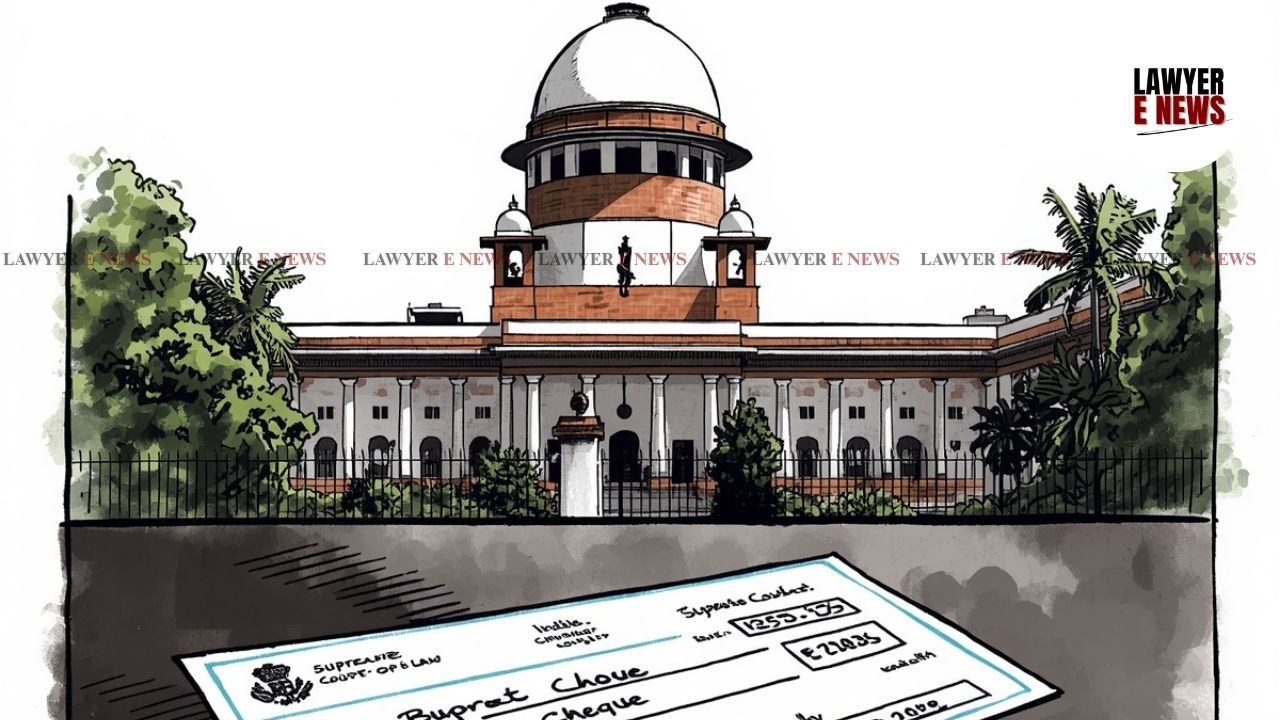
"The participation in the transaction giving rise to the debt constitutes a relevant and proximate circumstance while considering whether respondents were in-charge of and responsible for the affairs of the Society within the meaning of Section 141 of the NI Act, " Supreme Court, in a significant ruling dated May 26, 2026, held that office bearers of a society or company can be prosecuted for a cheque bounce offence under the Negotiable Instruments Act even if they are not signatories to the specific cheque, provided there is foundational material showing their active participation in the underlying financial transaction.
A bench comprising Justice Prashant Kumar Mishra and Justice N.V. Anjaria observed that while mere designation is insufficient to attract vicarious liability, the execution of antecedent documents like Memorandums of Understanding (MoUs) and promissory notes provides sufficient grounds for trial.
The appellant, M/s Mansi Finance (Chennai) Ltd., filed a criminal complaint under Sections 138 and 141 of the NI Act after a cheque for over Rs. 5.12 Crores, issued by the Ravindra Bharathi Educational Society, was dishonoured with the remark "Account Blocked." The Madras High Court had quashed the proceedings against four office bearers (Respondents 1 to 4) on the grounds that they were not signatories to the cheque and that the allegations against them were omnibus in nature. Aggrieved by the quashing of the complaint, the finance company approached the Top Court.
The primary question before the court was whether the High Court was justified in quashing the complaint against non-signatory office bearers in exercise of its inherent jurisdiction under Section 482 CrPC. The Court also examined the degree of specificity required in a complaint to fasten vicarious liability on office bearers who participated in the execution of underlying debt documents but did not sign the dishonoured cheque itself.
Mere Designation Insufficient To Attract Vicarious Liability
The Court began by reiterating the established legal position under Section 141 of the NI Act, noting that criminal liability is not automatically attracted merely by virtue of holding an office in a company or society. Relying on the landmark three-judge bench decision in S.M.S. Pharmaceuticals Ltd. vs. Neeta Bhalla, the Court emphasized that a complaint must specifically aver that at the time the offence was committed, the person accused was in-charge of and responsible for the conduct of the business.
Distinction Between Signatories And Non-Signatories In Financial Transactions
The Bench observed that the High Court failed to distinguish between the different roles played by the respondents in the transaction. It noted that while Respondent No. 3 was a mere Executive Member with no specific role attributed to him in the debt transaction, Respondents 1, 2, and 4 were signatories to the MoU and promissory notes that formed the "substratum of the legally enforceable debt." The Court held that such participation constitutes a relevant and proximate circumstance for trial.
“These are not matters of mere designation but constitute prima facie material linking them to the underlying transaction.”
Role Of Antecedent Documents As Foundational Material
The Court clarified that the documentary material forming part of the complaint, such as MoUs acknowledging liability and stipulating repayment terms, furnishes the necessary factual foundation for continuing prosecution. It held that the High Court erred in extending relief to those office bearers whose signatures appeared on financial documents related to the borrowing, as their involvement was not merely "by association" but was independently discernible from the record.
Hyper-Technical Approach Not To Be Adopted At Quashing Stage
Relying on S.P. Mani and Mohan Diary vs. Dr. Snehalatha Elangovan, the Bench cautioned against adopting a hyper-technical approach while construing a complaint. The Court noted that if a factual foundation for the offence is disclosed when the complaint is read as a whole, the proceedings should not be interdicted at the threshold. It emphasized that at the stage of quashing under Section 482 CrPC, the Court does not adjudicate upon the truthfulness of allegations or appreciate evidence.
“The complaint need not mechanically reproduce the exact phraseology of Section 141 of the NI Act if the substance of the allegations, read as a whole, discloses the factual basis for such liability.”
Specific Role Requirement For Executive Members
In contrast, the Court upheld the quashing of proceedings against Respondent No. 3, the Executive Member. The Bench noted that no specific role was attributed to him in the transaction, and his name did not appear on any promissory note or MoU. The Court held that in the absence of a specific factual foundation connecting him to the transaction, the principles laid down in Ashok Shewakramani vs. State of Andhra Pradesh would apply, protecting him from vicarious liability.
The Supreme Court partly allowed the appeal, setting aside the High Court's order insofar as it related to the Vice-President, Treasurer, and Manager (Respondents 1, 2, and 4). The criminal complaint was restored against them, while the quashing of proceedings against the Executive Member was upheld. The Court concluded that the existence of foundational material linking office bearers to the underlying debt is sufficient to justify the continuation of a prosecution under the NI Act.
Date of Decision: May 26, 2026