-
by sayum
28 August 2026 8:44 AM







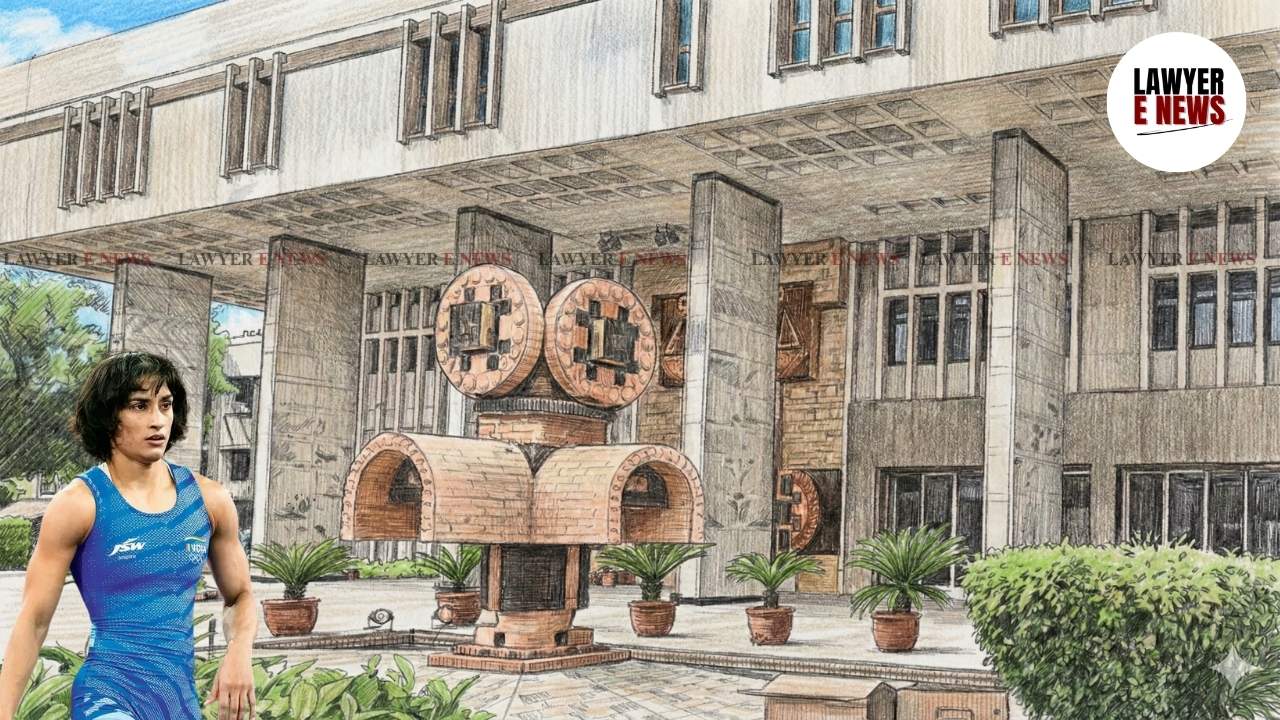
"Becoming mother can never become a disability. The journey of a female athlete through pregnancy and the post-partum period is one marked by extraordinary physical challenges, the magnitude of which is often insufficiently acknowledged within institutional sporting frameworks." Delhi High Court, in a significant ruling, held that motherhood cannot be treated as a professional impediment or a circumstance warranting adverse treatment for female athletes.
A bench of Chief Justice Devendra Kumar Upadhyaya and Justice Tejas Karia observed that any regulatory framework that disadvantages a woman on account of pregnancy or post-partum recovery violates the principles of non-discrimination enshrined under the Constitution of India. The Court emphasized that institutional sensitivity is mandatory to ensure that maternity does not become a ground for the marginalization of iconic athletes.
The Appellant, internationally acclaimed wrestler Vinesh Phogat, approached the Division Bench assailing a Single Judge's order that refused to grant her interim protection to participate in the Selection Trials for the Asian Games 2026. Phogat had taken a disclosed maternity sabbatical starting December 2024 and gave birth to her child in July 2025. Due to this recovery period, she was unable to participate in the specific domestic championships of 2025 and early 2026, which the Wrestling Federation of India (WFI) had set as the sole qualifying route for the upcoming selection trials.
The primary question before the court was whether a sports selection policy that restricts eligibility to specific domestic events, without providing any leeway for maternity-related absences, is arbitrary and discriminatory. The court was also called upon to determine whether the Appellant, as an "iconic player," was entitled to participate in the Selection Trials despite the rigid criteria of the WFI Selection Policy and Circular.
Motherhood Is A Virtue, Not A Professional Disability
The Court began by observing that motherhood is celebrated globally as a great virtue and an intimate transformation. The bench noted that the law and society must respect this journey rather than penalizing it. The judges emphasized that a woman’s professional career, ranking, or promotion cannot be prejudiced due to maternity leave.
"Motherhood must be viewed as a natural and deeply significant aspect of life that deserves accommodation and institutional sensitivity," the bench observed. The Court held that the law must ensure that childbirth does not become a ground for exclusion or marginalization of female athletes like the Appellant.
Exclusionary Policies Violate Constitutional Principles
The bench found that the WFI’s Selection Policy and Circular created a rigid and mechanically exclusionary eligibility framework. By restricting trials only to medal winners of domestic events held during the Appellant's maternity and recovery period, the framework converted her maternity-related interruption into a disabling factor.
"A legal and regulatory framework that either expressly or impliedly disadvantages a woman on account of pregnancy or post-partum recovery would clearly violate the principles of non-discrimination enshrined in Articles 14 and 21 of the Constitution of India, 1950."
WFI's "National Embarrassment" Remark Termed Deplorable
The Court took strong exception to a Show Cause Notice (SCN) issued by the WFI, which referred to Phogat’s disqualification at the 2024 Paris Olympics as a "national embarrassment." The bench noted that such observations were made despite an award by the Court of Arbitration for Sport (CAS) which explicitly stated there was "no suggestion of any wrongdoing on her part."
The bench described the WFI's remarks as "deplorable" and "retrograde," suggesting a mala fide and vindictive intent against the athlete. The Court observed that the grounds taken in the SCN appeared pre-mediated and were aimed at reopening closed issues to prevent the Appellant's participation in trials.
"The observations made by Respondent No. 1 in the SCN... are deplorable. Such observations are retrograde and show the mala fide intent of Respondent No. 1 by being vindictive against the Appellant."
Deviation From Past Practice Of Selecting Iconic Players
The Court noted that the current selection policy marked a significant deviation from past practices. Previously, the WFI guidelines provided discretion to the Selection Committee to select "iconic players," such as Olympic or World Championship medallists, for trials even if they had not participated in specific domestic coaching camps or championships.
The bench observed that Phogat, being an iconic player with multiple international medals, was prima facie entitled to an opportunity to compete on merit. The Court held that the lack of maternity-sensitive accommodation in the new policy appeared arbitrary and discriminatory, warranting protection of the athlete's interests during the pendency of the writ petition.
Final Directions Of The Court
The Court disposed of the appeal by directing that Vinesh Phogat be permitted to participate in the Selection Trials for the Asian Games 2026, scheduled for May 30 and 31, 2026. To ensure transparency and fairness, the Court ordered that the trials be video-recorded by the WFI.
Furthermore, the Court directed the Ministry of Youth Affairs and Sports to nominate two independent observers from the Sports Authority of India (SAI) and the Indian Olympic Association (IOA). These observers are required to submit a report on the conduct of the trials to the learned Single Judge who is currently adjudicating the main writ petition.
The Division Bench concluded that the Appellant had made out a strong prima facie case. It held that excluding an athlete of Phogat's stature solely due to the timing of her maternity would cause irreversible loss and render her writ petition infructuous. The ruling reinforces the doctrine that institutional frameworks must adapt to the physiological realities of female athletes to uphold the constitutional guarantee of substantive equality.
Date of Decision: 22 May 2026