-
by sayum
25 August 2026 12:32 PM







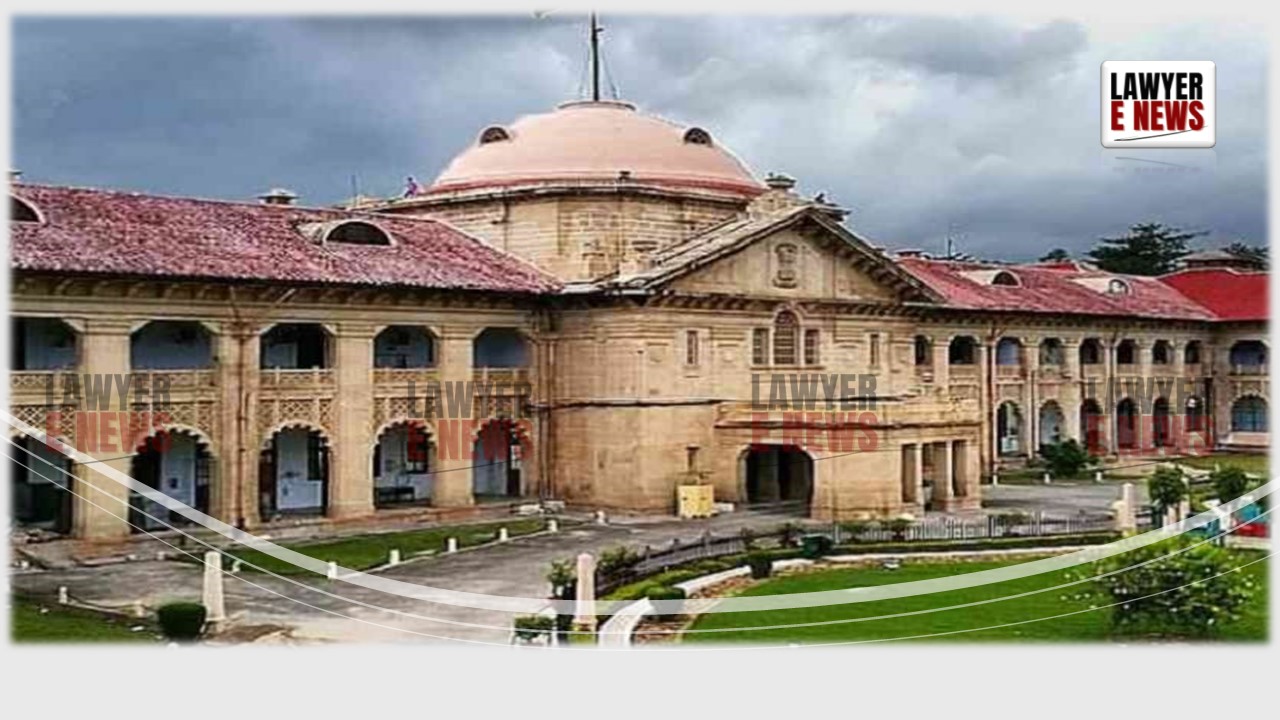
"Purely contractual obligations, absent statutory backing or admitted liability, are not enforceable under Article 226 of the Constitution" - In a firm reaffirmation of settled constitutional limits on writ jurisdiction, the Allahabad High Court dismissed a contractor’s plea seeking a writ of mandamus for release of payments under a construction contract with the State. In the case of Karmesh Kumar Srivastava Prop. Venus Trading Corporation v. City Development Secretary and 5 Others, Writ-C No. 15336 of 2018, the Division Bench comprising Justice Vivek Saran and Justice Prakash Padia held that Article 226 cannot be used to enforce disputed contractual claims, particularly when the obligation lacks statutory flavour and the liability is not admitted.
Refusing to entertain the petition, the Court made it abundantly clear:
“When disputed questions of fact are present, the writ jurisdiction is not the viable forum... such disputes cannot be decided upon bare exchange of affidavits.”
The ruling draws a decisive boundary between public law remedies and private contract enforcement, holding that civil suits or arbitration are the proper avenues where the claim arises from a contested agreement, and the High Court cannot be converted into a small causes court for money recovery.
“A Government Contract Does Not Become Statutory Merely Because the Employer Is a State Body”—Court Rejects Contractor’s Reliance on Work Order Absent Admitted Liability
The case arose out of a petition filed by contractor Karmesh Kumar Srivastava, who sought release of payments for various construction activities allegedly carried out in 2011 pursuant to a work order dated 23.12.2011, issued by the respondent civic authorities. The works included building overhead tanks, sewer pipelines, sewer chambers, and a CC road, undertaken in the Kanpur region.
The petitioner claimed that though partial payments were made for certain works, a substantial balance remained unpaid, despite repeated representations. He invoked Article 226, seeking a writ to compel the respondents to clear the dues along with interest.
However, the State authorities denied all claims, asserting that full and final payment was made via Cash Voucher No.1412 and Cheque No.754959 dated 04.02.2012, amounting to ₹3,53,750. They also contended that no additional work was ever sanctioned nor any liability acknowledged in writing.
The Court observed:
“The petitioner has not been able to bring on record any document wherein the respondent authorities have admitted that a particular sum is owed... The claim of the petitioner is disputed by the respondents in their counter affidavit.”
Relying heavily on the judgment in Kerala SEB v. Kurien E. Kalathil, (2000) 6 SCC 293, the Court held:
“Interpretation and implementation of a clause in a contract cannot be the subject-matter of a writ petition... A contract would not become statutory simply because it is for construction of a public utility and it has been awarded by a statutory body.”
“High Court Should Not Be Transformed Into a Trial Court for Assessing Measurements and Work Bills”—Disputed Questions of Fact Must Go to Civil Forum
A core issue identified by the Court was the presence of disputed facts, which could only be resolved by evaluating evidence, conducting measurements, and analyzing contractual performance—tasks clearly beyond the writ court’s constitutional role.
The Court observed:
“It has to be kept in mind that when disputed questions of fact are present, the writ jurisdiction is not the viable forum, as such disputes cannot be decided upon bare exchange of affidavits.”
Citing Orissa Agro Industries Corpn. Ltd. v. Bharati Industries, (2005) 12 SCC 725, and Union of India v. Puna Hinda, (2021) 10 SCC 690, the Court underscored the principle that writs are not meant to resolve complex factual disputes, especially in contractual claims, where statutory duties are absent and the relationship is rooted solely in private law.
Referring to Union of India v. Puna Hinda, the Court quoted:
“Though the jurisdiction of the High Court is wide, pure contractual matters in the field of private law... are better adjudicated upon by the forum agreed to by the parties.”
Even if payments were withheld or certain works were completed without formal measurement, the Court held that such factual assessments must be undertaken through appropriate evidence before the competent civil forum, and not by writ courts.
“Extraordinary Constitutional Remedies Cannot Be Invoked to Enforce Ordinary Commercial Claims”—Petitioner Must Seek Relief in Civil Court or Arbitration
The Court dismissed the argument that the petitioner was left remediless. It clarified that in purely contractual matters involving contested claims, the civil courts or agreed arbitral tribunals are the correct fora.
Referring to the Division Bench ruling in M/s Bio Tech System v. State of U.P., (2020) 11 ADJ 488 (DB), the Court stated:
“Contractual obligations are matters of private law... Pure contractual obligation in the absence of any statutory complexion would not be enforceable through a writ.”
Emphasizing the limited scope of Article 226, the Court reinforced that:
“The remedy under Article 226 of the Constitution being an extraordinary remedy, it is not intended to be used for the purpose of declaring private rights of the parties.”
Petition Dismissed—Writ Court Cannot Enforce Contested Contractual Rights Without Statutory Backing
The Allahabad High Court ultimately dismissed the writ petition, refusing to entertain the contractor’s claim for unpaid dues based on a disputed, non-statutory construction contract. The judgment sends a clear message that writ jurisdiction is not a substitute for civil trial, particularly where factual controversy exists, and no statutory obligation or admitted liability is shown.
The decision affirms the judicial policy of keeping Article 226 within its intended constitutional purpose—as a safeguard against illegality in public law—not as a short-cut for enforcement of commercial demands against the State in breach of formal remedies.
“The writ petition is dismissed. No order as to cost.” – concluded the Bench.
Date of Decision: 17 October 2025