-
by sayum
28 August 2026 10:07 AM







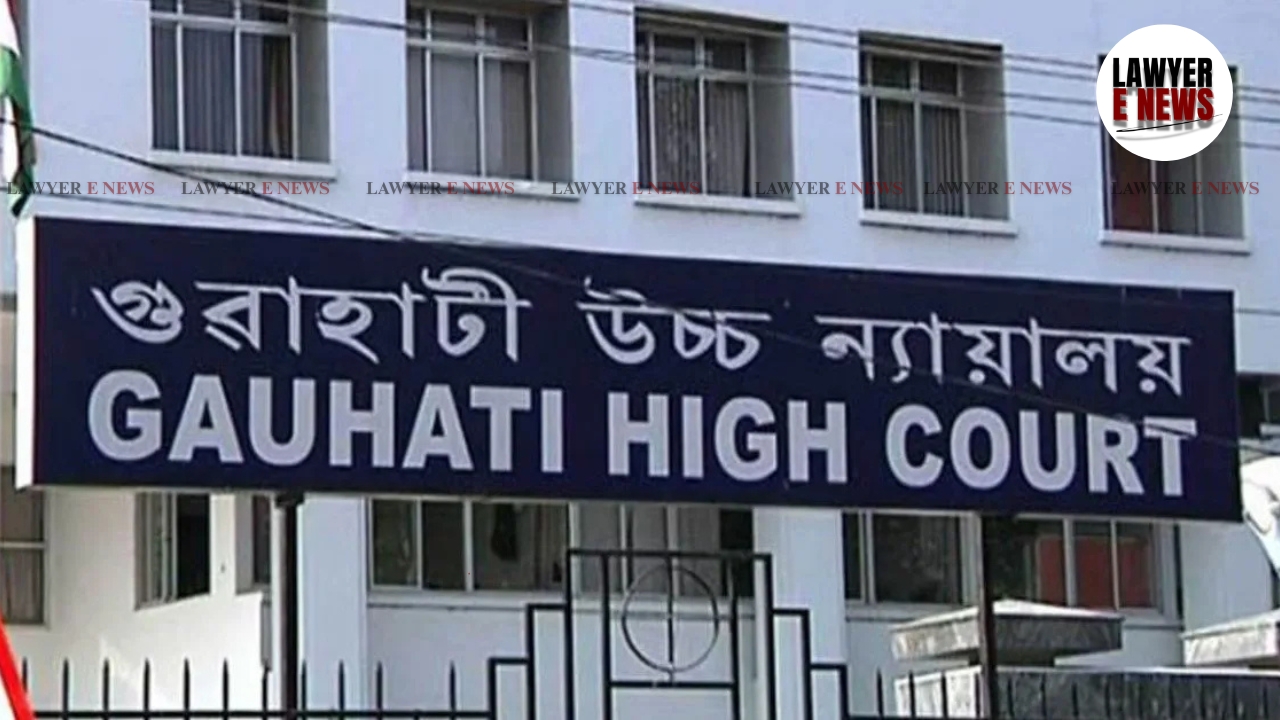
"Allowing it could amount to permitting inconsistent pleas that would undermine the sanctity of pleadings," Gauhati High Court has ruled that a defendant who has formally denied the right, title, and interest of a plaintiff in their written statement cannot later be permitted to substitute that plaintiff as an "assignee" upon their death.
A bench of Justice Robin Phukan, in an order, observed that such a transposition would lead to the party taking "diametrically opposite" and "inconsistent" stands in the same proceeding, which is hit by the principle of estoppel. The court emphasized that while any party can seek to bring legal heirs on record to prevent abatement, the substitution of a contesting defendant into the shoes of the plaintiff is subject to judicial discretion and the bona fides of the assignment.
Substitution Based On Assignment Is Discretionary, Not An Absolute Right
The case originated from a partition suit (Title Suit No. 337/2008) where the original Plaintiff No. 1 passed away during the pendency of the litigation. The petitioner, who was arrayed as Defendant No. 3 in the suit, moved an application under Order XXII Rule 9(2) and Rule 10(1) of the CPC to set aside the abatement and substitute himself as the plaintiff's assignee. He claimed his right based on a registered Deed of Assignment executed in 2011. However, both the Trial Court and the First Appellate Court rejected his plea, prompting the revision petition before the High Court.
SANCTITY OF PLEADINGS AND ESTOPPEL BY INCONSISTENT POSITION
The primary question before the court was whether a defendant who denied the plaintiffs' title in his written statement could be allowed to represent the same plaintiffs as an assignee. The court was also called upon to determine the scope of its interference under Article 227 of the Constitution regarding discretionary orders passed by subordinate courts.
Defendant Cannot Support Plaintiff’s Case After Formally Denying Their Title
The Court noted that the petitioner, in his written statement, had categorically stated that the plaintiffs had no share in the suit property and that the land had been gifted to Defendant No. 1. By seeking to substitute the deceased plaintiff, the petitioner would essentially be required to support the very claim he had previously denied. The bench observed that "his stand in the suit would not only be diametrically opposite but also would be inconsistent," which would directly undermine the sanctity of judicial pleadings.
"The conduct of the petitioner would be hit by the principle of estoppel by inconsistent position."
Validity Of Assignment Deed Requires Scrutiny Given Prior Contradictory Stands
Justice Phukan highlighted that under Order XXII Rule 10 CPC, the court has the discretion to allow a suit to be continued by or against a person upon whom interest has devolved. However, this is not an absolute right. The court held that there is a mandatory requirement to examine whether such an assignment is genuine, valid, and not collusive. In this specific factual matrix, the Court found the assignment’s validity to be "under the cloud of suspicion" because the petitioner had already challenged the plaintiffs' title in his previous pleadings.
"In view of the challenge made by the petitioner in his written statement regarding plaintiffs’ title, the assignment’s validity itself is under the cloud of suspicion, which requires scrutiny for bonafide and separate adjudication."
Scope Of Article 227 Interference In Discretionary Orders
Referring to Supreme Court precedents like Essen Deinki v. Rajiv Kumar and Waryam Singh v. Amarnath, the High Court reiterated that the power of superintendence under Article 227 must be exercised sparingly. It is intended to keep subordinate courts within the bounds of their authority and not to correct mere errors of fact or law. The Court noted that since the lower courts had assigned cogent reasons for rejecting the petitioner's plea based on the peculiar facts of the case, their orders could not be termed illegal, irregular, or arbitrary.
"High Court, under Article 227 can interfere with a Trial Court's discretionary refusal to relief, but only in exceptional cases involving jurisdictional error, patent illegality, perversity, or grave miscarriage of justice."
Assessing Transferee Pendente Lite Rights Under CPC
The Court discussed the interplay between Order XXII Rule 10 and Section 146 of the CPC. While acknowledging that an assignee or transferee pendente lite generally has the locus to apply for continuation of proceedings, it clarified that this is always subject to the leave of the court. Citing H. Anjanappa v. A. Prabhakar (2025), the Court reminded that even if an assignee is not brought on record, they remain bound by the outcome of the suit due to the doctrine of lis pendens under Section 52 of the Transfer of Property Act.
"It is not as of right; the court has discretion based on the facts, nature of the suit (e.g., title suit), and material on record."
The High Court concluded that the concurrent findings of the lower courts were justified. It held that allowing a defendant to transpose as a plaintiff's assignee after filing a contradictory written statement would jeopardize the integrity of the trial. Consequently, the revision petition was dismissed, affirming that the petitioner lacked the bona fide standing required to substitute the deceased plaintiff in these specific circumstances.
Date of Decision: 02 June 2026