-
by sayum
11 August 2026 2:00 PM







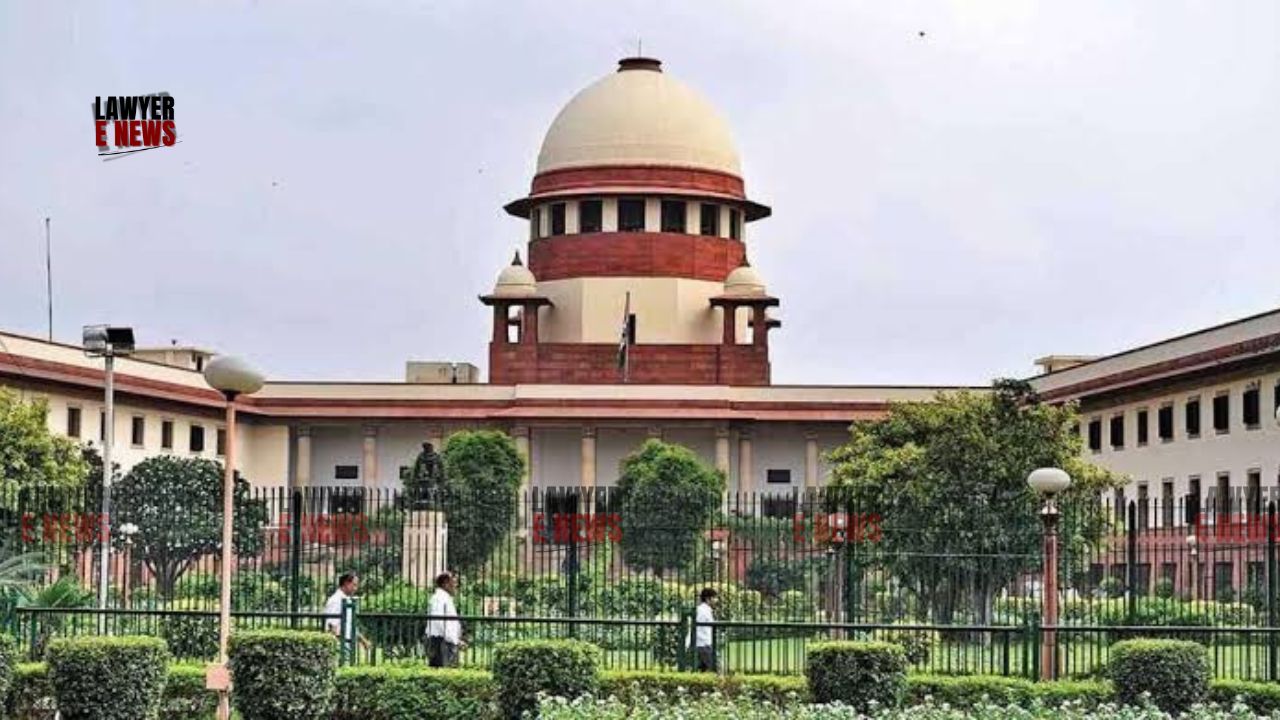
“Welfare Legislation Must Be Interpreted to Serve Its Purpose, Not Defeat It” – In a judgment reinforcing the welfare intent behind the Motor Vehicles Act, the Supreme Court of India reversed a Delhi High Court ruling that had arbitrarily slashed compensation awarded to the family of a road accident victim. The Court restored the Motor Accident Claims Tribunal’s (MACT) award of ₹31,41,000 and criticized the High Court’s "casual and superficial" approach in rejecting valid income proof solely because the Income Tax Return was filed after the date of the accident.
Kapil Bhargava, a businessman, tragically died on August 12, 2008, when a Blue Line bus driven negligently struck his motorcycle. His wife, Nidhi Bhargava (Appellant No. 1), who was riding pillion, suffered grievous injuries. A claim petition was filed under Sections 166 and 140 of the Motor Vehicles Act, 1988, before MACT, Delhi, which awarded ₹31.41 lakhs as compensation with 9% interest.
However, the High Court drastically reduced the compensation to ₹16.97 lakhs. The sole basis: the income tax return for AY 2008–09 had been filed after the date of the accident and was thus disregarded. The appellants challenged this reasoning before the Supreme Court.
The pivotal legal question was whether an income tax return filed after the date of accident but relating to a prior financial year could be excluded in determining the deceased's income for compensation purposes.
The Supreme Court held unequivocally:
“Just because on the date of the accident the Return for the Assessment Year 2008–2009 had not been filed, cannot disadvantage the appellants… No income earned beyond 31.03.2008 would reflect in the ITR for AY 2008–2009.”
The Court described the High Court’s approach as erroneous:
“It is quite unfortunate that the High Court… reduced the rightful claim of the appellants under a welfare legislation… on a very tenuous ground, which we find to be totally unjustified.”
Referring to Malarvizhi v. United India Insurance Co. Ltd., (2020) 4 SCC 228, and S. Vishnu Ganga v. Oriental Insurance Co. Ltd., 2025 SCC OnLine SC 182, the Court reaffirmed:
“Income Tax Returns are reliable evidence to assess the income of a deceased.”
The Court further observed that judicial discretion must serve the social object of the Act, adding:
“When faced with returns for different years, it is for the Tribunal to adopt either the average or one of them… bearing in mind the Act’s welfare purpose.”
Restoration of MACT’s Award
The High Court had recalculated loss of income by using the return for AY 2007–08 (which showed ₹1,23,990 net income), ignoring the more accurate figure for AY 2008–09. The Tribunal had correctly used the latter, reflecting the deceased’s improved earnings.
The Supreme Court found no fault in this:
“The relevance of the Income Tax Return stems… from the financial year it relates to, not from the filing date.”
Consequently, the Court restored the original award of ₹31,41,000 with 9% interest from the date of the claim. It directed payment within two months, failing which an additional 9% annual interest would apply on the total amount, including interest already due.
This decision serves as a stern reminder that procedural technicalities must not override substantive justice, especially in beneficial legislations like the Motor Vehicles Act. The Supreme Court’s ruling reaffirms the importance of contextual interpretation that aligns with the purpose of compensatory frameworks.
“Welfare statutes must be construed in favour of the claimants, not against them,” the Court implied.
Date of Decision: April 22, 2025