-
by sayum
28 August 2026 12:24 PM







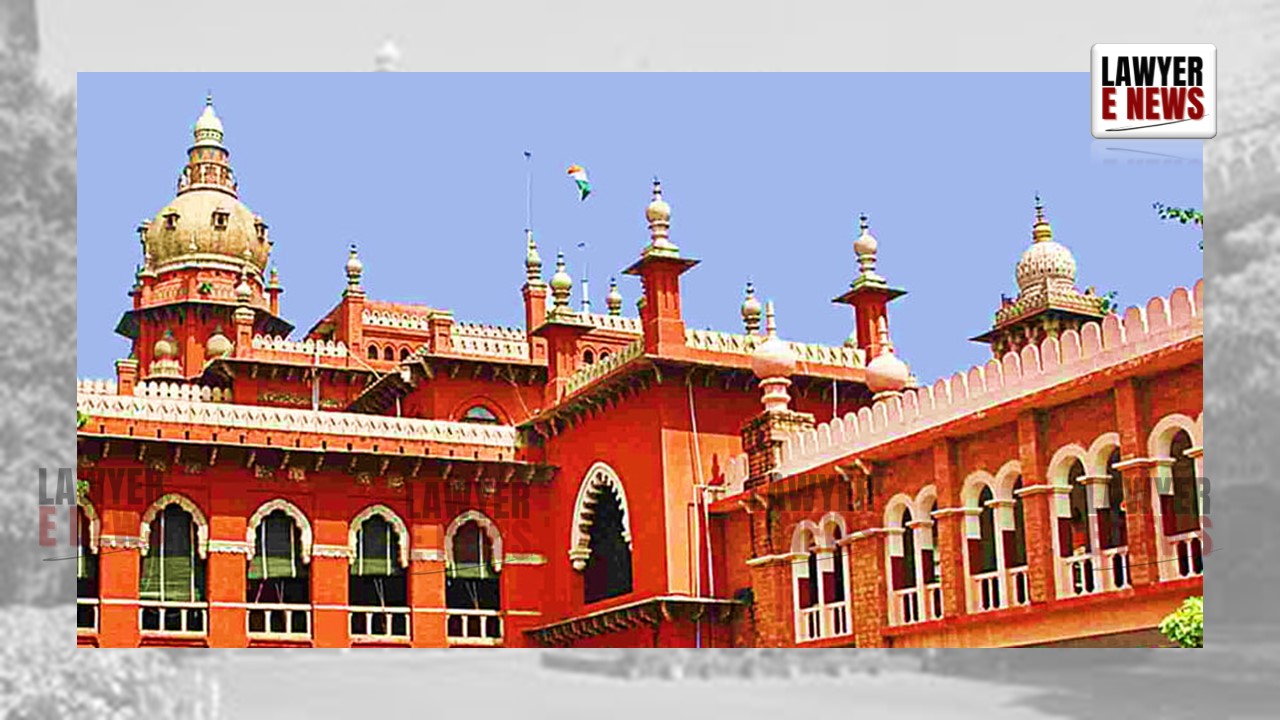
Section 317 CrPC Is Not an Empty Form—Judicial Discretion Must Be Informed by Fairness, Not Suspicion: Madras High Court set aside the Special NIA Court’s rejection of a petition under Section 70(2) CrPC to recall a Non-Bailable Warrant, issued against the appellant for failure to appear during trial. The Division Bench of Justice M.S. Ramesh and Justice N. Senthilkumar found that the Special Court had exercised its discretion arbitrarily, ignoring binding Supreme Court precedent and failing to explore lawful alternatives under Section 299 CrPC.
In a stern rebuke to the routine rejection of petitions under Section 317 CrPC by the NIA Special Court, the High Court held:
“Power under Sections 317 and 70(2) CrPC is discretionary—but discretion is not suspicion cloaked in law. It must be exercised judicially, not routinely denied based on past absence alone.”
Absence on a Single Day, With Prior Intimation and Immediate Appearance,
Cannot Be Branded as Delay Tactic—Remand Was Unwarranted
The appellant, A11 in a pending NIA case involving serious charges under IPC Sections 302, 153A, 341, 212, 109 and UAPA Sections 16, 18, had filed a Section 317 CrPC petition on 30 January 2025 citing ill health while en route to Chennai. The petition was rejected the same day and a Non-Bailable Warrant (NBW) issued. However, the appellant appeared in court by 11:00 AM, filed a recall application under Section 70(2) CrPC, but was remanded to custody citing
“repeated absence” on 10 previous occasions.
The High Court disagreed: “Even if earlier absences were condoned, the court cannot later use those very condoned absences to brand subsequent application as mala fide. Procedural justice demands individual assessment, not generalised suspicion.”
When Courts Can Record Evidence Without Accused Under Section 299 CrPC, Blaming the Accused for Delay Is Misplaced
The Court observed that the trial had already examined 65 witnesses and could proceed in absence of A11, as per Sections 299 CrPC, 16(5) of the NIA Act, and even 29(5) of POTA, all of which allow continuation of trial in absence of the accused in suitable circumstances.
Citing Atma Ram v. State of Rajasthan [(2020) 3 SCC (Cri) 846], the Bench stated: “Section 273 CrPC recognises the accused’s presence as a valuable right—but when absence is temporary and justified, and alternative statutory provisions exist, trial need not halt nor liberty be compromised.”
Supreme Court Has Repeatedly Warned Against Routine NBWs—Liberty Under Article 21 Cannot Be Sacrificed to Trial Formalism
The High Court drew extensively from Inder Mohan Goswami v. State of
Uttaranchal [(2007) 12 SCC 1], Satender Kumar Antil v. CBI [(2023) 1 SCC (Cri) 1], and Sherif Ahmed v. State of U.P. [2024 SCC OnLine SC 726], which caution that NBWs:
• Must be issued only when summons or bailable warrants fail
• Require clear reasons for belief that the accused will not appear
• Should not be routine, especially where Article 21 rights are engaged
The Court strongly remarked: “The Special Court appears to have turned NBW issuance into reflex—forgetting that it curtails liberty and must rest on substantive grounds.”
Justice Cannot Be Denied by Judicial Habit—Section 317 CrPC Must Be Interpreted in Light of Fairness, Not Formalism
The Court was alarmed that the Special NIA Court had been consistently rejecting Section 317 petitions, including the present one, in a mechanical manner, branding all such requests as “dilatory tactics,” even where absences were genuine or explained.
Justice Ramesh observed: “What is expected is judicious discretion, not judicial habit. Section 317 allows courts to act with sense, not suspicion. Rejection cannot become a rule.”
The Madras High Court allowed the appeal, set aside the Special Court’s orders in Crl.M.P. Nos. 73 and 76 of 2025, recalled the NBW, and directed the appellant to comply with modified bail conditions earlier imposed by the High Court.
It concluded: “The impugned orders are arbitrary and legally unsustainable. The appellant shall cooperate with the trial, and the Special Court must henceforth apply the law, not assumptions.”
This judgment is a vital reaffirmation of personal liberty in terror-linked trials, where the pressure to fast-track cases must not overtake constitutional due process. The Madras High Court has made it clear: the right to fair trial includes the right to be treated fairly by the trial court itself.
As the Bench emphatically held: “Liberty cannot be lost in the pursuit of speed. Judicial discretion is a constitutional trust—it cannot be exercised in fear, fatigue, or frustration.”
Date of Decision: 21 March 2025