
-
by sayum
26 August 2026 6:42 AM







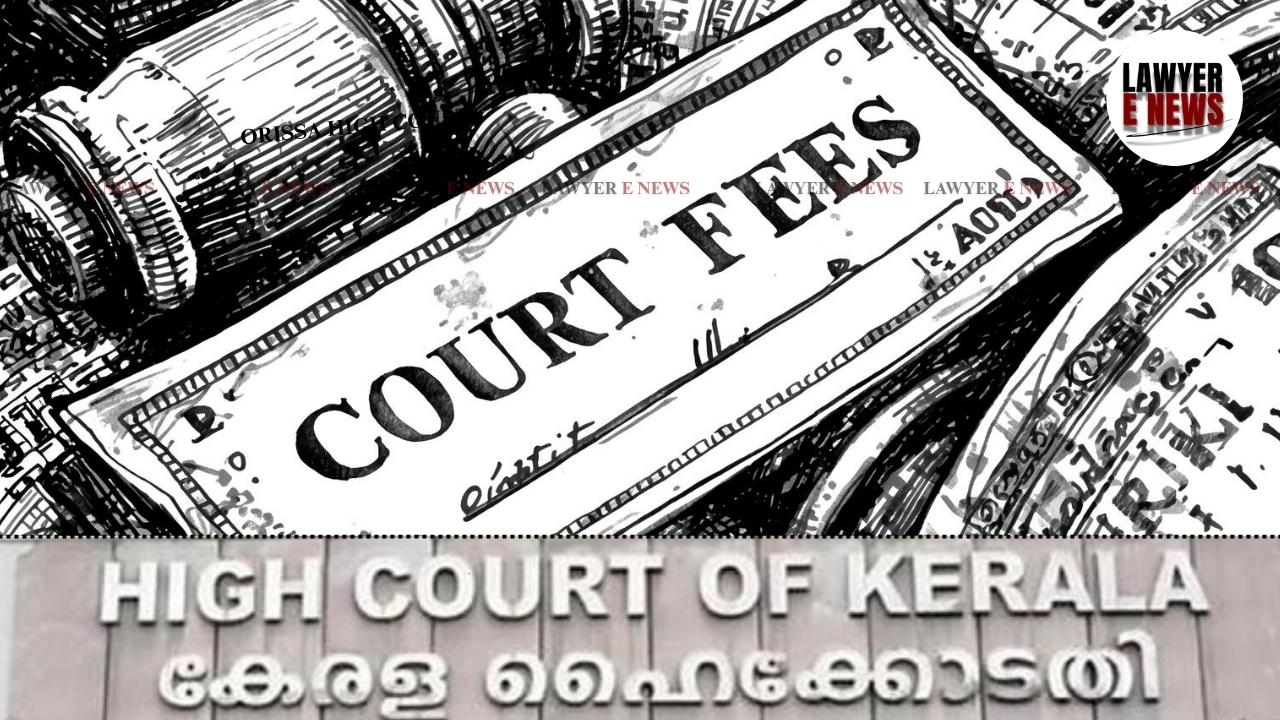
“Every Hike in Court Fees Does Not Violate Access to Justice – Legislature Has Competence and Justification” - In a significant judgment that balances judicial access with economic policy, the Kerala High Court upheld the Kerala Finance Act, 2025, which introduced a sweeping revision of court fees under the Kerala Court Fees and Suits Valuation Act, 1959. A Division Bench comprising Chief Justice Nitin Jamdar and Justice Basant Balaji dismissed the Public Interest Litigation (WP (PIL) No. 14 of 2025) filed by the Kerala High Court Advocates’ Association (KHCAA). The petition had challenged the steep revision of court fees and the continued exemption of the government from paying any such fees under Section 73A of the parent Act.
The Court rejected the plea that the new fee structure violates Article 21 (right to access to justice) or Article 14 (equality before law) of the Constitution, and declared:
“Court fee is not a tax on justice. It is a regulatory mechanism to support the administration of justice. Increase in fee, per se, is not a denial of access.”
“Access to Justice Not a Casual Allegation – No Concrete Harm Proved to Any Litigant”
The petitioner’s central contention was that the steep hike in fixed court fees, in some cases exceeding 1900%, constituted a barrier to accessing justice. But the Court ruled that constitutional rights cannot be tested on speculative fears.
“A general assertion that fees are high is not sufficient to hold a statute unconstitutional. No factual matrix has been produced to show that any class of litigants has been denied justice.”
The Court emphasized that Articles 21 and 14 are not abstract ideals in fiscal matters. The State’s legislative competence under Entry 3 of List II (State List) of the Seventh Schedule to legislate on court fees was beyond question. The Bench noted:
“Legislative policy, especially on economic matters, is entitled to judicial deference unless manifestly arbitrary. A mere increase in fee is not, by itself, unreasonable.”
“Section 73A Exempting Government From Court Fees Is a Valid Classification – There’s No Logic in the State Paying Itself”
“When the State is both litigant and payee, exemption from fees is neither discriminatory nor arbitrary”
The second major challenge was to Section 73A, which exempts the government from paying any court fees. KHCAA contended this violated the principle of equality, since private litigants bear the full burden while the State, the largest litigant, pays nothing.
But the Court invoked its own earlier decision in Human Rights Protection Forum v. State of Kerala (2003) and refused to revisit the issue.
“The exemption to the State serves administrative efficiency, reduces workload, and eliminates futile fiscal exchanges. The classification is based on intelligible differentia with a rational nexus to the object.”
The Court held that the State is not a ‘favoured litigant’, but rather a distinct class due to its unique financial relationship with the judiciary and other departments.
“400% Hike After 34 Years Not Shocking – What Is Shocking Is The Delay in Revision”
“Court cannot sit in appeal over legislative wisdom in fiscal policy – Judicial restraint applies”
KHCAA had challenged the fixed fee hikes as irrational, pointing to the increase from ₹10 to ₹500 in anticipatory bail applications. The Court responded bluntly:
“Court fee structures that have remained stagnant since 1962 or 1989 cannot remain frozen in time. Economic realities change, and fiscal policy must respond accordingly.”
Relying on data provided by the State and the Justice V.K. Mohanan Committee Report (2024), the Court found that fee revisions were justified. The Committee had recommended updates based on inflation, rising court infrastructure costs, and comparative fee structures in other states.
The Court noted that judicial infrastructure spending rose from ₹97 crore in 2002–03 to ₹1248 crore in 2022–23, while court fee collection only grew marginally.
“Legislation does not require perfect mathematical precision. Broad correlation with the purpose is sufficient. The test is of reasonableness, not perfection.”
“Ad Valorem Fees Not Even Revised – No Challenge Survives”
On the issue of ad valorem court fees (which are percentage-based), the Court noted that no actual percentage revision had occurred. After this was clarified by the Advocate General during the hearing, the petitioner chose not to press this ground. The Court observed:
“A challenge to a non-existent grievance cannot be entertained. Ad valorem fees remain unchanged, and hence that part of the challenge fails.”
“Statute Already Contains In-Built Safeguards Against Financial Hardship”
“Sections 72 to 75 of the 1959 Act provide exemptions – Petitioners ignored available remedies”
The Court strongly rebutted the argument that poorer litigants would be priced out of the legal system. It pointed out that the existing law already provides relief through exemptions, remissions, and legal aid for specific categories:
Women, Scheduled Castes and Tribes, prisoners, unemployed handicapped persons, NGOs, and others are statutorily protected from financial hardship.
“No material has been brought to show that these protections are inadequate. Mere apprehension cannot become a constitutional claim.”
“Legislative Policy May Be Imperfect, But That Does Not Make It Unconstitutional”
“Judicial interference in economic matters must be cautious – Court cannot substitute its view for legislature”
The Bench relied on the Supreme Court’s dictum in CIT v. Vegetable Products Ltd., Sriramulu v. State of Tamil Nadu, and P.M. Ashwathanarayana Setty, to reiterate the settled principle:
“In matters involving economic or fiscal policy, courts must exercise restraint. Two views may exist, but judicial review does not permit substitution of one over the other merely for being preferable.”
The Court also cited the Zenith Lamps judgment, holding that mathematical equivalence between fees and services is not constitutionally required.
“State May Consider Further Exemptions – But That’s Policy, Not Constitutional Mandate”
While dismissing the petition, the Court gently advised the State to keep the door open for future relaxations in deserving cases.
“The State Government may, in its wisdom, consider whether additional classes of litigants require full or partial exemption under financial or social parameters. Section 75 enables such discretion.”
Court Fees Are Not a Tax on Justice – They Are a Necessary Support to the Justice System
The Kerala High Court has sent a clear message that revised court fees, even if high, do not automatically violate constitutional rights. The State is entitled to revise fees after decades, especially when supported by data, consultation, and legislative competence. The judgment reaffirms the principle that access to justice is a fundamental right, but one that coexists with fiscal sustainability.
“Litigation must remain accessible, but justice delivery must also remain viable.”
Date of Decision: 31 October 2025





