-
by sayum
28 August 2026 2:11 PM







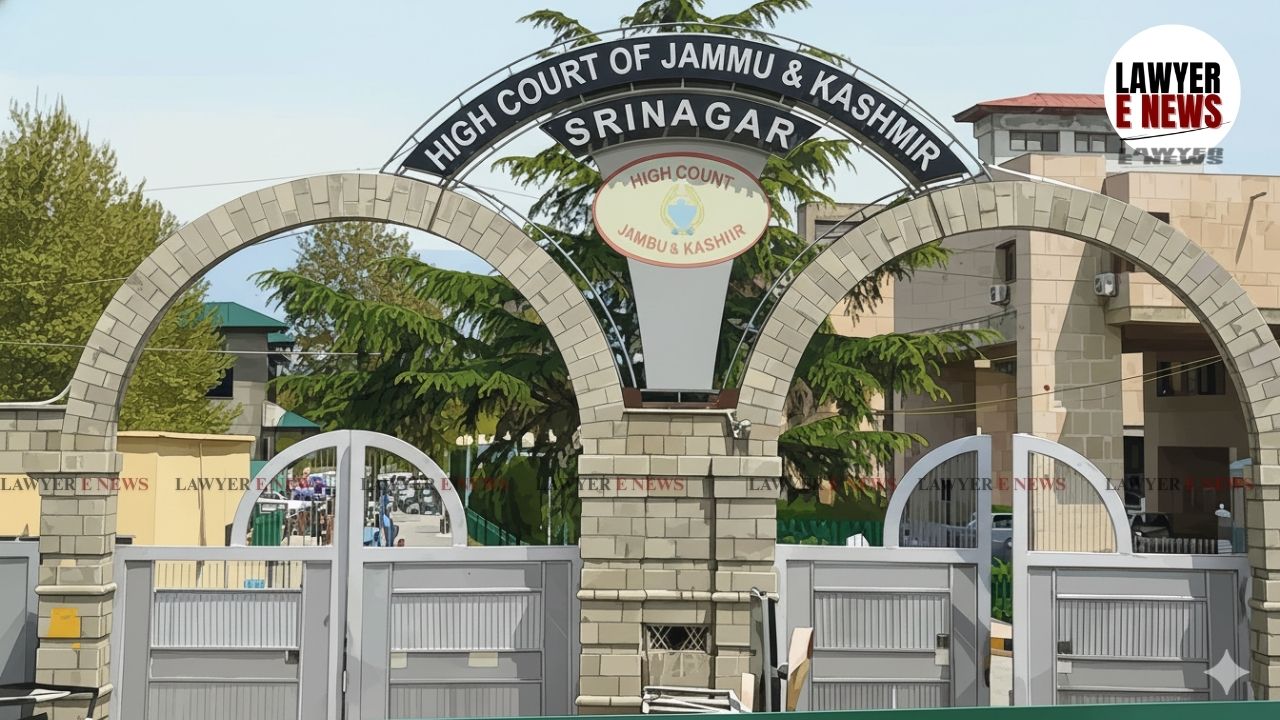
"Expression ‘sufficient cause’ occurring in Section 5 of the Limitation Act, in the context of abatement of suits and appeals, ought to receive a liberal construction so as to advance substantial justice, more particularly when the delay is not on account of dilatory tactics, want of bona fides, deliberate inaction, or negligence on the part of the appellants, " High Court of Jammu & Kashmir and Ladakh at Srinagar, in an order, held that Order XXII Rule 10-A of the CPC casts a mandatory obligation on the counsel appearing for a party to inform the court about the party's death.
A single bench of Justice Sanjeev Kumar observed that in the absence of such communication, the opposite party cannot be faulted for a slight delay in seeking to set aside the abatement of the proceedings.
The matter arose from a Civil Second Appeal (CSA No. 8/2013) where Respondent No. 7, Mohd. Ashraf, died on March 21, 2020. While the surviving respondents sought dismissal of the appeal as abated, the appellants filed applications seeking condonation of a 12-day delay in setting aside the abatement. The appellants claimed they only learned of the death when the respondents filed a formal application for dismissal in October 2025, whereas the respondents argued that the parties were residents of the same village and the fact of death was well known.
The primary question before the court was whether the counsel for the deceased respondent had fulfilled the statutory duty under Order XXII Rule 10-A of the CPC to inform the court of the death. The court also had to determine whether a 12-day delay in seeking to set aside abatement warranted a liberal construction of "sufficient cause" under Section 5 of the Limitation Act, 1963.
Counsel's Mandatory Duty Under Rule 10-A
The court emphasized that Rule 10-A of Order XXII CPC was specifically inserted to avoid unnecessary disputes of fact regarding the death of a party. Justice Sanjeev Kumar noted that the learned counsel appearing for a party is the best person to know about the death of his client and is thus put under a statutory duty to bring this fact to the notice of the court so that the opposite party is informed.
The bench observed that this duty was not performed by the counsel for the respondents in the present case. Consequently, nothing came on record regarding the death of Respondent No. 7 prior to October 2025. The court held that without such communication, there was no occasion for the court to put the appellants on notice about the death of the respondent.
"Clever Attempt" To Intimate Death In Small Font
The court took serious note of an earlier application filed by the respondents in 2024 where the word “dead” was written in a very small font against the name of Respondent No. 7. The bench described this as a "clever attempt" made by the surviving respondents to intimate the death without providing the specific date, month, or year of the demise.
Justice Kumar remarked that the font of the word “dead” was far smaller than the font used in the application title, suggesting a deliberate attempt to keep the appellants in the dark until the limitation period expired. The court held that such a cryptic mention in the smallest possible font cannot be deemed compliance with the duty enjoined upon the counsel by Rule 10-A of Order XXII.
"The font of the word 'dead' is far smaller than the font used in the application as well as the title. This was done with a deliberate attempt to keep the appellants in the dark till the period of limitation expired and the appeal stood abated."
Liberal Approach To Setting Aside Abatement
Regarding the 12-day delay, the court held that the expression “sufficient cause” under Section 5 of the Limitation Act must be interpreted reasonably and pragmatically. It noted that the appellants, being laypersons, might not be aware of the "niceties of law" or the specific legal consequences of a respondent's death on the survival of an appeal.
The court further observed that while a valuable right accrues to the legal representatives once an appeal abates, an appellant should not be non-suited for unintended lapses. It held that courts generally maintain a tendency to set aside abatement and decide matters on merits rather than terminating proceedings on technical grounds.
"While the Courts must keep in mind that a valuable right accrues to the legal representatives of the deceased respondent once the appeal abates, but at the same time, the appellant ought not to be non-suited for unintended lapses resulting in foreclosure of the appeal."
Abatement Occurs By Operation Of Law But Requires Judicial Cognizance
The bench clarified that while abatement occurs automatically by the operation of law upon the expiry of the 90-day period prescribed under the Limitation Act, it still requires judicial cognizance to put an end to a case. In this case, since the 12-day delay was satisfactorily explained and no negligence was found, the court deemed it fit to condone the delay.
The court concluded that the primary function of a court is to advance substantial justice and that rules of limitation are not meant to destroy the rights of parties. Finding the appellants' explanation for the delay sufficient, the court set aside the abatement and allowed the substitution of the legal heirs of the deceased respondent.
The High Court condoned the 12-day delay and set aside the abatement of the Civil Second Appeal. It directed the appellants to file a fresh memo of parties and ordered the Registry to issue notice to the substituted respondents. The matter has been listed for further hearing on July 17, 2026.
Date of Decision: 29 May 2026