-
by sayum
25 August 2026 11:12 PM







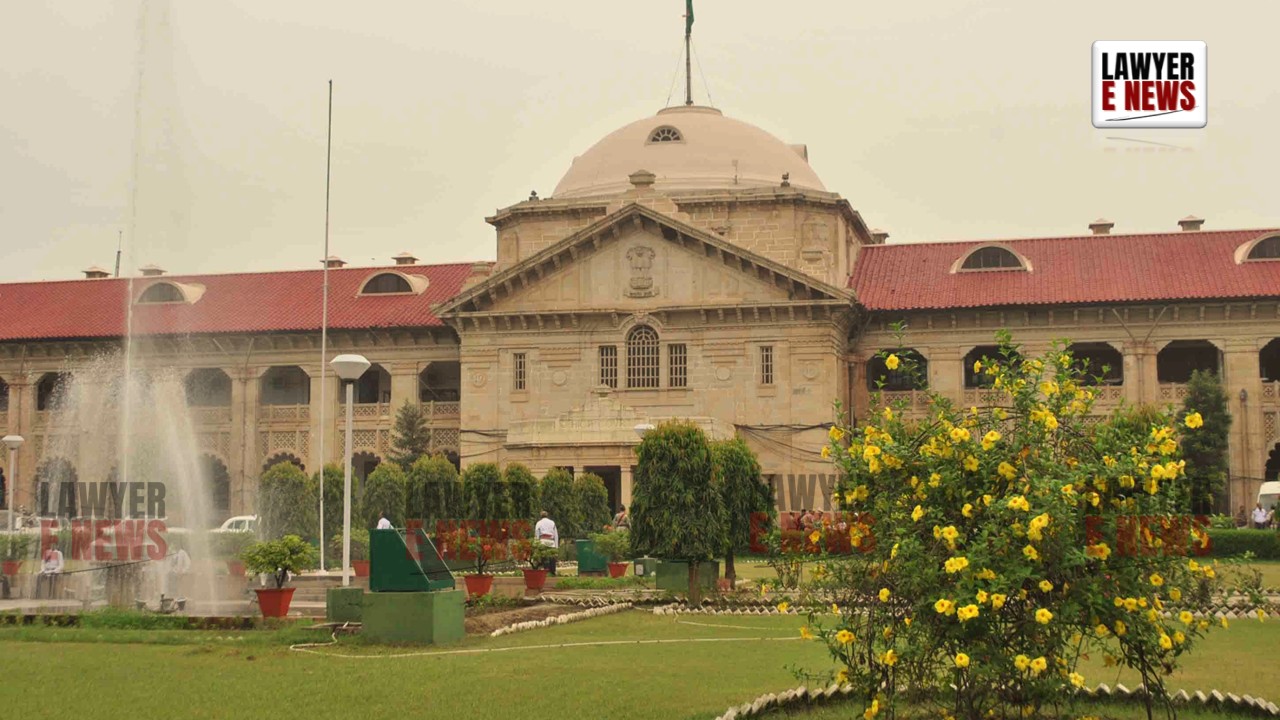
“Dispute whether CNI is lawful successor of CIPBC involves disputed facts... not to be adjudicated in writ jurisdiction, but before competent Civil Court,” held the Allahabad High Court in a landmark decision, finally breaking the deadlock in a decades-old controversy involving the Allahabad High School Society, which manages the historic Boys’ High School & College and Girls’ High School & College in Prayagraj.
The decision came in Writ-C No. 26058 of 2024 and its connected matters, in which rival factions of the Church of North India (CNI) and the Church of India, Pakistan, Burma and Ceylon (CIPBC) have been locked in litigation for over a decade, each claiming the right to control the Society and its institutions. Justice Saurabh Shyam Shamshery delivered a detailed judgment setting aside the controversial Registrar’s order dated 03.08.2022, which had directed joint operation of school bank accounts by rival factions, and restructured interim management through court-appointed oversight.
“Registrar Cannot Override High Court Orders” – Court Declares 2022 Bank Account Directive Illegal
The Court strongly criticized the Registrar, Firms, Societies and Chits, Prayagraj, for issuing directions in 2022 despite the High Court’s earlier status quo order dated 05.06.2015, which explicitly barred changes in the management structure.
“Once there was an order of status quo... the Assistant Registrar should have restrained himself... The impugned order dated 03.08.2022 is an attempt to march over the Court’s authority, and is illegal,” the Court observed while striking down the Registrar’s action.
The 2022 directive had permitted joint bank account operation by the school Principals and one Bishop Rt. Revd. Edgar Morris Dan, associated with the CNI faction. The High Court held that the Registrar had no jurisdiction to decide disputed church leadership or override interim court orders.
“Church Factions Must Fight It Out in Civil Court – Writ Court Not Forum to Settle Succession”
At the heart of the dispute is whether CNI is the rightful successor of CIPBC, which originally controlled the Society under the 1888 registration and 1952 bye-laws. The CIPBC claims that it never lawfully merged with CNI, while the CNI faction insists on being the legitimate ecclesiastical heir.
Both parties cited conflicting precedents. CIPBC relied on the Supreme Court ruling in Vinod Kumar Malviya v. Maganlal Gameti, (2013) 15 SCC 394, which held that mere resolutions of merger do not effect legal succession unless statutory requirements are fulfilled. CNI, on the other hand, cited judgments from the Lucknow Bench of the Allahabad High Court and the Uttarakhand High Court, supporting their continuing management of similar church-run institutions.
But the High Court refused to resolve this in writ jurisdiction, making it clear that only a civil court could determine such disputed and fact-intensive claims.
“There is no specific finding that conclusively establishes the merger... all important legal issues remain open. The matter is better suited for trial, pleadings, and evidence before a competent Civil Court,” the Court said.
“No Legal Elections Held Since 2011 – Interim Management Cannot Continue Indefinitely”
The Court noted with concern that no lawful elections for the Society’s Committee of Management have taken place since 2011, owing to repeated litigation and the High Court’s own status quo orders. As a result, management of the schools has been handled through ad-hoc, court-directed arrangements, giving rise to allegations of mismanagement, financial opacity, and even criminal proceedings between rival factions.
The Court stated: “The interim measure cannot continue indefinitely... Delay has led to allegations of mismanagement and initiation of criminal proceedings. Both factions must now go to the Civil Court to crystallize their rights and allow proper elections.”
“Declare Your Assets to Clear Doubts of Misappropriation” – Court to Long-Serving Principal
The judgment also flagged concerns about the school Principal, whose tenure has stretched over decades amid persistent accusations of misuse of funds and interference in church factional disputes. While the Court acknowledged there is no statutory retirement age, it advised:
“It is always better to infuse young blood... The Principal is advised to voluntarily declare his assets publicly to dispel any perception of embezzlement or mismanagement.”
Court Appoints Justice Umesh Kumar as Observer – Sets Up Transparent Interim Management
Recognizing the need for transparent governance until a final civil court verdict, the High Court appointed Justice Umesh Kumar (Retd.), former judge of the Allahabad High Court, as Court Observer. His role includes verifying records, ensuring regular audits, and supervising school management.
“Justice Umesh Kumar will ensure quarterly audits are conducted by an independent Chartered Accountant... He may seek further directions from this Court if required,” the Court ordered.
For operational control, the Court directed that bank accounts of the schools shall now be jointly operated by the respective Principals, the District Magistrate, and the Commissioner of Police, Prayagraj. The Court also instructed that proper office space and support staff be provided to the Observer on the school premises.
“Delay Is Not in the Interest of Institutions or Either Church” – Court Urges Civil Suit to End Deadlock
The Court urged both factions to move promptly to civil litigation:
“Both factions appear hesitant to go to Civil Court... perhaps in their interest to keep the dispute pending. But they are misled. Prolonged delay only promotes mismanagement and damages these historic institutions.”
The Court concluded that only a binding civil court decision on succession and by-law interpretation can pave the way for fair elections and long-term resolution.
All connected writ petitions were disposed of, the Registrar’s order of 03.08.2022 was set aside, and the Court imposed a transparent interim regime while relegating parties to pursue their claims in civil court. Substitution applications by rival claimants were rejected, holding that no elections could have been lawfully held under a subsisting status quo.
The Allahabad High Court has thus taken a firm step to end institutional paralysis, pushing for final adjudication through proper legal channels while preserving the functioning of one of Prayagraj’s oldest educational institutions.
Date of Decision: November 6, 2025