-
by sayum
04 August 2026 6:31 AM







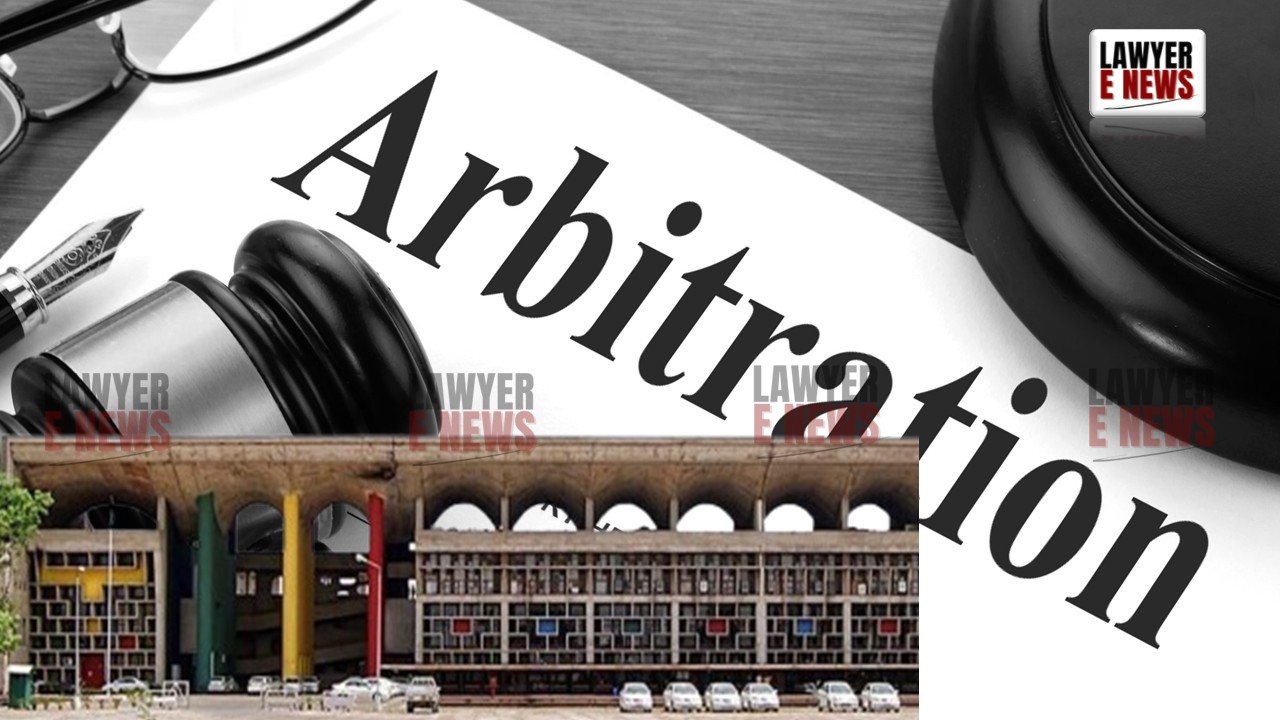
"The dispute is essentially a dispute in personam and not a dispute in rem" — Punjab and Haryana High Court resolving a key issue on the arbitrability of disputes regarding land mutations. Justice Vikram Aggarwal ruled that a dispute challenging a mutation entry in revenue records can be referred to arbitration under Section 8 of the Arbitration and Conciliation Act, 1996, and does not mandatorily require a civil suit. The Court dismissed the revision petition filed under Article 227 of the Constitution, thus affirming that "the Arbitrator would have the jurisdiction to decide about the arbitrability of the dispute as well."
Dalbir Singh and Charanjit Singh, the petitioners, owned ancestral land in Gurugram which had been partially acquired by the State. Disputes arose when a mutation in 2008 recorded Haryana Shehri Vikas Pradhikaran (HSVP) as owner, which the petitioners alleged was never validly effected, claiming continued possession. A Memorandum of Settlement had earlier been executed between the parties during proceedings before the Supreme Court in 2011, whereby the parties had agreed to share rights and proceeds, and importantly, to refer any disputes to arbitration. When petitioners filed Civil Suit No. 4930 of 2018 challenging the mutation, the respondent invoked the arbitration clause. The Trial Court allowed the application under Section 8, referring the matter to arbitration, leading to the current revision petition.
The principal legal issue was whether a dispute concerning mutation entries in land records is arbitrable or whether it exclusively falls within the jurisdiction of civil courts under Section 45 of the Haryana Land Revenue Act, 1887.
The Court emphatically observed, "the dispute in question is a dispute in personam and not a dispute in rem." Justice Aggarwal reasoned that, as the issue concerned the rights inter se between the petitioners and the respondent arising out of a Memorandum of Settlement, it did not impact third-party rights, nor was it of such a public character as to oust arbitration.
The petitioners relied heavily on Sukanya Holdings v. Jayesh Pandya (2003), Booz Allen and Hamilton Inc. v. SBI Home Finance Ltd. (2011), and Vidya Drolia v. Durga Trading Corporation (2021), arguing that the challenge to a mutation is non-arbitrable. However, the Court found these arguments unpersuasive, highlighting that none of the fourfold tests laid down in Vidya Drolia were satisfied to bar arbitration.
The Court meticulously analyzed the statutory framework, especially Sections 8, 9, and 11 of the Arbitration Act, Sections 34 and 35 of the Specific Relief Act, and Sections 45 and 127 of the Haryana Land Revenue Act. Justice Aggarwal quoted extensively from Booz Allen, noting that disputes about private rights and obligations arising under a contract are generally arbitrable.
Citing the Memorandum of Settlement's arbitration clause, the Court stated, "In case of any difference/dispute, the matter will be referred to sole Arbitrator appointed by the Hon’ble Chief Justice of India in accordance with Arbitration and Conciliation Act, 1996 as amended."
Justice Aggarwal further declared, "The law on the subject as also the provisions of Section 16 of the 1996 Act make it manifestly clear that the Arbitrator would have the jurisdiction to decide about the arbitrability of the dispute as well."
The Court criticized the Petitioners for attempting to “wriggle out” of the settlement they had voluntarily entered into, remarking, "Parties should not be permitted to abuse the process of law by instituting multiple litigations with a view to frustrate the settlement arrived at between them."
While noting that the Trial Court erroneously rejected the plaint under Order 7 Rule 11(d) CPC despite no such application, Justice Aggarwal clarified that this technical error would not vitiate the reference to arbitration.
Thus, the Court conclusively held that "there would be no necessity of filing a civil suit" and that the disputes could be decided within arbitration.
The Punjab and Haryana High Court’s judgment reinforces the pro-arbitration stance established by recent Supreme Court decisions. It sets an important precedent that challenges to land mutation entries, when arising between parties to an arbitration agreement, are arbitrable and do not necessarily require a civil court’s intervention.
Date of Decision: 22 April 2025