-
by sayum
26 August 2026 10:38 AM







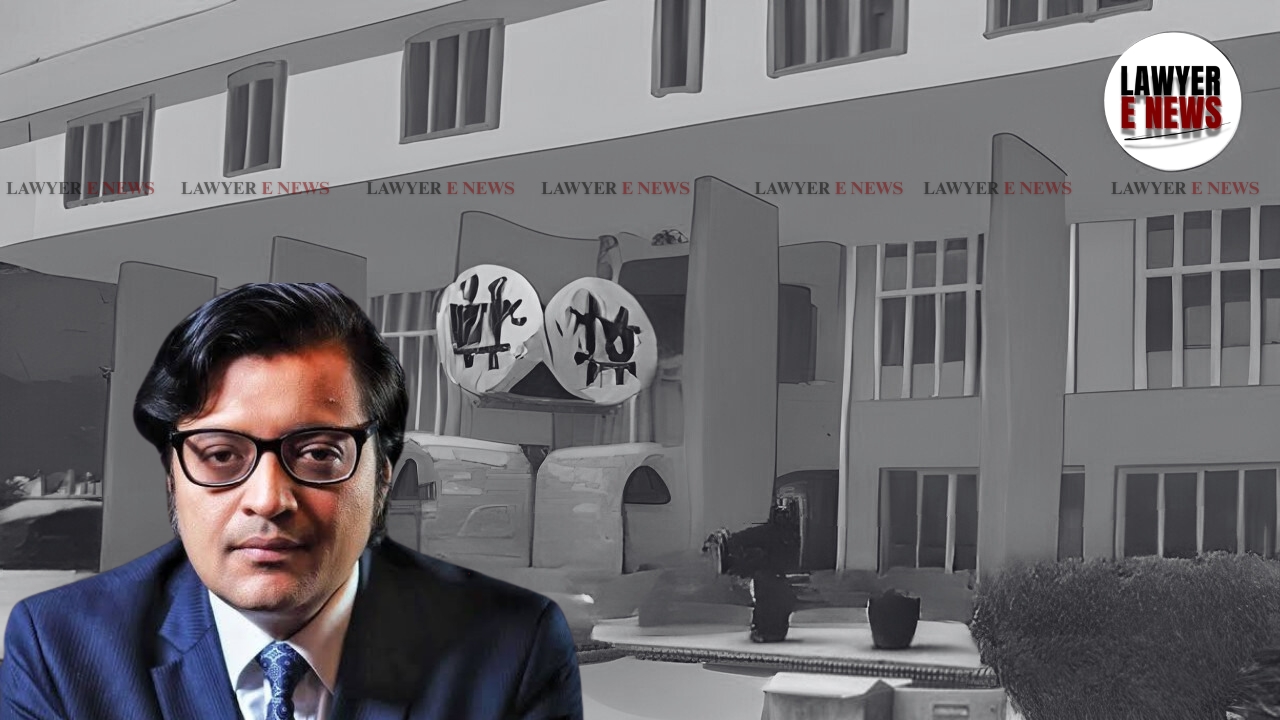
“Words like ‘Gunda’ and ‘Hooligan’ May Be Unpleasant, But Not Defamatory When Reflecting Publicly Documented Conduct” – In a powerful reaffirmation of journalistic freedom, the Delhi High Court quashed the criminal defamation complaint and summoning order against journalist Arnab Goswami and senior directors of Bennett Coleman & Co. Ltd. Justice Neena Bansal Krishna, ruling in Arnab Goswami and Others v. State, held that using expressions like “Gunda Lawyer” or “Hooligan” in the context of public violence cannot amount to criminal defamation, as they reflected commentary on recorded conduct, not an assault on personal reputation.
“It may be in poor taste,” observed the Court, “but words describing documented acts of public violence cannot be criminally prosecuted when used as fair journalistic comment.”
The decision came in three connected petitions under Section 482 CrPC, arising from a complaint filed by Advocate Vikram Singh Chauhan, who alleged that Goswami’s televised debate titled ‘Why No Action Against Goon Lawyers’ had harmed his reputation following the 2016 Patiala House Court violence during the JNU protests.
“No Intention, No Defamation”: Court Finds Remarks Contextual, Not Malicious
Justice Bansal Krishna clarified that the offence of defamation under Section 499 IPC requires mens rea — an intent to harm or knowledge that one’s words would damage another’s reputation. “Unless one makes the offending imputation with such a state of mind,” the Court held, “he cannot be said to have committed the offence of defamation.”
Arnab Goswami’s remarks, the Court said, must be seen against the factual background of violent assaults inside Patiala House Court, widely condemned by the Supreme Court and the Bar Council of India. “When assessed in this context,” the judgment noted, “a reasonable viewer would perceive the programme as legitimate journalistic commentary on matters of significant public concern, rather than as a malicious attack.”
The Court found that the words “Gunda”, “Hooligan” and “Rogue Lawyers” did not target the complainant’s moral character or professional integrity, but referred to publicly documented conduct during violent events. “Where conduct itself is violent, rowdy, and criminal,” the Court remarked, “describing it in strong terms does not constitute defamation merely because more polite language could have been used.”
“Company Has No Mind to Form Intent”: Bennett Coleman & Co. Ltd. Cannot Be Prosecuted for Defamation
A striking part of the judgment addressed whether a company could be prosecuted for defamation. The Court gave a categorical answer — No. “A juristic entity cannot possess a criminal mind,” Justice Krishna wrote, drawing from the Calcutta High Court’s ruling in Sunilakhya Chowdhury v. H.M.J.H. Jadwet.
“The absence of a natural mind or capacity for forming the requisite mens rea precludes the attribution of criminal intent to a juristic entity,” the Court declared. “In light of settled law, a company cannot be prosecuted for the offence of defamation under Section 499 IPC.”
With this reasoning, Bennett Coleman & Co. Ltd. was released from all liability in the case.
“Directors Are Not Criminally Liable Without Specific Role”: Court Rejects Vicarious Liability in Defamation
The Court also dismantled the complaint’s attempt to implicate the company’s senior management — Samir Jain, Vineet Jain, Indu Jain, and Shrijeet Ramakant Mishra — merely based on their positions in the organisation.
“It is the cardinal principle of criminal jurisprudence,” the Court reminded, “that there can be no vicarious liability unless the statute specifically provides so.” Referring to the Supreme Court’s ruling in Sunil Bharti Mittal v. CBI, the Court reiterated that directors can only be summoned if there is specific evidence of their personal involvement in the alleged offence.
The complaint, however, “failed to delineate their respective roles in editorial oversight or decision-making processes related to the broadcast,” observed the Court. “Omnibus statements alleging connivance are not enough. Mere designation in corporate hierarchy cannot fasten criminal liability.”
“Press Freedom Includes the Right to Criticize Public Misconduct”: Court Balances Article 19(1)(a) and Article 21
In a detailed discussion on the balance between free speech and reputation, Justice Bansal Krishna reaffirmed that the press enjoys constitutional protection when reporting or commenting on matters of public importance.
Quoting the Supreme Court’s ruling in Subramanian Swamy v. Union of India (2016), the Court observed that while “reputation is part of Article 21’s protection of dignity,” the right to reputation must yield when the speech concerns truthful, good-faith criticism of public conduct.
“Honest reporting, absent malice, is protected by the freedom of speech,” the Court said, echoing the apex court’s observation in Sanjay Upadhya v. Anand Dubey (2024). “The broadcast in question neither invented facts nor relied on rumour; it directly addressed documented events that were already part of public record.”
“Continuation of Proceedings Would Be an Abuse of Process”: Complaint and Summoning Order Quashed
Finding the entire prosecution baseless, Justice Bansal Krishna declared that the continuation of the criminal complaint would “amount to an abuse of the process of law.”
“The complaint does not contain any allegations to establish defamation by any of the petitioners,” she concluded. “The continuation of proceedings would serve no purpose other than harassment.”
The criminal complaint and summoning order dated 28.02.2018 were thus quashed in entirety.
“A Company Cannot Defame; A Journalist Can Comment” — Delhi High Court Draws the Line Between Reporting and Malice
By holding that companies cannot possess criminal intent, directors cannot be vicariously liable, and journalists cannot be punished for fair, factual commentary, the Delhi High Court reaffirmed the principle that freedom of speech under Article 19(1)(a) must be interpreted with “a generous spirit, not a grudging mind.”
This decision underscores a crucial precedent: “Harsh criticism, if based on facts and public record, is not defamation — it is democracy speaking.”
Date of Decision: November 4, 2025