-
by sayum
26 August 2026 12:18 PM







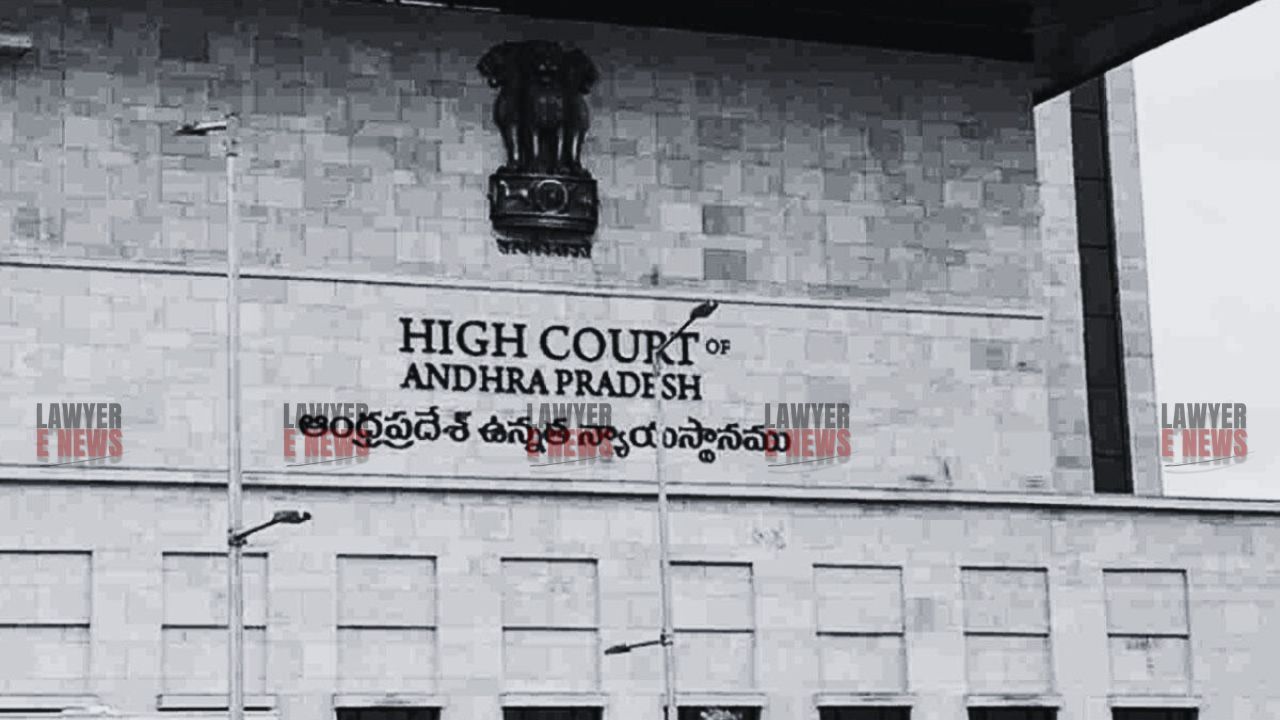
High Court of Andhra Pradesh, through Justice T. Mallikarjuna Rao, dismissed a 16-year-old criminal appeal filed by the State of Andhra Pradesh against the acquittal of the accused in a case under Section 354 of the Indian Penal Code, 1860. The Court found no perversity or illegality in the judgment of the Sessions Court that had acquitted the accused, holding that the prosecution failed to establish guilt beyond reasonable doubt and that the principles guiding appellate interference in acquittal cases were not satisfied.
The case revolved around an allegation of outraging the modesty of a woman in a public space, but the High Court found that the testimony of the prosecutrix lacked the consistency, corroboration, and evidentiary weight required to justify reversal of acquittal.
"Sole Testimony of Prosecutrix Must Inspire Confidence to Sustain Conviction; Mere Allegation Not Sufficient"
The core issue in the case was whether the trial court erred in acquitting the accused when the complainant’s testimony remained uncorroborated. While acknowledging that the law permits conviction solely on the testimony of the prosecutrix if it is found to be credible and reliable, the Court held that such was not the situation in the present case.
The High Court underscored that “though conviction may be based on the sole testimony of the prosecutrix, such evidence must be of sterling quality and inspire confidence.” Citing Wahid Khan v. State of Madhya Pradesh (2010) 2 SCC 9 and Rameshwar v. State of Rajasthan AIR 1952 SC 54, the Court reiterated that “the absence of corroboration is not fatal, but the quality of the sole testimony must stand up to rigorous scrutiny.” In this case, however, the testimony of PW.1—the prosecutrix—suffered from internal inconsistencies and lack of support from any other material witness.
Sessions Court Had Acquitted Accused Based on Unreliable Evidence and Procedural Lapses
The prosecution alleged that on 14.10.2006 at around 10:00 p.m., the accused, in an inebriated state, purchased cigarettes from the complainant’s roadside shop and subsequently slapped her, dragged her into a dark area, and hugged her against her will. The woman’s screams allegedly caused the accused to flee when some jute mill workers arrived.
The complainant lodged the FIR (Ex.P1) nearly 36 hours later, on 06.10.2006 at 2:00 p.m. The delay, said to be due to waiting for village elders to mediate the issue, was deemed unexplained and suspicious by both the Sessions Court and the High Court.
In Sessions Case No. 5 of 2008, the Additional Assistant Sessions Judge, Eluru, after evaluating six prosecution witnesses and five exhibits, acquitted the accused on 10.12.2008, citing unreliable evidence and lack of independent corroboration. The State appealed under Section 378(4) of the Cr.P.C., challenging the acquittal.
“Interference in Acquittal Only When Judgment is Perverse or Illegal”: High Court Reaffirms Appellate Restraint in Criminal Appeals
Justice Rao meticulously reviewed the applicable standards for interfering in an appeal against acquittal. Referring to the landmark ruling in A. Shankar v. State of Karnataka (2011) 6 SCC 279, the Court noted:
“In exceptional circumstances the appellate Court, under compelling circumstances, should reverse the judgment of acquittal of the Court below if the findings so recorded are perverse…or manifestly illegal or grossly unjust.”
The Court further emphasized the heightened presumption of innocence that operates in favour of an acquitted person, observing that once acquitted, the accused benefits from a “double presumption of innocence”, making interference permissible only in rare circumstances. Citing State of Goa v. Sanjay Thakran (2007) 3 SCC 755, the Court held:
“Merely because two views are possible, the appellate court would not substitute its own view unless the one taken by the trial court is unreasonable or contrary to the weight of evidence.”
Reasons for Dismissal: Hostile Witnesses, Unexplained Delay, and Discrepancies in Testimony
The High Court agreed with the Sessions Court’s reasoning on several critical evidentiary issues:
PW.3, an alleged eyewitness, turned hostile, denying knowledge of the incident. The prosecution failed to identify or examine the jute mill workers said to have witnessed the assault.
PW.1’s testimony was riddled with contradictions, including omission of key allegations like slapping in her initial statement and inconsistency regarding when village elders were approached.
PW.2, the complainant's mother, was not present at the time of the incident, and did not come to the scene despite being just 50 yards away, even as the victim allegedly cried for help.
The 36-hour delay in lodging the FIR was not credibly explained. Citing Apren Joseph v. State of Kerala AIR 1973 SC 1 and State of M.P. v. Kriparan (2003) 12 SCC 675, the Court observed that such delays raise suspicion and undermine the trustworthiness of the prosecution’s version.
Testimony of PW.4, a village elder, conflicted with PW.1 regarding the timing of reporting the incident, further weakening the prosecution’s narrative.
“Suspicion Cannot Replace Proof” – High Court Upholds Acquittal
Summing up, the High Court ruled that:
“It is a settled proposition of law that in a criminal trial, suspicion, however grave, cannot take the place of proof. The prosecution must establish guilt beyond reasonable doubt.”
There being no glaring error, manifest illegality, or perversity in the Sessions Court’s approach, and the view taken by it being plausible, the High Court concluded that there was no reason to disturb the acquittal.
Accordingly, the appeal was dismissed and the judgment of the Sessions Court was confirmed.
Date of Decision: 31.10.2025