-
by Deepak Kumar
13 September 2026 8:08 AM







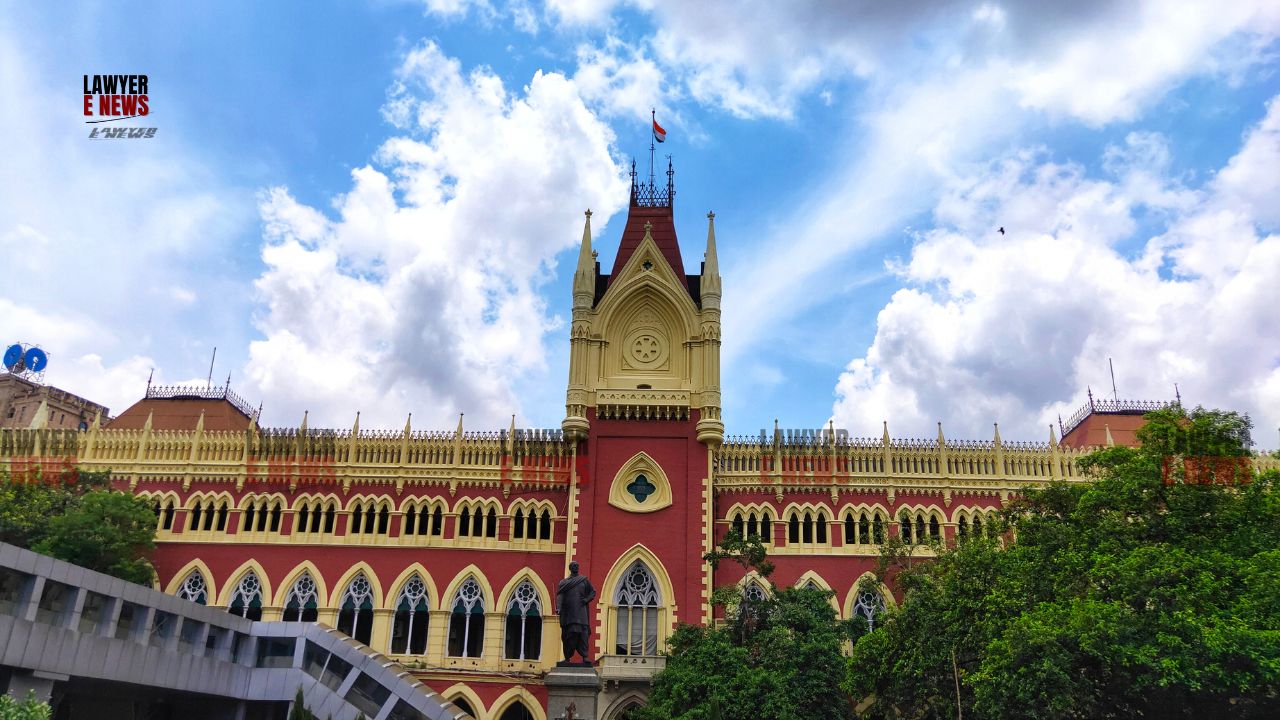
Calcutta High Court, in a significant ruling dated August 20, 2026, held that a writ petition under Article 226 of the Constitution of India is maintainable against major disciplinary penalties when alternative statutory forums are non-functional and administrative conciliation processes remain indefinitely stalled.
A Single Judge bench of Justice Shampa Dutt (Paul) underscored that the extraordinary constitutional writ jurisdiction must step in to prevent arbitrariness, observing that "access to justice ought not to be denied when Tribunal is not functioning" and the workman is left with no effective forum.
The petitioner, a union office-bearer employed with Garden Reach Shipbuilders & Engineers Ltd. (GRSE), approached the High Court challenging two separate domestic enquiry proceedings and consequential major penalty orders reducing his pay scale. Facing back-to-back disciplinary actions spanning nearly a decade alongside long-pending conciliation applications that yielded no reference, the petitioner invoked Article 226 seeking quashing of the punitive measures.
The primary questions before the Court were whether the writ petition was maintainable under Article 226 in the presence of alternative statutory machinery under the Industrial Disputes Act, 1947, and whether tribunal vacancies and prolonged pendency of conciliation proceedings justified the High Court’s direct exercise of judicial review.
Alternative Remedy Rule Is Discretionary, Not An Absolute Bar
The employer vehemently contested the maintainability of the writ petition, arguing that the legality of domestic disciplinary penalties must be adjudicated before the statutory labour machinery where oral and documentary evidence can be adduced. Relying extensively on Supreme Court precedents including Thansingh Nathmal v. Superintendent of Taxes, Bongaigaon Refinery & Petrochemicals Ltd. v. Samijuddin Ahmed, and Punjab National Bank v. Atmanand Singh, the respondent contended that the High Court should decline to exercise its discretionary jurisdiction and relegate the workman to statutory forums.
Addressing these contentions, the Court reiterated the settled constitutional position that the power to issue prerogative writs under Article 226 is plenary in nature and not confined by rigid statutory limitations. While the High Court ordinarily observes self-imposed restrictions where an equally efficacious statutory remedy exists, such self-restraint cannot be converted into an insurmountable technical barrier when the State or its instrumentality acts arbitrarily.
Non-Functional Tribunals And Stalled Conciliation Cannot Foreclose Relief
The Court meticulously evaluated the institutional impediments faced by the petitioner, noting that the Central Government Industrial Tribunal (CGIT) at Kolkata lacked a regular, full-time Presiding Officer and was functioning merely on ad-hoc charge. Furthermore, the petitioner's statutory applications alleging unfair labour practices under the Fifth Schedule of the Industrial Disputes Act, 1947, had been languishing before the Regional Labour Commissioner (Central) for more than four years without any conclusive determination.
The Bench highlighted that the fast-track mechanism under Section 2A(2) of the Industrial Disputes Act, 1947, was statutorily unavailable to the employee since the dispute pertained to major salary reductions rather than discharge, dismissal, or retrenchment. Consequently, an indefinite delay at the conciliation stage virtually extinguished the employee's prospects of securing a reference to an industrial adjudicator, rendering the alternative remedy entirely illusive and remote.
"Conciliation proceedings pending indefinitely also causes severe prejudice to the employees, who having being given 'major penalty' but not the punishments which would enable the worker to take recourse to section 2A of the Act, are left with no option to avail the provisions of the Industrial Disputes Act, 1947, a beneficial legislation..."
Expansive Reach Of Mandamus To Prevent Manifest Injustice
Citing the landmark ruling in Andi Mukta Sadguru Shree Muktajee Vandas Swami Suvarna Jayanti Mahotsav Smarak Trust v. V.R. Rudani, the Court reaffirmed that the judicial review powers under Article 226 must remain adaptable to variable circumstances to ensure that technicalities do not defeat justice. Relying on the doctrine that mandamus is a broad remedy designed "to reach injustice wherever it is found," the Court held that the writ court is fully competent to examine questions of both fact and law when a litigant is effectively shut out of alternative forums.
The Bench also drew support from the Supreme Court's pronouncement in Gunwant Kaur v. Municipal Committee, Bhatinda, as reaffirmed in Punjab National Bank, which settled that the High Court is not deprived of its jurisdiction merely because questions of fact arise. Where the material dispute rests primarily on documents and record without demanding complex oral evidence, summary dismissal of a writ petition in limine on grounds of disputed facts or alternative remedy is wholly unjustified.
Prima Facie Arbitrariness Justifies Constitutional Scrutiny
Examining the factual backdrop, the Court observed that the petitioner had been subjected to continuous, back-to-back disciplinary actions since 2017 while serving as an elected union office-bearer. The Court took note of procedural infirmities, including the curtailment of defense witnesses from ten to four during the enquiry, as well as the institution of subsequent proceedings founded solely on an uncorroborated statement of an HR official without independent eyewitnesses.
The Court concluded that the cumulative circumstances established a prima facie case of arbitrariness and unfair labour practice against the State instrumentality, warranting direct constitutional intervention rather than mechanical relegation to stalled statutory mechanisms.
"In the present case, the action of the respondents, the State and its instrumentality prima facie appears to be arbitrary and unreasonable and this Court thus holds that the writ is maintainable and is now to be now heard on merit."
The High Court accordingly dismissed the preliminary objection on maintainability and directed the writ petition to be listed for final hearing on merits. The Court directed both parties to exchange and submit their respective written notes of arguments ahead of the substantive hearing.
Date of Decision: 20 August 2026