
-
by sayum
26 August 2026 1:49 PM







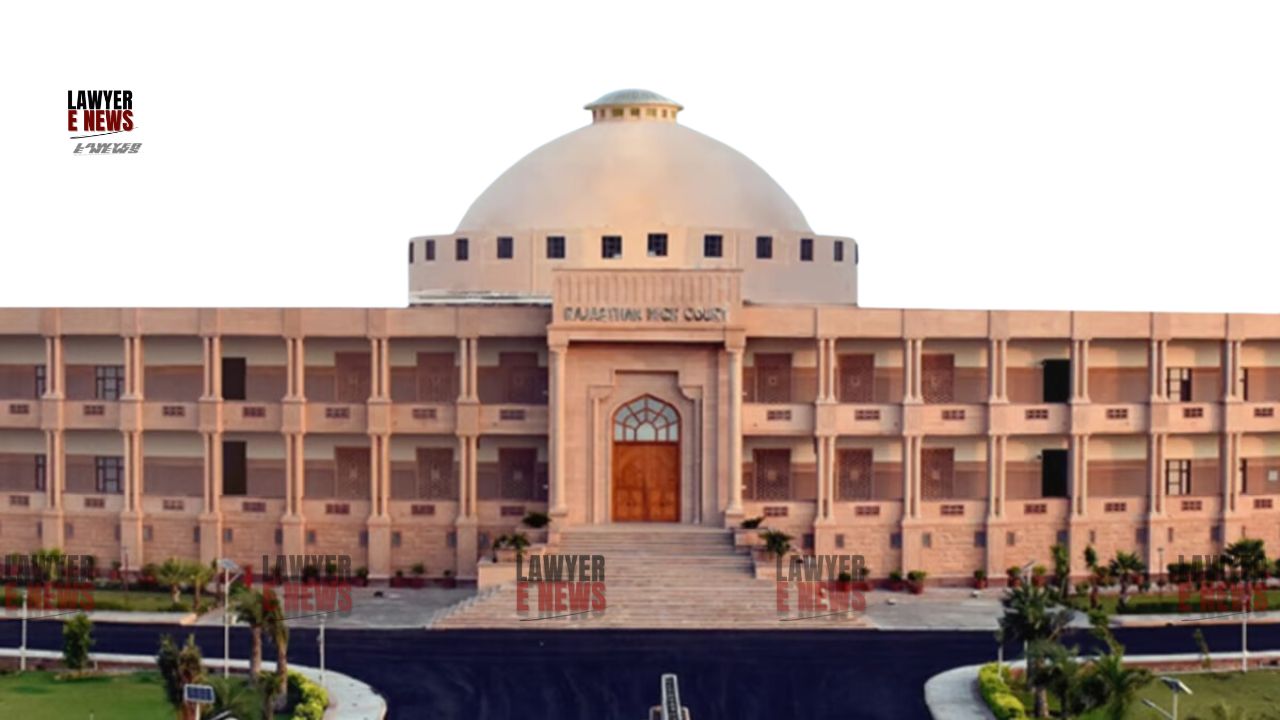
“Permissive Possession Does Not Confer Ownership — A Father’s Permission Can Be Withdrawn at Any Time” - In a powerful reaffirmation of a property owner's right to reclaim self-acquired property from family members occupying it without legal title, the Rajasthan High Court dismissed a son’s second appeal against eviction orders passed by two lower courts. Justice Sudesh Bansal held that the son’s claim of joint family ownership and coparcenary rights was "entirely misconceived and unproven", observing that residing in a parent's property under permissive occupation creates no vested legal right.
The Court held: “A child continues to reside in the property of his father during his childhood by virtue of love and affection and because of the parental duty of the father. But that does not create a right in the child to claim the property to be his own.”
The judgment settles a vital question in family property disputes, where adult children resist vacating parental homes by asserting vague claims of ancestral or joint ownership. The Court called such litigation not only frivolous but an erosion of societal values and family trust, imposing ₹1,00,000 as exemplary costs on the appellant.
“The Word ‘Licensee’ is Not Fatal — Suit for Mandatory Injunction Maintainable Against Permissive Occupant”
In the case of Ritesh Khatri v. Shyam Sundar Khatri, the appellant-son challenged concurrent findings of the Trial and First Appellate Courts, which had directed him to vacate a portion of the residential property owned by his father. The High Court upheld the decisions and clarified that a person in permissive possession — especially in a parent-child relationship — can be evicted through a suit for mandatory injunction, even without strict proof of a licensor-licensee relationship.
Refusing to interfere under Section 100 of the Code of Civil Procedure, the High Court held there was no substantial question of law since the lower courts had already made sound fact-findings based on cogent evidence.
The suit property, a residential house in Sawai Madhopur, was jointly purchased in 1974 by the plaintiff-father and his brother through auction and partitioned mutually. The plaintiff built his residence on the western side. His son, the defendant, was allowed to live in a portion of the house after his marriage.
However, due to alleged misbehaviour, the father revoked permission via a legal notice in 2018 and filed a suit in 2019 seeking a mandatory injunction for eviction along with mesne profits. The son retaliated by claiming the property was part of an HUF and that he was a coparcener. He even sought to restrain his father from interfering with his continued possession and alleged oral partition in his favour.
The Trial Court rejected the counterclaim and found that the firm from which the property was purchased was a registered partnership, not an HUF. The First Appellate Court affirmed the finding. The son approached the High Court through second appeal.
Whether permissive occupation can be equated with legal possession entitling protection against mandatory injunction?
The Court held: “Permissive possession is not a legal right. It stems from a family arrangement or affection and can be withdrawn. A person in such possession is bound to vacate when the owner desires.”
The appellant tried to rely on the use of the term licensee in the plaint to argue that since the trial court found no formal license, the suit must fail. The High Court rejected this technical argument:
“Though the word ‘licensee’ has been used, the true intent is to describe a permissive occupation. Gratuitous permission by a parent does not create enforceable rights.”
In support, the Court cited the decision in Joseph Severance v. Benny Mathew, (2005) 7 SCC 667, and Prabhudas Damodar Kotecha v. Manhabalal Jeram Damodar, (2013) 15 SCC 358, where the Supreme Court recognised gratuitous licenses and permissive possession as valid grounds for eviction upon revocation.
Referring to Ramesh Kumar Handoo v. Binay Kumar Basu [MANU/DE/8953/2007], the Court underlined:
“A child lives with his parents under permissive possession, not as a licensee in the contractual or statutory sense. Once permission is revoked, no legal right subsists.”
Dismissal of Coparcenary Claim
The High Court upheld the concurrent factual finding that the property was self-acquired and not part of a Hindu Undivided Family. It held:
“The defendant did not produce a single document or piece of evidence to establish that the property in question belonged to HUF… He miserably failed to prove any right, title, or interest.”
Even the partnership firm cited by the appellant was proven not to be an HUF entity. The register of firms, partnership documents, and income tax records collectively disproved the claim of joint family ownership.
The Court found support in the ruling of the Punjab and Haryana High Court in Jai Raj v. Shyam Lal, RSA No.1270/2016, where it was held:
“Continued residence by a child in the property of the parent out of love and affection does not create a legal right unless the property is ancestral.”
Suit for Mandatory Injunction Not Barred
The appellant also argued that since he was in possession, the father ought to have filed a suit for possession rather than injunction. This argument too was rejected, with the Court citing Maria Margadia Sequeria Fernandes v. Erasmo Jack De Sequeria, AIR 2012 SC 1727, where it was held:
“A title holder can file a civil suit for mandatory injunction requiring a person to remove himself, if the possession was permissive and the permission is withdrawn.”
The Bombay High Court decision in Conrad Dias v. Joseph Dias, AIR 1995 BOM 210, was also cited:
“Where the father and son are in joint possession, and the father revokes permission, a suit for injunction is not barred.”
No Substantial Question of Law Under Section 100 CPC
The Court emphasized that under Section 100 of the CPC, interference is permissible only on a substantial question of law. Citing S. Subramanian v. S. Ramasamy, (2019) 6 SCC 46, the Court said:
“Concurrent findings of fact by both courts below cannot be interfered with unless they are perverse or based on no evidence. None of the framed questions qualify as substantial questions of law.”
Exemplary Costs Imposed for Harassment and Erosion of Family Trust
Noting that the son persisted with litigation despite failing in every forum and lacking any legal claim, the Court imposed exemplary costs of ₹1,00,000 on him:
“This is nothing but sheer harassment of the father by his son. In order to demote such kind of litigation, which undermines the pious and trustful relationship of father and son, the appellant deserves to be saddled with costs.”
The Court remarked that such litigations damage not only the individual family fabric but also clog judicial processes with emotionally charged but legally untenable claims.
The second appeal was dismissed in its entirety. The Court held: “The present second appeal is devoid of substance and has no merit. No other substantial question of law arises. The suit for mandatory injunction was rightly decreed.”
Date of Judgment: 28 October 2025





