-
by sayum
26 August 2026 10:38 AM







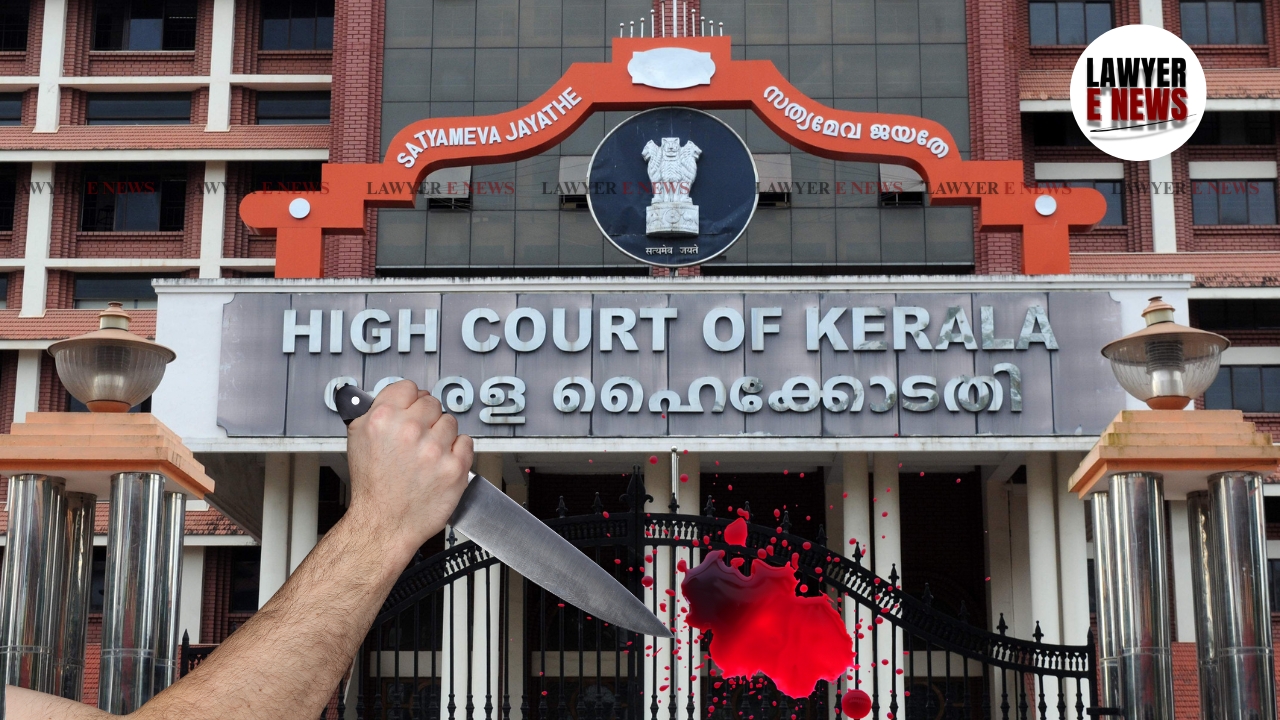
“When the blade pierces vital organs in a deliberate thrust, Section 300 ‘Thirdly’ is unmistakably attracted”— Kerala High Court delivered a significant ruling reaffirming the principles governing single-blow homicide cases under Section 302 of the Indian Penal Code, 1860. A Division Bench of Justice Raja Vijayaraghavan V and Justice P. Krishna Kumar dismissed the criminal appeal filed by the appellant, affirming the conviction and life sentence imposed by the Sessions Court for the murder of an electrician, Sumesh, by a single, deliberate stab wound to the chest, which the Court held fell squarely within the ambit of Section 300 “Thirdly” of the IPC.
Rejecting the argument that the case should be treated as culpable homicide not amounting to murder, the Court held that the nature, location, and depth of the injury—passing through the chest, pericardium, right ventricle, aorta, left atrium, and esophagus—left no doubt about the homicidal intent and ruled that Section 302 IPC was rightly applied by the trial court.
“Credibility of Independent Temple Witnesses Remains Unshaken—Their Testimonies Bear the Ring of Truth”
The bench underscored that the conviction was not solely based on forensic recovery but firmly anchored in clear and cogent ocular evidence from two natural and independent eyewitnesses—Muthu (PW8) and PW9, both of whom were present inside the temple premises at the time of the murder.
The Court observed, “On a close reading of the cross-examination, it is apparent that not even a single suggestive question was put to indicate that these witnesses were interested, biased, or motivated to falsely implicate the accused.”
The High Court emphatically dismissed the defence's attempt to challenge the credibility of the eyewitnesses, highlighting that minor discrepancies in testimony are natural and expected in traumatic situations, and quoting State of Rajasthan v. Kalki, reiterated that:
“Discrepancies in testimony are inevitable, however honest and truthful the witness may be. Only those discrepancies that are unnatural or inconsistent with the normal course of human conduct can be termed material.”
A Stabbing in the Temple Precincts
The case arose from a gruesome incident on 18 November 2015, when the deceased Sumesh, an electrician, was standing inside the Edakkadavu Temple, Kollam, around 7:45 a.m., engaged in a conversation with PW8. According to the prosecution, the accused persons—Unnikuttan (A1), Sreekuttan @ Chemban (A2, appellant), and Rahul @ Nikesh (A3)—arrived at the temple on a motorcycle.
The 1st accused struck the victim with the blunt side of a sword, the 3rd accused slapped him, and the 2nd accused (appellant) stabbed Sumesh on the left side of the chest with a knife (MO6). The wound proved fatal. Though the injured was rushed to the District Hospital, Kollam, he succumbed to his injuries. The appellant was apprehended shortly after by locals.
Delay in FIR – Satisfactorily Explained, Not Fatal
The appellant argued that the delay in registration of the FIR (from 9:40 a.m. to 2:34 p.m.) cast doubt on the prosecution version and allowed room for embellishment. Relying on Imrat Singh v. State of M.P. and Jaffrudheen v. State of Kerala, the defence contended that such delay was indicative of manipulation.
However, the Court held:
“The sequence of events—statement at 9:40 a.m., inquest from 11:00 a.m. to 12:30 p.m., FIR registered by 2:34 p.m., and reaching the Magistrate’s Court by 4:20 p.m.—shows no undue delay. The delay stands reasonably explained by medical and procedural necessities.”
The Court further rejected the claim that delay in examining PW9, who was questioned on the third day, vitiated the case, noting that his testimony stood independent and credible.
Credibility of Eyewitnesses – Consistent, Natural, and Unimpeached
The central pillar of the prosecution case was the ocular testimony of PWs 8 and 9, who, being unconnected to the deceased, had no motive to falsely implicate the accused.
The Court observed:
“There is no plausible basis for suggesting that they had any reason to shield the real culprit or falsely implicate the appellant.”
“Testimonies must be viewed holistically and with due regard to human limitations in perception and recollection. Minor inconsistencies do not go to the root of the case.”
Recovery of Weapon – Helpful But Not Indispensable
The knife (MO6) used to stab the deceased was recovered based on the disclosure statement made by the appellant, as recorded in Ext.P2 Mahazar. Although the defence sought to challenge the recovery citing procedural lapses and ownership of the premises, the Court held:
“Even if there were infirmities in the recovery of MO6, it is not the sole or indispensable link. The consistent and credible ocular testimony, corroborated by medical evidence, independently establishes the appellant’s guilt.”
Section 300 “Thirdly” – Intention Inferred from the Nature and Consequence of the Blow
The most contested issue in the appeal was whether the act of stabbing, which involved a single blow, constituted murder or could be scaled down to culpable homicide not amounting to murder.
Rejecting the plea for conversion to Section 304 Part II, the Court relied on the Supreme Court’s settled position in Virsa Singh v. State of Punjab and Anpazhagan v. State to hold:
“Even if a single injury is inflicted, if that particular injury was intended and objectively sufficient in the ordinary course of nature to cause death, Clause Thirdly of Section 300 IPC is attracted.”
It concluded:
“The blade passed through multiple vital organs—the heart, aorta, and esophagus—with force and precision. The nature, depth, and direction of the wound clearly establish that it was a grave, homicidal injury sufficient in the ordinary course of nature to cause death.”
Thus, the offence was held to fall clearly within Section 302 IPC, and not within the exceptions of Section 300, nor within Section 304.
No Interference Warranted—Appeal Dismissed
The Kerala High Court concluded that the Sessions Judge had properly appreciated the evidence and correctly applied the law in convicting the appellant for murder under Section 302 IPC.
“We find no reason to interfere with the judgment rendered by the learned Sessions Judge. This appeal is dismissed.”
The conviction of life imprisonment, along with the fine and default clause, stands affirmed.
Date of Decision: 03 November 2025