-
by sayum
28 August 2026 2:11 PM







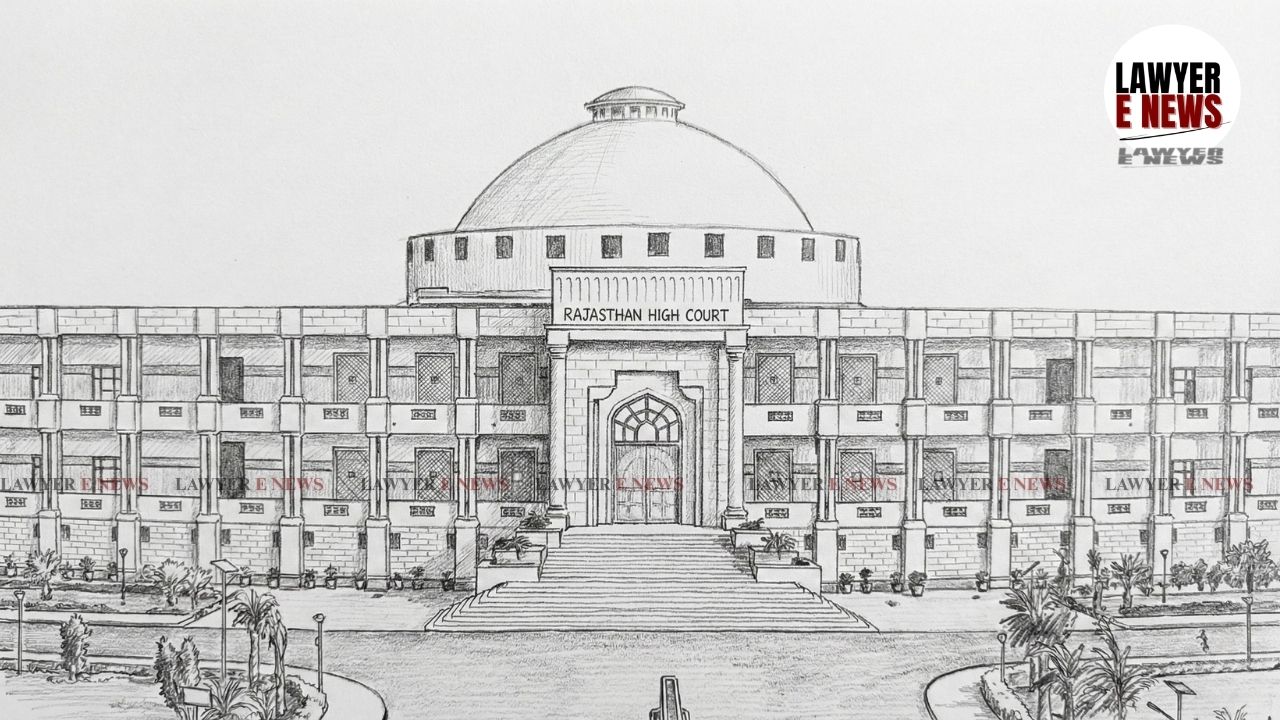
"The learned trial Court, while rejecting the application, failed to appreciate that expert examination of the disputed document may have a direct bearing on the just adjudication of the matter," Rajasthan High Court, in a significant ruling, held that when a complainant in a cheque dishonour case categorically denies their signatures and handwriting on a document produced by the accused, the document must be sent for expert forensic examination.
A bench of Justice Farjand Ali observed that such verification is essential for a just adjudication, especially when the document is claimed to be a receipt for the very amount forming the subject matter of the complaint.
The matter arose from a complaint filed under Section 138 of the Negotiable Instruments Act, 1881, alleging that the petitioner, Vikram Singh, failed to repay a loan of Rs. 10,00,000. During the trial, the petitioner produced a document (Exhibit D01A), claiming it to be a receipt related to the transaction. However, the complainant denied both the handwriting and the signatures on the said receipt. Consequently, the petitioner moved an application to refer the document to the Forensic Science Laboratory (FSL), which was rejected by the trial court on January 3, 2026.
The primary question before the court was whether the trial court was justified in rejecting the application for forensic examination of a disputed receipt. The court was also called upon to determine if a complainant's total denial of a document necessitates expert intervention to ensure a fair trial for the accused.
Trial Court Rejected Application On Conjectural Premises
The High Court noted that the petitioner sought the referral of Exhibit D01A to the FSL for verification of the complainant’s signatures after the recording of the accused's statement. The learned trial court had rejected this application on the ground that the said verification would not have any bearing on the outcome of the trial.
Court Finds Rejection Order Legally Unsustainable
Justice Farjand Ali observed that the trial court’s decision was based on "wholly conjectural premises." The High Court emphasized that once a document is tendered as evidence pertaining to the transaction in question, its authenticity becomes a pivotal factor in the trial.
Effect Of Categorical Denial By Complainant
Total Denial Disentitles Complainant From Claiming Lack Of Nexus
The Court highlighted a crucial distinction in legal strategy. It observed that if the complainant had admitted the execution of the receipt but explained that it was unrelated to the specific transaction, the matter might have stood on a different footing. However, the complainant chose a stand of complete denial regarding both handwriting and signatures.
"Once the complainant has taken a complete stand of denial regarding both handwriting and signatures appearing on Exhibit D01A, such denial, prima facie, disentitles him from subsequently raising a plea that the document bears no nexus with the transaction involved in the complaint."
Expert Opinion Vital For Fair Trial Rights Of Accused - Direct Bearing On Just Adjudication
The Court underscored that the appropriate course for the complainant would have been to clarify in his testimony if the receipt had no concern with the transaction. By failing to allow the FSL examination, the trial court overlooked the fact that an expert opinion could be decisive for the final judgment.
"The appropriate course for the complainant was to clarify in his testimony itself that the receipt in question had no concern with the transaction forming subject matter of the complaint."
"The learned trial Court may itself identify such admitted documents or may require the parties to furnish the same and whereafter send those, both disputed and undisputed admitted papers to the FSL."
Directions For Forensic Comparison
Trial Court To Use Vakalatnama And Other Records For Comparison
The High Court set aside the trial court's order and allowed the petitioner's application. It directed the trial court to send the disputed Exhibit D01A to the FSL. For the purpose of comparison, the court instructed the use of the complainant’s admitted signatures available on the record, including the Vakalatnama and other applications.
Stay On Trial Proceedings Pending FSL Report
To ensure that the forensic evidence is integrated into the trial properly, the Court ordered that further proceedings before the learned trial court shall remain stayed until the receipt of the FSL report. The Court also directed that all documents be properly marked separately before being forwarded to the handwriting expert.
The High Court concluded that the trial court's refusal to seek an expert opinion on a disputed document produced in defense caused a legal infirmity. By allowing the petition under Section 528 of the Bharatiya Nagarik Suraksha Sanhita (BNSS), 2023, the Court reinforced the principle that the accused must be given a fair opportunity to prove their defense through scientific evidence when the complainant denies the execution of documents.
Date of Decision: 12 May 2026