-
by sayum
05 August 2026 9:31 AM







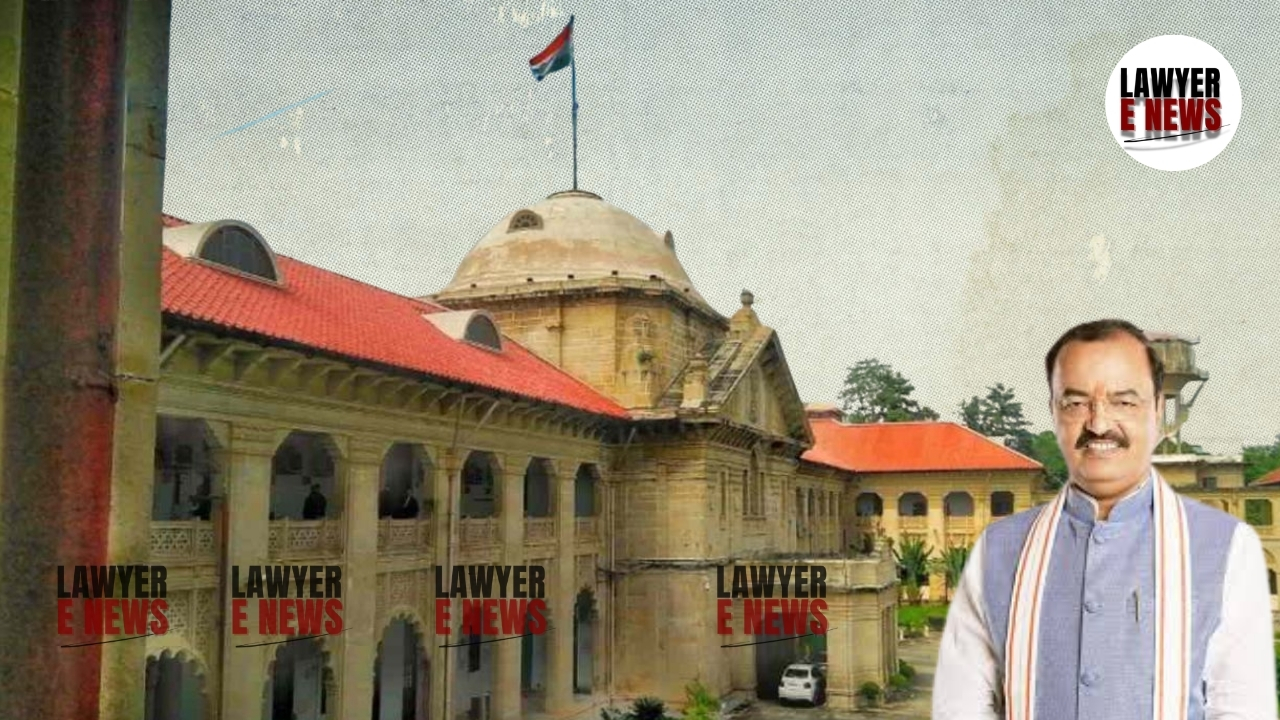
"A Social Worker Cannot Invoke Criminal Law Merely Because He Is Hurt—Absence of Personal Injury Bars Action Under Section 156(3) CrPC", In a significant ruling Allahabad High Court rejected a criminal revision petition seeking the registration of an FIR against Keshav Prasad Maurya, the Deputy Chief Minister of Uttar Pradesh, for allegedly using forged educational certificates in his election affidavits and for obtaining a petrol pump dealership. The petition, filed by Diwakar Nath Tripathi, was found to be “devoid of merit, motivated, and lacking in legal substance.”
Justice Sanjay Kumar Singh, dismissing the plea, remarked that, “If there is no forgery in any document or educational certificate and the same has been issued by the authority concerned under seal and signature, then said document cannot be said to be forged.”
The Court held that no cognizable offence was disclosed, and that the revisionist lacked locus standi, having suffered no personal injury or deception.
The case arose from a Section 156(3) CrPC application filed by Tripathi before the Magistrate, alleging that Keshav Prasad Maurya submitted false educational qualifications in affidavits during elections held in 2007, 2012, and 2014, and used the same documents to secure a petrol pump dealership from Indian Oil Corporation.
Tripathi claimed that the educational certificates in question—Prathma (1986), Madhyama (1988), and Uttama (1998)—were issued by Hindi Sahitya Sammelan, Allahabad, an institution not recognised by the Uttar Pradesh Government or UGC. According to him,
“The use of such certificates amounts to a criminal act of forgery, intended to gain political power and public property through fraudulent means.”
The Magistrate, however, found the application insufficient and vague, and rejected it on September 4, 2021, after a preliminary police inquiry found no evidence of fabrication. The revisionist approached the High Court under Section 397 CrPC, which has now also ended in dismissal.
Unrecognised Does Not Mean Forged
One of the central issues was whether the use of unrecognised educational certificates in election affidavits amounts to forgery under the Indian Penal Code.
The Court answered in the negative, observing: “It is not the case of the revisionist that said certificates have not been issued by Hindi Sahitya Sammelan... Merely being unrecognised does not render them forged under law.”
Justice Singh distinguished between an unrecognised certificate and a false document, noting that for an offence under Sections 463, 464, and 471 IPC, there must be a deliberate intention to defraud or fabrication of a document.
Citing the Supreme Court’s ruling in Vimla v. Delhi Administration, the Court reiterated:
“A false document is one that is dishonestly or fraudulently made with intent to deceive or support a false claim. That intent is essential to constitute forgery.”
Since the certificates were authentic documents issued by the Hindi Sahitya Sammelan, they could not be classified as forged, regardless of their legal recognition.
Lack of Locus Standi: “You Cannot Set Criminal Law in Motion If You Are Merely Hurt”
The Court strongly questioned the revisionist's right to file the application in the first place. Tripathi, identifying himself as a social worker and RTI activist, argued that he was “hurt” by the misuse of educational qualifications by a public figure.
The Court dismissed this emotional plea, stating unequivocally: “A person not deceived or aggrieved cannot invoke criminal law merely based on personal hurt... The complainant is not a person deceived under Section 39 CrPC.”
Justice Singh added that no complaint had been filed by the Election Commission or Indian Oil Corporation, which were the actual stakeholders:
“There is no complainant of Smt. Manju Singh nor from the Election Commission or Indian Oil Corporation. The revisionist cannot be permitted to drag respondent no. 2 into criminal prosecution in absence of aggrieved parties.”
Delay Bars Action: Limitation Under Section 468 CrPC Applies
The alleged offences under Section 125A of the Representation of the People Act, 1951 relate to election affidavits submitted as far back as 2007, 2012, and 2014. The complaint, however, was filed in 2021—after a gap of 13, 9, and 7 years respectively.
The Court stressed the limitation period for such offences:
“Section 125A provides punishment up to six months. Thus, under Section 468(2)(b) CrPC, the limitation for cognizance is one year. This application, filed in 2021, is clearly time-barred.”
The Court cited the Constitution Bench judgment in Sarah Mathew v. Institute of Cardiovascular Diseases, which clarified:
“For computing the limitation period, the relevant date is the filing of the complaint, not the date of cognizance.”
No Evidence of Forgery or Mens Rea
Rejecting the argument that differing declarations in affidavits and documents pointed to fraud, the Court held:
“Even if respondent no. 2 made a false declaration, it does not cross into the domain of Sections 420 or 471 IPC without intent to deceive and proof of fabricated documents.”
There was no material to suggest that the certificates were forged. The Court added: “Forgery as defined under Section 463 IPC is dependent upon creation of a false document. Here, the documents are real; the allegation is about their recognition.”
Tripathi argued that the Deputy CM, being a proposed accused, should not have been heard during revision. The Court, rejecting this view, held:
“The right of hearing under Section 401(2) CrPC extends to the prospective accused where the revision challenges an order rejecting complaint or 156(3) application.”
Citing Manharbhai Muljibhai Kapadia and Santhakumari, the Court affirmed the procedural right of the proposed accused to defend a favourable order.
Summarising its findings, the Court observed: “The allegations made in the application under Section 156(3) CrPC, even if taken at face value, do not constitute any cognizable offence.”
Justice Singh concluded that the revisionist failed to establish any legal basis for invoking the criminal machinery:
“The complainant-revisionist is not aggrieved, not deceived, and not competent to seek prosecution on behalf of public institutions... Allowing such an application would amount to a travesty of justice.”
The criminal revision was dismissed, and the Magistrate’s order was upheld as “legally sound and reasoned.”
Date of Decision: 07 July 2025