-
by sayum
25 August 2026 11:12 PM







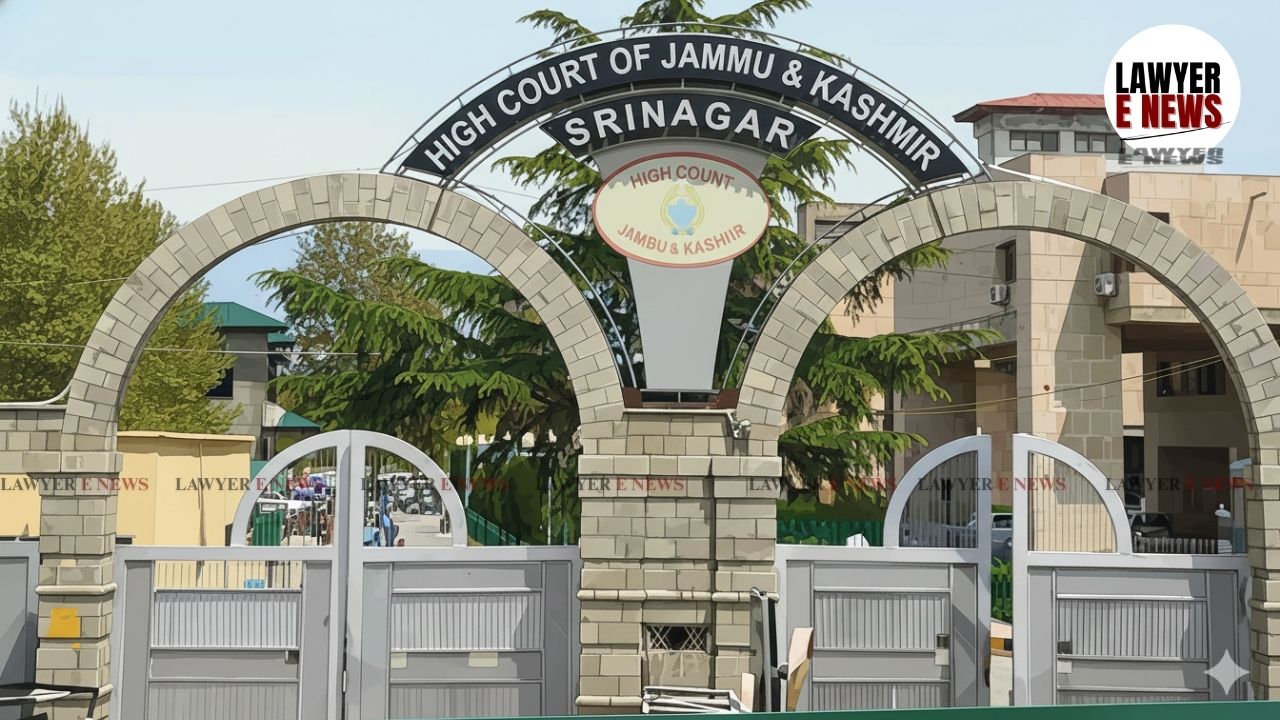
“Such a statement does not amount to a voluntary and unambiguous confession in the eye of law”, In a significant pronouncement on the evidentiary value of extra-judicial confessions, the High Court of Jammu & Kashmir and Ladakh has held that a statement allegedly made before a Panchayat, which is exculpatory in nature and implicates co-accused, cannot be treated as a “confession proper” nor used as substantive evidence to convict others.
Division Bench comprising Justice Sanjeev Kumar and Justice Sanjay Parihar dismissed the State’s appeal against acquittal under Sections 302 and 120-B of the Ranbir Penal Code, inter alia, rejecting the prosecution’s reliance on an alleged extra-judicial confession made before a Panchayat more than a month after the incident.
High Court delivered a detailed judgment examining the evidentiary worth of an alleged confession made in a village Panchayat in a murder case dating back to March 2005. The prosecution sought to overturn the acquittal by contending that respondent No. 3 had confessed before community members, thereby establishing conspiracy and culpability.
The Court, however, held that the alleged statement was neither voluntary nor unambiguous and, in any case, could not be used as substantive evidence against co-accused. The Bench reaffirmed settled principles under Sections 25, 30 and 3 of the Indian Evidence Act, 1872.
Prosecution’s Reliance on Panchayat Proceedings
The prosecution case rested substantially on a Panchayat Nama dated 07.05.2005, convened more than one month after the alleged murder committed during the intervening night of 30-31 March 2005.
It was alleged that respondent No. 3, Kanchan Bala, made a statement before the Panchayat implicating the co-accused in the killing of the deceased pursuant to a criminal conspiracy.
However, upon appreciation of evidence, both the Trial Court and the High Court found serious infirmities in the manner and substance of the alleged confession.
Inconsistent Versions by Panchayat Witnesses
The High Court noted that different Panchayat witnesses attributed different versions to the alleged statement. There was no uniformity regarding what exactly was said, to whom it was said, and in what manner.
The Bench observed that such material inconsistencies strike at the root of credibility, particularly when the prosecution seeks to base conviction on an extra-judicial confession — a weak piece of evidence even in otherwise reliable circumstances.
Crucially, the alleged statement was not inculpatory of the maker. Instead, it attributed the act of killing to other accused persons.
The Court categorically held:
“Such a statement does not amount to a voluntary and unambiguous confession in the eye of law and, in any event, could not be used as substantive evidence against the co-accused.”
Not a “Confession Proper” Under the Evidence Act
The Division Bench undertook a legal analysis of the admissibility and use of confessional statements.
Referring to Section 25 of the Evidence Act, the Court reiterated that confessions made to police officers are inadmissible unless recorded before a Magistrate in accordance with law.
Turning to Section 30 of the Evidence Act, the Bench clarified that before a confession can be used against a co-accused, it must be strictly proved and must qualify as a “confession proper.”
The Court emphasized that what must be before the Court is a true confession — an unambiguous admission of guilt — and not a mere incriminating circumstance or a narrative shifting blame.
Further, invoking Section 3 of the Evidence Act, the Court underscored that even when admissible, a confession of a co-accused is not substantive evidence against a non-maker. It can only be used as a corroborative piece of evidence when independent material connects the co-accused with the crime.
In the present case, the alleged Panchayat statement was exculpatory and lacked the essential attributes of a confession. Therefore, even if assumed to be made, it could not form the foundation of conviction.
Delay and Allegations of Police Influence
Another crucial factor that weighed with the Court was the unexplained delay of more than one month in convening the Panchayat.
The Panchayat Nama surfaced only on 07.05.2005, long after the incident. The defence had alleged police influence in procuring the statement.
The Court found that such delay, coupled with allegations of pressure and inconsistencies in testimony, seriously eroded the evidentiary value of the alleged confession.
The Bench concluded that the so-called Panchayat confession lacked the hallmarks of voluntariness and reliability required in criminal law.
Extra-Judicial Confession: A Weak Piece of Evidence
The judgment reinforces the settled principle that extra-judicial confessions are inherently weak and must be approached with caution. They can form the basis of conviction only when they are voluntary, truthful, and corroborated by other reliable evidence.
In the absence of corroboration, and where the statement itself is inconsistent and exculpatory, it cannot be elevated to substantive proof of guilt.
The Court’s reasoning makes it clear that suspicion or community proceedings cannot substitute strict legal standards governing admissibility and proof.
By rejecting the Panchayat-based extra-judicial confession, the High Court reaffirmed that criminal conviction cannot rest on shaky, delayed, and inconsistent statements — especially when such statements do not amount to a “confession proper” under law.
The ruling serves as a reminder that before a confession is used against an accused — particularly a co-accused — it must satisfy stringent statutory requirements and must be strictly proved.
Finding no perversity in the Trial Court’s disbelieving of the Panchayat proceedings, the Division Bench dismissed the State’s appeal and affirmed the acquittal.
Date of Decision: 07.02.2026