-
by sayum
28 August 2026 12:24 PM







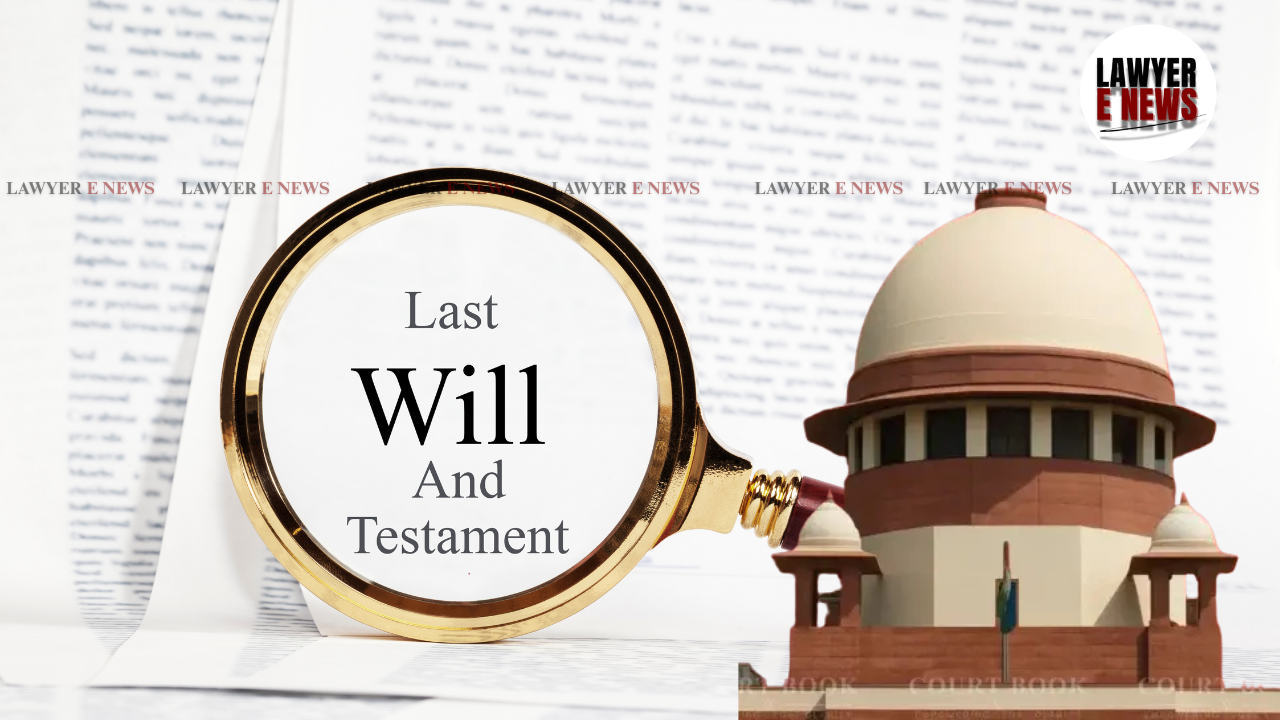
“Mere Dismissal of Probate Doesn’t Trigger Escheat—State Is a Stranger to Testamentary Succession”, Supreme Court of India delivered a judgment that draws a constitutional line through the State's claim to private property under escheat. The Court held that “the doctrine of escheat under Section 29 of the Hindu Succession Act is not triggered unless a competent court finds that there are absolutely no heirs to inherit”, and hence, the State cannot assert a right over private property simply on the basis that a probate was once denied.
This case, involving the estate of Raja Bahadur Sardar Singh of Khetri, reaffirmed that a Will once probated stands as a valid testament, and the Government has no locus to dispute it, unless the Will fails and no heirs are found under Hindu succession.
“State Has No Business in a Valid Will—You Are a Stranger to Probate”: SC Dismisses Rajasthan’s Special Leave Petition
The State of Rajasthan had challenged the decision of the Delhi High Court Division Bench, which had granted probate of the Will dated 30.10.1985 and Codicil dated 07.11.1985 of the late Raja Bahadur Sardar Singh, in favour of the Khetri Trust. Earlier, the Single Judge of the High Court had rejected the probate, citing that the State had already invoked the Rajasthan Escheats Regulation Act, 1956 and taken possession of the properties.
However, the Division Bench reversed this, and the Supreme Court, upholding the same, remarked sharply:
“Merely because the State of Rajasthan has invoked the Escheats Regulation Act does not give it the locus standi to assail the grant of probate.”
“No Failure of Heirs—No Escheat. A Valid Will Ends the Matter”: Supreme Court Defines Boundary Between Intestate and Testamentary Succession
In dismissing the State’s SLP, the Court underscored the legal preconditions required for invoking escheat. It held that Section 29 of the Hindu Succession Act, which enables the State to claim unclaimed estates, would only apply if there is an intestate death and complete failure of heirs.
The Court clarified:
“In the event of a competent court of law declaring a testament of a Hindu to be invalid, and in the absence of any heirs under Section 8, then Section 29 of the Act would apply... Thereafter, the properties would devolve on the Government.”
But, as in this case, where a probate has already been granted, the succession is not intestate, and hence:
“Section 29 of the Act does not apply in the instant case as this is not a case of intestate succession but one of testamentary succession.”
“You Cannot Blow Hot and Cold”: SC Imposes ₹1 Lakh Cost on Agnates Who Withdrew Suit, Then Claimed Inheritance
In a related proceeding, in Surendra Singh & Anr. vs. Lord Northbrook & Ors., the Court dealt with an audacious attempt by two alleged agnates to reopen claims over the same estate. The petitioners had withdrawn their caveat and a civil suit challenging the Will, only to later approach the Supreme Court again under Article 136, seeking to contest the probate.
The Court condemned this duplicity, stating:
“The petitioners cannot blow hot and cold at the same time in the very same proceeding as they are estopped from doing so.”
Moreover, the Court found that the petitioners deliberately suppressed the withdrawal of their earlier suit, a material fact that disqualifies them from seeking discretionary relief under Article 136. For this, the Court not only dismissed their petition on grounds of lack of locus standi but also imposed ₹1,00,000/- costs each, to be paid to the Supreme Court Mediation Centre.
“Probate Once Granted Is Final—Only Heirs Can Revoke It, Not the State”: Court Explains Role of Section 263 of Indian Succession Act
The Court also elaborated on the remedies available for challenging a probate. It stated that if the Will is believed to be forged or obtained fraudulently, only those who would have succeeded in absence of the Will—that is, heirs under Section 8 of the Hindu Succession Act—can challenge the probate under Section 263 of the Indian Succession Act, 1925.
It categorically held:
“Since the Will has been probated, the legatees are bound to act upon the directions in the Will. The Government has no standing to challenge the same unless there is a finding of complete failure of heirs.”
“Doctrine of Escheat Is Not a Tool for Government Land Acquisition”: Supreme Court's Reminder to States
The larger significance of this judgment lies in its preservation of private testamentary rights against government overreach. The Court firmly held that testamentary succession takes precedence, and government can only step in when succession law fails entirely.
The judgment ends with this strong pronouncement:
“We have no hesitation to hold that in the instant case the State of Rajasthan has no locus standi to challenge the judgment of the Division Bench of the High Court as the Will of the deceased testator has been probated... The Special Leave Petitions are dismissed on the ground of locus standi.”
Date of Decision: 1st September 2025