-
by sayum
25 August 2026 12:32 PM







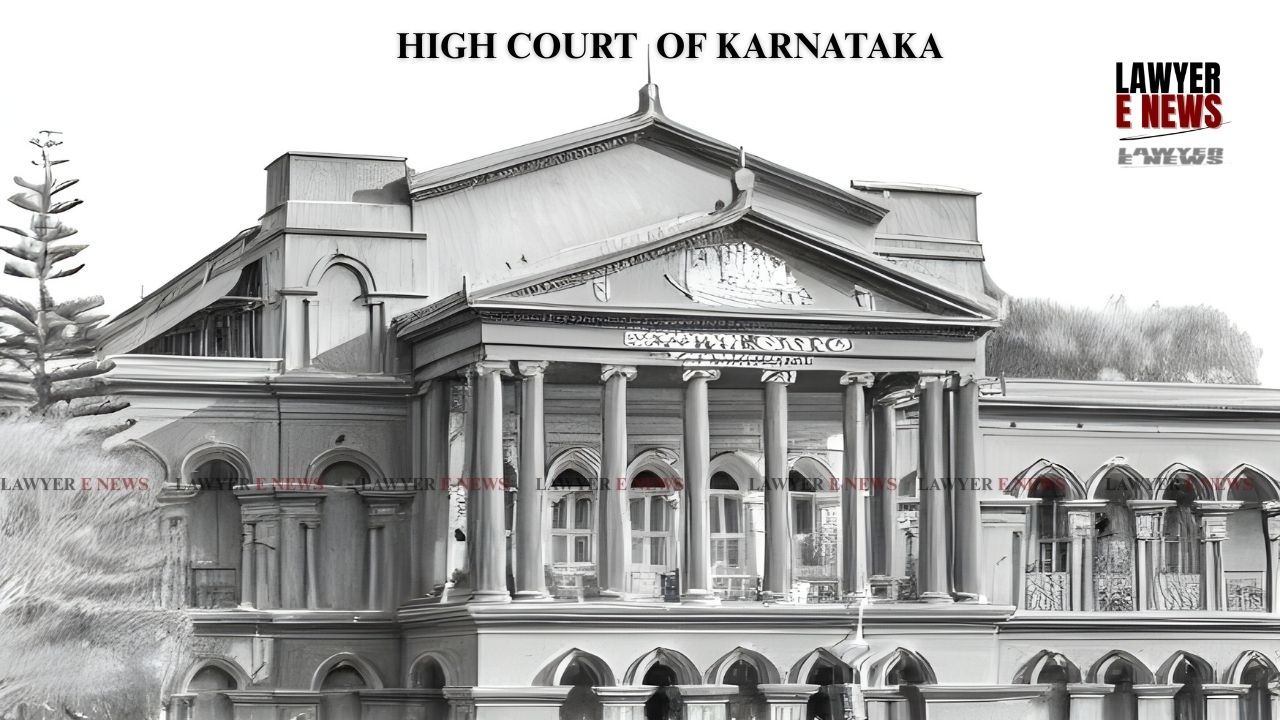
“The Expression ‘May Be Tried’ Confers Judicial Discretion — A Judicial Pardon Cannot Be Lifted Unilaterally”, In a significant judgment interpreting Sections 306 to 308 of the Code of Criminal Procedure, 1973, the Karnataka High Court has held that revocation of pardon granted to an approver is not automatic upon the filing of a certificate by the Public Prosecutor.
Justice Anant Ramanath Hegde dismissed the CBI’s revision petition seeking prosecution of two approvers under Section 308 CrPC for alleged violation of pardon conditions.
The Court ruled that a pardon granted through a judicial order cannot be forfeited merely on the strength of a prosecutor’s certificate, and that the Court must independently form a prima facie opinion after hearing the approver.
The case arose out of a corruption prosecution registered by the CBI against two Customs Superintendents under Sections 7, 8, 13(1)(d) read with Section 13(2) of the Prevention of Corruption Act, 1988 and Section 120B IPC.
Accused Nos.3 and 4, employees of clearing house agents, had given statements under Section 164(1) CrPC during investigation and later sought pardon under Section 306 CrPC. The Special Judge granted pardon subject to the condition that they would make “full and true disclosure” of all circumstances relating to the offence and the persons involved.
After they were examined as PW-1 and PW-2 during trial, the CBI filed an application under Section 308 CrPC alleging that the approvers had violated the terms of pardon by resiling from earlier statements and claiming in cross-examination that their confessions under Section 164 were made under CBI pressure.
The Trial Court rejected the application. The CBI challenged that rejection in revision.
“Pardon Cannot Be Revoked Solely on a Prosecutor’s Certificate”
At the heart of the case was the interpretation of Section 308(1) CrPC, which states that where the Public Prosecutor certifies that an approver has wilfully concealed material facts or given false evidence, such person “may be tried” for the offence.
The CBI argued that once the certificate is filed, revocation of pardon is automatic.
Rejecting this contention, the High Court observed:
“Section 308(1)… uses the expression ‘may be tried’. In other words, the Court has the discretion as to whether the approver has to be tried or not.”
The Court reasoned that since the grant of pardon is a judicial order conferring a significant concession, it cannot be unilaterally undone by executive action.
“If the Court were to take the view that a mere certificate of the Public Prosecutor is sufficient to revoke pardon, it would have the effect of unilaterally setting aside a judicial order.”
The Court further held that Parliament consciously used the phrase “may be tried” and not “shall be tried”, thereby conferring judicial discretion. Before revocation, the Court must hear the approver and examine whether the certificate discloses a prima facie violation.
Scope of Inquiry Under Section 308 CrPC
Justice Hegde clarified that the inquiry at the stage of Section 308 is limited. The Court is not required to conduct a mini-trial but only to assess whether prima facie the approver has failed to make a “full and true disclosure”.
If no prima facie case is made out, the application must be rejected and the approver continues as a prosecution witness.
Though the Trial Court had registered the application as a separate miscellaneous petition, the High Court observed that such elaborate procedure was unnecessary, though curable.
Examination Under Section 306(4) Not Mandatory When Special Judge Tenders Pardon
Another issue raised was whether examination of the approvers under Section 306(4) CrPC was mandatory since the Special Judge granted pardon.
The Court held that where the Special Judge competent to take cognizance and try the offence tenders pardon under Section 307 CrPC, examination under Section 306(4) is not mandatory.
The expression “same conditions” in Section 307 refers to substantive conditions in Section 306(1), not the procedural mandate of sub-sections.
While such examination may be a prudent practice, its absence does not render the pardon illegal.
“Mere Assertion of Pressure Does Not Amount to Violation of Pardon”
The prosecution’s principal grievance was that in cross-examination, the approvers stated that their earlier statements under Section 164 were made under CBI pressure and inducement.
The Court analysed their statements in detail and found that on material aspects — collection of ₹5,000 and payment to Customs officials — PW-1 remained consistent in his Section 164 statement, examination-in-chief, and cross-examination.
Similarly, PW-2 consistently maintained that he did not collect money but maintained bill records.
The Court held:
“The said statements in the cross-examination… even if true, cannot be termed as violation of the terms of the pardon.”
If the allegation of pressure was true, then the approvers were merely narrating the truth and could not be penalised.
If it was false, then it could amount to giving false evidence. In that event, prosecution must seek leave of the High Court under the proviso to Section 308(1) to try the approver for false evidence. Admittedly, no such leave had been sought.
The Court observed that absence of such leave was fatal to the present application.
Wide Scope of Cross-Examination Under Section 138 Evidence Act
The Court emphasised that cross-examination is not confined to matters stated in examination-in-chief, relying on Section 138 of the Evidence Act.
“Every new statement made in the cross-examination by the approver cannot be termed as violation of the terms and conditions of the pardon.”
If the prosecution felt clarification was necessary, it had liberty to re-examine the witnesses but failed to do so. It cannot invoke Section 308 merely because the evidence is not favourable.
No Violation of Core Conditions of Pardon
The High Court concluded that there was no wilful concealment or deviation regarding the core transaction of bribe collection and payment.
There was no material suppression of essential facts concerning the offence or the principal offenders.
Accordingly, the conditions of pardon were not violated.
Dismissing the revision petition, the Court upheld the Trial Court’s order rejecting the application under Section 308 CrPC.
However, liberty was reserved to the prosecution to seek leave of the High Court to prosecute the approvers for false evidence, if so advised.
The Court clarified that it had not expressed any opinion on the truthfulness of the statements regarding alleged inducement.
This judgment significantly strengthens judicial control over revocation of pardon and safeguards the statutory purpose of Sections 306 to 308 CrPC — to secure the best possible evidence in complex criminal cases.
By holding that revocation is not automatic and that a judicial order of pardon cannot be undone by executive certification alone, the Karnataka High Court has reinforced the principles of judicial discretion, procedural fairness, and statutory interpretation in criminal law.
Date of Decision: 04.02.2026