-
by sayum
05 August 2026 3:07 PM







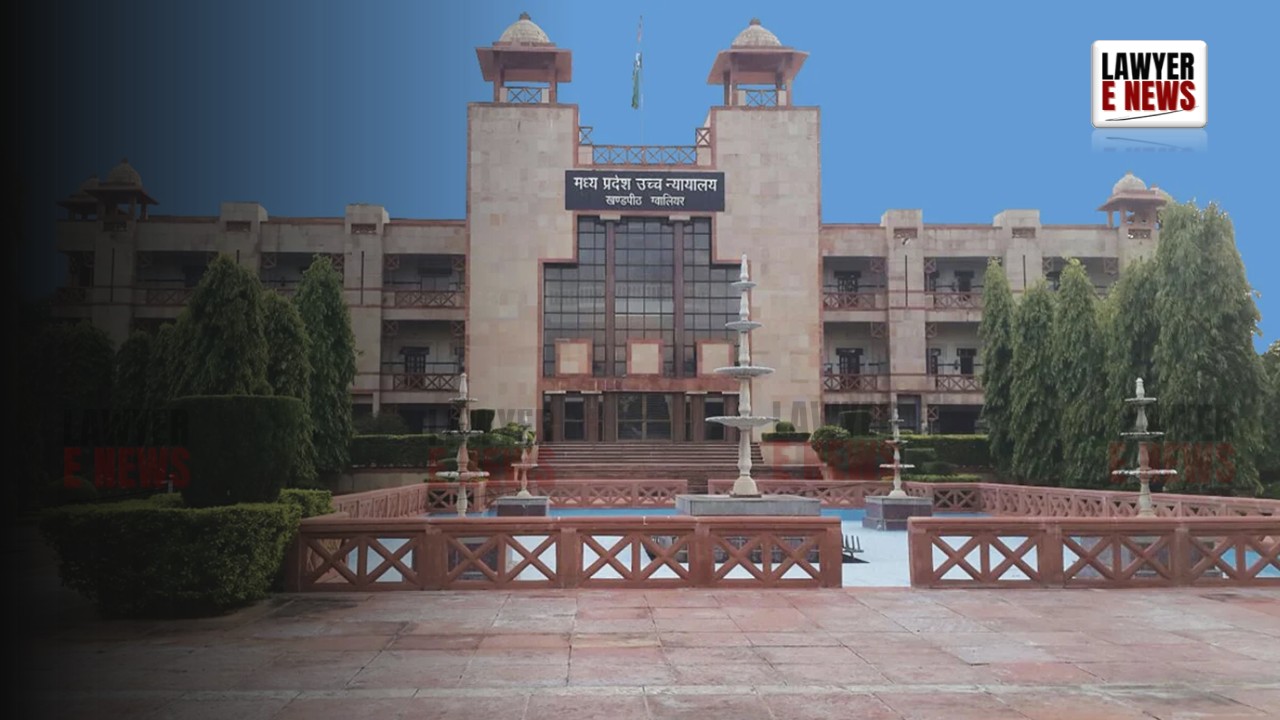
Succession To Gaddi Does Not Extinguish Heirs' Rights Over Private Property – Madhya Pradesh High Court, in a significant decision, set aside the judgment and decree of the District Judge, Bhopal, in First Appeal Nos. 437 of 2000 and 296 of 2000, remanding the matter back for a fresh adjudication. Justice Sanjay Dwivedi observed that the trial court erroneously dismissed the plaintiffs’ partition claims by relying on a High Court judgment which has since been overruled by the Supreme Court.
“The trial court committed a serious legal error by basing its findings on a precedent which no longer holds the field after the authoritative pronouncement of the Supreme Court in Talat Fatima Hasan v. Syed Murtaza Ali Khan [(2020) 15 SCC 655],” the Court said.
The case revolved around the long-standing partition dispute of the private properties of Nawab Hamidullah Khan of Bhopal, who passed away in 1960. Plaintiffs, being descendants and legal heirs of Nawab Hamidullah Khan, claimed rights over private properties based on Muslim Personal Law. In contrast, the respondents, descendants of Sajida Sultan (the successor to the Gaddi under the Bhopal Succession Act of 1947), claimed exclusive ownership of the Nawab’s personal properties.
“The plaintiffs’ right to demand partition of personal property cannot be extinguished merely on the ground of succession to the throne,” the Court observed, highlighting that succession to the Gaddi is distinct from the succession of personal estate.
The trial court had dismissed the partition suits by relying on the judgment of the Allahabad High Court in AIR 1997 All 122 (Miss Talat Fatima Hasan v. Nawab Syed Murtaza Ali Khan). However, Justice Dwivedi noted that the Supreme Court in Talat Fatima Hasan [(2020) 15 SCC 655] had expressly overruled that decision.
“Since the very foundation of the trial court’s dismissal is now unsustainable in law, the entire matter requires fresh consideration in light of the correct legal position,” the Court emphasized.
It was also pointed out by the appellants that Clause VII of the Bhopal Merger Agreement, 1949, and Article 366(22) of the Constitution of India, which the trial court heavily relied upon, were misapplied to defeat legitimate claims of succession under personal law.
“The Supreme Court in Talat Fatima Hasan clarified that succession to Gaddi is a political decision, whereas succession to private property must follow the personal law applicable to the deceased ruler,” the judgment stated.
Justice Dwivedi further elaborated that even though the Government of India had issued a certificate recognizing Sajida Sultan as the successor of the personal property of the last Nawab under Article 366(22), such recognition cannot override substantive succession rights of other legal heirs under personal law.
“Succession certificates or government notifications cannot nullify rights flowing from personal law, especially in matters of private property,” the Court held.
The High Court also invoked the remand powers under Order 14 Rule 23A of the Code of Civil Procedure, 1908, citing that the trial court had failed to adjudicate crucial issues arising out of the pleadings and evidence, particularly after the Supreme Court’s latest jurisprudence.
“The trial court did not exercise due care in evaluating the broader legal principles applicable to succession of personal properties vis-à-vis succession to Gaddi. A retrial is necessary to render justice,” Justice Dwivedi concluded.
In its operative directions, the High Court remanded the matter back to the District Judge, Bhopal, for a fresh trial, directing the trial court to consider any additional evidence in light of the new legal position clarified by the Supreme Court.
“It is further directed that the trial court shall endeavor to conclude the matter within one year from the date of receipt of the judgment, considering the pendency of these suits since 1999,” the judgment directed.
The High Court further clarified that its findings on preliminary issues such as maintainability and jurisdiction, which had already been upheld by the trial court in favor of the plaintiffs, were left undisturbed.
“No findings are warranted on issues of jurisdiction or maintainability as no appeals or cross-objections have been filed by the respondents on those aspects,” the Court clarified.
The appeals filed by the plaintiffs were thus allowed, the judgment and decree of the trial court dated 14.02.2000 were set aside, and the suits were restored for fresh consideration.
“This Court leaves it open to the parties to raise all contentions afresh before the trial court, which shall decide the matter uninfluenced by the earlier findings and taking into account the subsequent authoritative pronouncement by the Supreme Court,” the Court concluded.
Date of Decision: 30th June 2025